TL;DR:
- Most CS2 traders miss out on significant profits by relying on guesswork instead of advanced tactics. Using data-driven strategies like arbitrage, trade-up optimization, and timing around market cycles can greatly increase inventory growth and profitability. Proper platform selection, fee management, and disciplined bankroll rules are essential for consistent success in skin trading.
Most CS2 traders leave serious money on the table. They buy skins they like, sell when prices feel right, and wonder why their inventory never grows. Advanced skin trading tactics change that equation entirely. Instead of guessing, you work with price data, fee structures, float values, and market cycles to make calculated moves. This guide covers the methods that separate profitable traders from hobbyists: arbitrage execution, trade-up contract optimization, float manipulation, platform selection, and timing strategies that exploit predictable market behavior.
Table of Contents
- Key takeaways
- Advanced skin trading tactics: building your toolkit first
- Mastering arbitrage across platforms
- Optimizing trade-up contracts mathematically
- Timing the market like a pro
- My honest take on what actually works
- Take your CS2 trading further with Dropskin
- FAQ
Key takeaways
| Point | Details |
|---|---|
| Arbitrage beats raw price differences | Calculate spreads after fees, not before, to identify trades that are actually profitable. |
| Float thresholds matter more than perfection | Avoid overpaying for minimal float improvements that yield no better trade-up output. |
| Market cycles create buying windows | Post-update dips last roughly 2 to 3 weeks and offer optimal entry points for inputs. |
| Platform fees compound over time | Choosing P2P over centralized markets saves roughly 10% per trade on high-value skins. |
| Risk rules protect your bankroll | Limit exposure to 1 to 5% of capital per trade-up contract to survive volatility. |
Advanced skin trading tactics: building your toolkit first
You cannot execute advanced trading techniques without the right setup. Before placing a single trade, you need to understand what tools you are working with and where the friction lives.
The first decision is platform type. Bot vs. P2P platforms each serve different purposes. Bot platforms offer instant trades at fixed prices, which is useful for liquidity but typically yields lower margins. P2P platforms give you pricing control and the ability to negotiate, which is where serious profit happens on high-value items. Choosing between the two depends on skin rarity, your speed requirements, and how margin-sensitive the trade is.
Fee structures are the single most overlooked factor in trading skins effectively. Steam charges 15% on all transactions. Specialized third-party platforms typically charge around 2.5%. That difference is not small. On a $200 skin, you are paying $30 on Steam versus $5 on a specialized platform. Over dozens of trades, this gap compounds fast.
Here is the toolkit every advanced trader needs assembled before starting:
- Float inspection tools: CSFloat or similar inspection tools let you verify the exact float value of a skin before buying. This matters for trade-up targeting.
- Price aggregators: Tools that pull live prices across multiple platforms simultaneously are non-negotiable for spotting arbitrage windows.
- Automated EV calculators: These simulate expected value on trade-up contracts so you are never guessing at profitability.
- Buy order setups: Rather than buying at market price, place buy orders slightly below ask. You get better fill prices during low-traffic hours.
Pro Tip: Set up buy orders before you go to sleep. Overnight price dips, when fewer traders are active, often fill orders at below-market rates that you would never catch manually.
Trade holds are a critical risk factor. When you transfer skins between platforms, Steam often applies a 7-day hold. During that window, the price can move against you. Factor holding periods into every trade you plan, especially arbitrage plays where timing is everything.
Mastering arbitrage across platforms
Arbitrage is one of the most reliable expert skin trading methods, but most traders misread how it actually works. The opportunity is not the raw price gap between two platforms. The real spread is what remains after you subtract buying fees on the first platform and selling fees on the second. Many apparent gaps evaporate once you run the actual math.
What causes these gaps in the first place? The CS2 skin market operates more like a fragmented financial ecosystem with multiple liquidity pools than a single unified marketplace. Price discovery happens at different speeds on different platforms. A major skin drop can move prices on Steam immediately while specialized markets lag by hours. Fee differences create structural gaps that are persistent even without news events.
Here is how to execute an arbitrage trade properly:
- Identify the raw gap. Use a price aggregator to find a skin priced significantly lower on Platform A than Platform B.
- Calculate the real spread. Subtract the buy fee on Platform A and the sell fee on Platform B from the gross difference. If the result is still positive, you have a real opportunity.
- Check the transfer timeline. Account for any trade hold periods. If the hold is 7 days and the gap typically closes within 48 hours, the trade is probably not worth executing.
- Buy and list immediately. Do not hold. The window can close fast.
- Track outcomes. Log every arbitrage trade with actual net profit. This builds pattern recognition over time.
Price discrepancies between platforms can reach 15 to 30% for the same skin when fee structures and liquidity delays align. That range sounds exciting, but the profitable slice after fees is much narrower. The traders who extract consistent profit are the ones doing the fee math every single time, not eyeballing spreads.
Speed is also decisive. Execution time often determines profitability because multiple traders are watching the same gaps. The ones with better tooling and faster workflows win the trade. This is where price alert tools earn their value.

Pro Tip: Never chase an arbitrage gap that appeared more than 20 minutes ago on a popular item. High-liquidity skins get corrected fast. Focus on mid-tier skins with moderate volume where gaps persist longer.
Watch out for fake spreads. These appear when a seller has priced incorrectly on one platform but the listing is stale or the item has a flaw (like an unusual float) that suppresses real demand. Always inspect the skin and cross-check recent sales before committing capital.
Optimizing trade-up contracts mathematically
Trade-up contracts are where profitable skin trades get genuinely sophisticated. Most players treat them like a slot machine. Advanced traders treat them like a math problem with a solvable expected value.
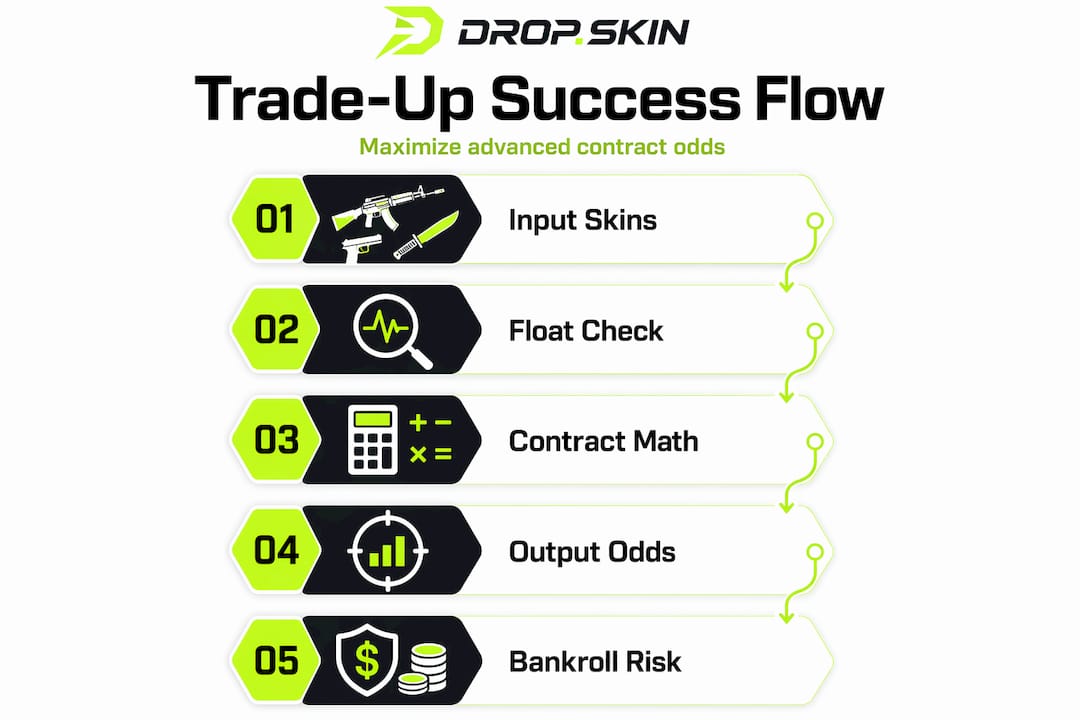
The basic mechanic: ten skins of one rarity go in, one skin of the next rarity comes out. The output is drawn from the collections represented in your inputs. This creates two variables you can actually control: the average float of your inputs and the collection weighting of your inputs.
Here is a structured approach to building contracts that hold up over time:
- Calculate expected value before every contract. Use an automated calculator. Input cost divided by probability-weighted output value must be greater than 1.0 for the trade to have positive EV.
- Apply the Collection Overlap Strategy. Use 90% safe inputs from a stable collection and 10% higher-value gamble skins from a secondary collection. This hedges downside risk while keeping upside potential.
- Target float thresholds, not perfect floats. Calculate the exact average float needed to land in your desired wear tier. Then buy inputs at that threshold rather than chasing 0.00x floats that carry heavy premiums.
- Model multiple scenarios. Run the EV calculation for best-case, average-case, and worst-case outputs. If the worst case wipes your profit on the best case, the contract is too risky.
- Time your buy-in with market dips. Post-update corrections and operation dips create windows where input skins trade below their long-term value.
| Contract element | What to optimize | Why it matters |
|---|---|---|
| Input float average | Target tier threshold, not perfection | Avoids premium pricing on marginal gains |
| Collection weighting | 90% safe, 10% gamble | Limits downside while preserving upside |
| Expected value | Must exceed 1.0 before committing | Negative EV contracts cause long-term losses |
| Buy-in timing | Post-update or post-hype dip | Lowers input cost, improves margin |
The October 2025 Covert-to-knife update reshuffled the trade-up market significantly. Contracts that were printing consistent returns before that update stopped working. This is why automated EV simulators are not optional. Market dynamics shift, and a contract you built three months ago needs to be re-evaluated against current prices.
Bankroll discipline is the other half of this equation. Limiting exposure to 1 to 5% of capital per contract means a losing streak cannot end your trading career. Variance is real in trade-up contracts even when you have positive EV.
Pro Tip: Never run a trade-up contract on a skin whose input supply is thin. Thin supply means price spikes when you try to acquire ten copies, which quietly destroys your EV before the contract even runs.
For a deeper breakdown of finding the best contracts, the winning contracts guide walks through the full evaluation process with real examples.
Timing the market like a pro
Market timing gets dismissed as luck. For skin trading, it is actually a structured skill. CS2 skin prices follow patterns that repeat around updates, operations, and community events. Learning these cycles is one of the most underrated advanced trading techniques available.
The cycle looks like this:
- Hype phase: A new operation or update drops. Prices spike on affected skins as demand surges. This is usually the worst time to buy and often a reasonable time to sell skins you already hold.
- Post-hype dip: About 2 to 3 weeks after a major update, prices correct as speculators who bought during the hype start selling off. This is the buy window for trade-up inputs.
- Equilibrium: Prices stabilize at a long-term fair value. Arbitrage opportunities get thinner but still exist between platforms.
- Pre-event accumulation: Informed traders begin accumulating certain skins before an anticipated event based on community intel and historical patterns.
The most reliable move in this cycle is using buy orders placed below market price during passive periods. When dips happen overnight or during off-peak hours, those orders fill at prices active buyers never see.
Passive versus aggressive trading approaches also matter here. Aggressive trading means watching charts in real time and jumping on opportunities as they appear. It requires time and fast execution tools. Passive trading means setting up orders, alerts, and then waiting. The skin trading trends for 2026 show passive strategies outperforming reactive ones for most traders who are not running automated tools.
Pro Tip: Track price history over 90-day windows, not 7-day windows. Short-term charts create panic and FOMO. Long-term charts show the cycle clearly and tell you whether current prices are genuinely low or just lower than yesterday's spike.
Knowing when to skip a trade is as valuable as knowing when to make one. If you cannot identify a clear entry thesis backed by price data, sitting on cash preserves your capital for a better setup.
My honest take on what actually works
I have watched traders obsess over the "perfect" contract or the "best" skin to flip, and it almost always ends the same way. They overpay, they miss the window, and they rationalize the loss instead of learning from it.
What I have found actually works is far less exciting than most people want to hear. It is the discipline to run the math on every trade, even when a gut feeling says to skip the calculation. Mathematical rigor and market psychology separate consistently profitable traders from hobbyists who rely on luck, and that gap widens the longer someone trades.
Platform fees are where most traders bleed money without realizing it. I have seen traders who are technically good at identifying opportunities completely undermine their returns by defaulting to Steam for every transaction. The fee difference between platforms is not a minor detail. It is the difference between a profitable trade and a breakeven one.
The psychological trap I see most often is chasing losses with bigger contracts. One bad trade-up contract leads to a bigger contract to recover, which often leads to a worse outcome. Stick to the 1 to 5% exposure rule and treat every trade as independent. The market does not owe you a recovery.
My biggest recommendation: spend one month just tracking and paper-trading before committing real capital to advanced strategies. The patterns become obvious fast once you are watching without the emotional pressure of real money.
— DROPSKIN
Take your CS2 trading further with Dropskin
Dropskin gives CS2 traders the tools to put these strategies into practice without the friction. With low-fee trading, you keep more of every profitable trade. The skin upgrader tool lets you apply trade-up logic directly on the platform, targeting higher-value outputs without building contracts from scratch. Case openings and upgrade features round out the toolkit for players who want more ways to grow their inventory value. If you want to apply what you have learned here with real leverage, explore Dropskin and see how the platform supports every tactic in this guide.
FAQ
What makes a skin arbitrage trade actually profitable?
The real profit in arbitrage comes from the spread after both buying and selling fees are subtracted, not the raw price gap. Fee differences between platforms can reach 15 to 30%, but the actual net gain after fees is much smaller and must be calculated before every trade.
How do float values affect trade-up contract outputs?
The average float of your ten input skins determines the wear tier of the output skin. Calculating the exact threshold you need and buying inputs at that level rather than chasing lower floats with premium prices prevents unnecessary overspending without improving results.
When is the best time to buy trade-up inputs?
The post-hype dip following a major update or operation, which typically occurs 2 to 3 weeks after release, offers the best entry prices on input skins as speculative sellers exit their positions.
Should I use bot platforms or P2P platforms for advanced trading?
It depends on your goal. Bot platforms offer speed and instant liquidity, while P2P platforms deliver better pricing control and roughly 10% lower fees on high-value skins, which significantly improves long-term compounded returns.
How much capital should I risk per trade-up contract?
Limiting each contract to 1 to 5% of your total trading capital protects you from losing streaks and gives you the runway to run enough contracts for the math to work in your favor over time.