
TL;DR:
- CS:GO case simulators allow players to virtually open cases using official drop rates and live market prices without financial risk. They help players understand expected returns and make smarter decisions, but cannot predict real-world outcomes or improve actual case results. Trustworthy platforms verify odds, provide transparent data, and caution players against confusing simulators with real gambling sites.
A CS:GO case simulator is a tool that lets players virtually open cases using Valve's official drop rates and live market pricing, with zero financial risk. The industry term for this category is "case opening simulator," and it covers both free web tools and feature-rich platforms built for CS2. The knife drop chance sits at just 0.26%, meaning you'd expect to open roughly 385 cases before seeing one. Knowing that number before spending real money changes how you approach skin acquisition entirely. This guide covers the top simulators available in 2026, how they work mechanically, and how to use them to build a smarter strategy.

1. What is a case simulator CS:GO and why does it matter?
A case opening simulator replicates the CS:GO and CS2 unboxing experience without requiring a Steam Wallet balance or a real case key. You select a case, click open, and the tool draws a result using the same probability weights Valve applies in the live game. The output includes the skin name, wear condition, and current Steam Market value.
The practical value is significant. Players who understand expected case ROI before spending money make better decisions. Simulators make that education free and immediate.
2. How drop rates and rarity tiers work in simulators
Every quality case opening simulator CS:GO tool uses Valve's fixed rarity probabilities. These are not estimates. They are the verified numbers behind every real case opening in the game.
The breakdown is as follows:
| Rarity | Drop chance |
|---|---|
| Mil-Spec (blue) | 79.92% |
| Restricted (purple) | 15.98% |
| Classified (pink) | 3.20% |
| Covert (red) | 0.64% |
| Special (knife/gloves) | 0.26% |
StatTrak items have a 10% chance on any weapon skin drop. That detail matters because StatTrak versions typically sell for 2–10x the value of a standard skin, which shifts the expected value calculation meaningfully.
Pro Tip: When using any case opener CS:GO tool, filter results to show StatTrak outcomes separately. A single StatTrak Covert skin can represent more value than 50 standard Mil-Spec drops combined.
3. Top features that define a reliable case opening simulator
Not every case opening CS:GO website delivers the same quality. The best tools share a specific set of features that separate them from low-effort clones.
- Verified Valve drop rates. The simulator must use the exact rarity percentages listed above, not approximations.
- Live market pricing. Skin values fluctuate daily. A simulator pulling stale prices gives you misleading ROI data.
- No download or signup required. The best free simulators run entirely in the browser. Requiring an account before you can open a single case is a red flag.
- Wear condition modeling. Each skin drops across five wear tiers: Factory New, Minimal Wear, Field-Tested, Well-Worn, and Battle-Scarred. A quality simulator weights these correctly and shows the wear-specific price.
- StatTrak probability included. Any simulator that ignores StatTrak is giving you an incomplete picture of expected value.
- Transparent result history. You should be able to review your simulated session and calculate your own return rate.
SteamAnalyst's case simulator is one of the most cited tools in the community because it combines live pricing with verified odds and requires no account. It covers both legacy CS:GO cases and current CS2 cases.
Pro Tip: Run at least 100 simulated openings before drawing conclusions about a specific case's value. Variance is extreme at low sample sizes, especially for Covert and Special tier items.
4. How simulators replicate market pricing and wear values
Simulators pull pricing data from the Steam Community Market, typically updated every 24 hours. Each skin has a different price for each wear condition, and the spread can be dramatic. A Factory New AK-47 Redline trades at a significant premium over a Battle-Scarred version of the same skin.
The wear condition distribution within each rarity tier is not uniform. Most cases weight drops toward the middle wear tiers, meaning Factory New results are rarer than the rarity tier alone suggests. A simulator that ignores this produces inflated expected value numbers.
StatTrak drop probability is the other critical variable. StatTrak value multipliers of 2–10x mean that including or excluding this calculation changes your ROI estimate by a wide margin. Serious players use simulators that show both standard and StatTrak expected values side by side.
5. What separates trustworthy platforms from unreliable ones
The case sites CS:GO ecosystem includes both pure simulators and real-money case opening sites. Knowing which category a platform falls into protects you from financial and security risks.
Provably fair platforms publish their server seed, client seed, and nonce after each round. This lets you independently verify that the result was not manipulated. SHA-256 cryptographic verification is the current standard for this. If a case website CS:GO does not publish this information, treat it as unverified.
Security experts recommend two-factor authentication and blockchain-based verification as baseline requirements for any platform handling real accounts or real money. Pure simulators carry lower risk because no financial transaction occurs, but platforms that blend simulation with paid features need the same scrutiny as full gambling sites.
Top-performing third-party case sites report average Return-To-Player rates around 92.9%, which is higher than Valve's official case RTP of roughly 80%. That gap explains why many players prefer third-party case opening CS:GO websites for real-money play after using simulators to understand the odds.
Community feedback is a reliable signal. Platforms with active Reddit threads, verified reviews, and transparent licensing histories earn trust over time. Platforms that appear suddenly with no history and offer unusually high free case bonuses are worth avoiding.
6. How to use a case opening simulator CS:GO strategically
A simulator is most useful when you treat it as a data tool, not just entertainment. These steps give you a structured approach.
- Pick a specific case and run 50–100 simulated openings. Record the total simulated cost and the total market value of results. This gives you a personal ROI sample.
- Compare your sample ROI to the known average. The average ROI for Valve cases is 40–60% of cost. If your sample is higher, variance is working in your favor temporarily, not permanently.
- Identify which skins drive most of the value. In most cases, one or two Covert or Special tier skins account for the majority of total expected value. Knowing which skins those are helps you decide if a case is worth opening at all.
- Factor in StatTrak outcomes. Run a separate count of how many StatTrak results appeared in your sample and what they were worth. This changes your expected value calculation significantly.
- Set a real-money budget based on your simulator data. If you want a specific skin and the simulator shows it appears roughly once every 200 openings, you can calculate the expected cost before committing.
- Use simulators to compare cases, not just individual openings. Different cases have different expected values based on their skin pool. A simulator lets you test multiple cases and pick the one with the best risk-adjusted return for your target skin.
The advantages of case opening are real, but only when you enter with accurate expectations. Simulators are the fastest way to build those expectations without spending money.
7. Common misconceptions about CS:GO case simulators
The biggest misconception is that a good simulator session predicts real-world results. It does not. Simulated openings cannot replicate the emotional impact of real financial loss or the psychological feedback loop that drives continued spending. Probability modeling and lived experience are fundamentally different things.
"Simulators model the math of case opening with accuracy. They cannot model what happens to your decision-making after you've spent $200 and received nothing above Restricted rarity. That gap between probability and psychology is where most players lose money they didn't plan to spend."
A second misconception is that simulators and paid case opening sites are the same category. Simulators model probability risk-free while paid sites involve real monetary risk and gambling mechanics. Treating them as equivalent leads players to underestimate the stakes of real-money openings.
Simulators also do not guarantee that practicing with them improves your real-money results. The odds are fixed. No amount of simulation changes the 0.26% knife drop rate when you open a real case.
Key takeaways
A case opening simulator CS:GO is the most effective free tool for understanding Valve's drop probabilities and setting realistic expectations before spending real money on cases.
| Point | Details |
|---|---|
| Knife drop rate is 0.26% | Expect to open roughly 385 cases before a knife or gloves result appears. |
| ROI averages 40–60% | Valve cases return less than half your investment on average, confirming a negative expected value. |
| StatTrak changes the math | StatTrak items drop 10% of the time and sell for 2–10x standard prices, shifting expected value significantly. |
| Provably fair is the standard | Quality platforms publish server seed, client seed, and nonce for independent result verification. |
| Simulators don't replace judgment | Probability modeling cannot replicate the psychological effects of real financial loss. |
Dropskin's take on simulators and real case opening
Simulators taught me something the community rarely says out loud: most players dramatically overestimate their odds before they see the actual numbers. The 0.26% knife rate looks abstract until you run 200 simulated openings and watch nothing above Classified drop. That experience recalibrates expectations faster than any written explanation.
What I've observed is that players who use simulators seriously before moving to real-money openings make fewer impulsive decisions. They know which cases have the best expected value for their target skin. They've already processed the disappointment of 50 blue drops in a row in a consequence-free environment.
The community trust problem is real, though. A lot of case opening CS:GO websites present themselves as simulators but quietly push players toward paid features. The line between a free educational tool and a funnel into real-money gambling is not always clear. My advice is to verify the platform's provably fair status and check whether it requires a deposit to access any meaningful features. If it does, it's a gambling site, not a simulator.
Use simulators for what they do well: probability education, case comparison, and expectation setting. Then make real-money decisions with that knowledge in hand, not before it.
— Dropskin
Dropskin: real CS2 case opening with transparent odds
After running hundreds of simulated openings, you understand the odds. Dropskin gives you the real experience with the same transparency you've come to expect from quality simulators.
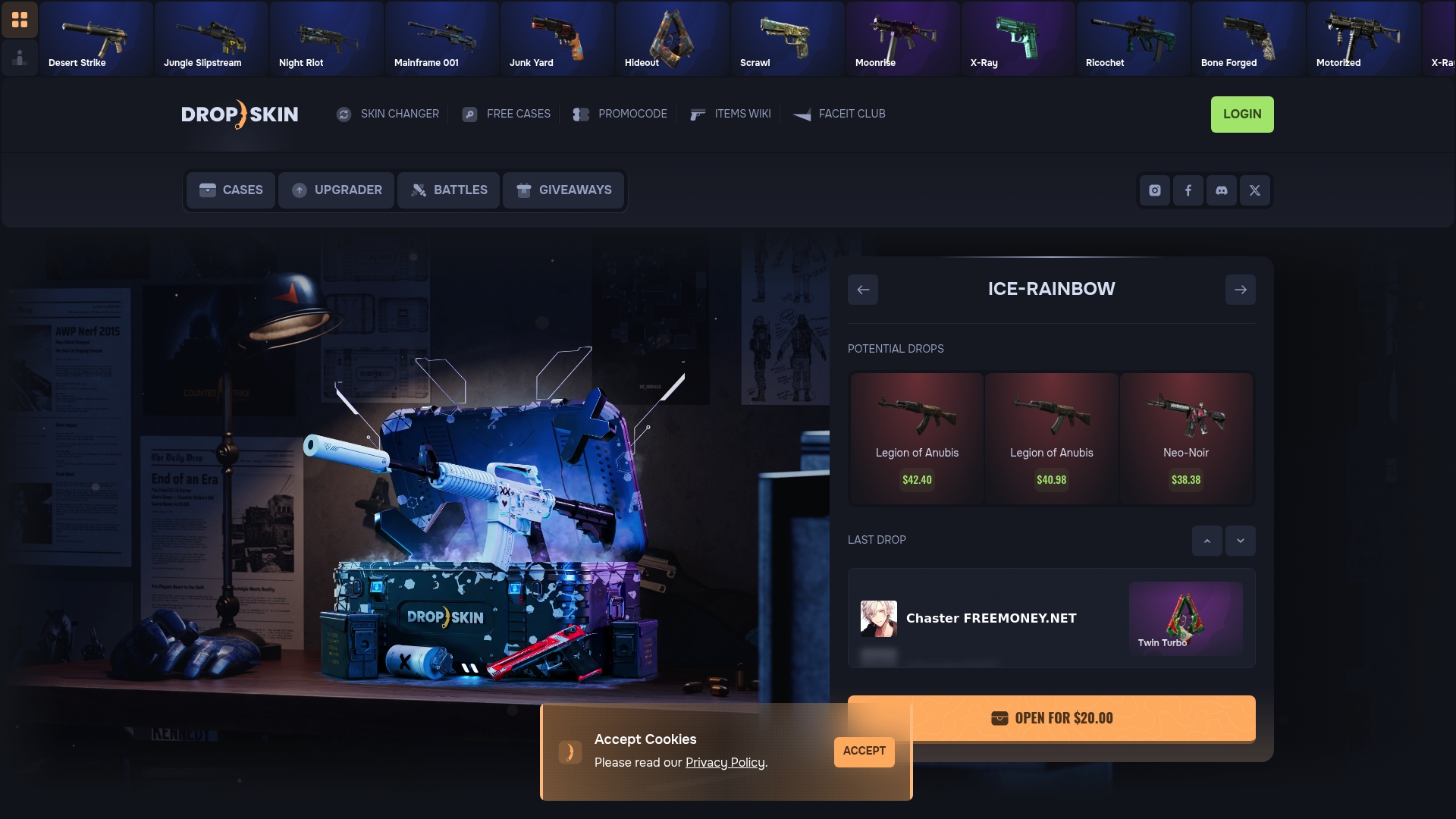
Dropskin's CS2 case opening platform shows drop rates upfront, integrates directly with your Steam inventory, and includes skin upgrade tools that let you trade up lower-value skins toward higher rarities. There are no hidden animations designed to obscure results. The platform also runs regular giveaways and offers promocodes, so you can stretch your first real-money session further. If you want to apply what you've learned from simulation to an actual case opening experience, Dropskin is the place to do it. Check the case opening methods guide on the Dropskin blog to see how different strategies perform before you commit.
FAQ
What is a CS:GO case simulator?
A CS:GO case simulator is a free web tool that replicates the case opening experience using Valve's official drop rates and live market prices, with no real money required.
Are case simulator results accurate to real CS:GO odds?
Quality simulators use Valve's verified rarity probabilities: 79.92% Mil-Spec, 0.64% Covert, and 0.26% for knives and gloves. Results match real odds when these exact rates are applied.
What is the average ROI for opening CS:GO cases?
The average return on investment for Valve's official CS2 cases is 40–60% of the cost paid, confirming a consistent negative expected value for players over time.
How do I know if a case opening site is trustworthy?
Look for provably fair verification, which means the platform publishes its server seed, client seed, and nonce after each round. Two-factor authentication and transparent licensing are additional trust signals.
Can using a simulator improve my real case opening results?
No. Simulators build probability knowledge and set realistic expectations, but the fixed drop rates in real cases cannot be influenced by practice or prior simulation sessions.