
TL;DR:
- CS:GO skin odds are fixed probabilities published by Valve, with Mil-Spec at about 80% and knives at 0.26%. StatTrak and float values add independent layers, significantly reducing the chances of obtaining high-tier skins in perfect condition, such as a Factory New StatTrak Covert. Opening cases is inherently a negative expected value activity, better treated as entertainment rather than an investment, due to high house edges and astronomical odds for rare drops.
CS:GO skin odds are fixed, officially disclosed probabilities that determine your exact chance of unboxing a specific skin rarity when you open a case. Valve publishes these rates directly in-game, so there is no guesswork involved. The standard rarity tiers run from Mil-Spec at the bottom to Covert and Gold (knives and gloves) at the top. Understanding how csgo skin odds work also means understanding that StatTrak and float values add separate, independent probability layers on top of the base rarity roll. This article breaks down every layer of the math so you can set realistic expectations before you spend a single key.
How CS:GO skin odds work: rarity tiers and exact drop rates
CS:GO and CS2 weapon cases share a consistent rarity structure that has remained stable since 2017. Valve discloses these rates publicly, and they apply to every standard weapon case in the game. The numbers are not estimates. They are the actual probabilities baked into the system.
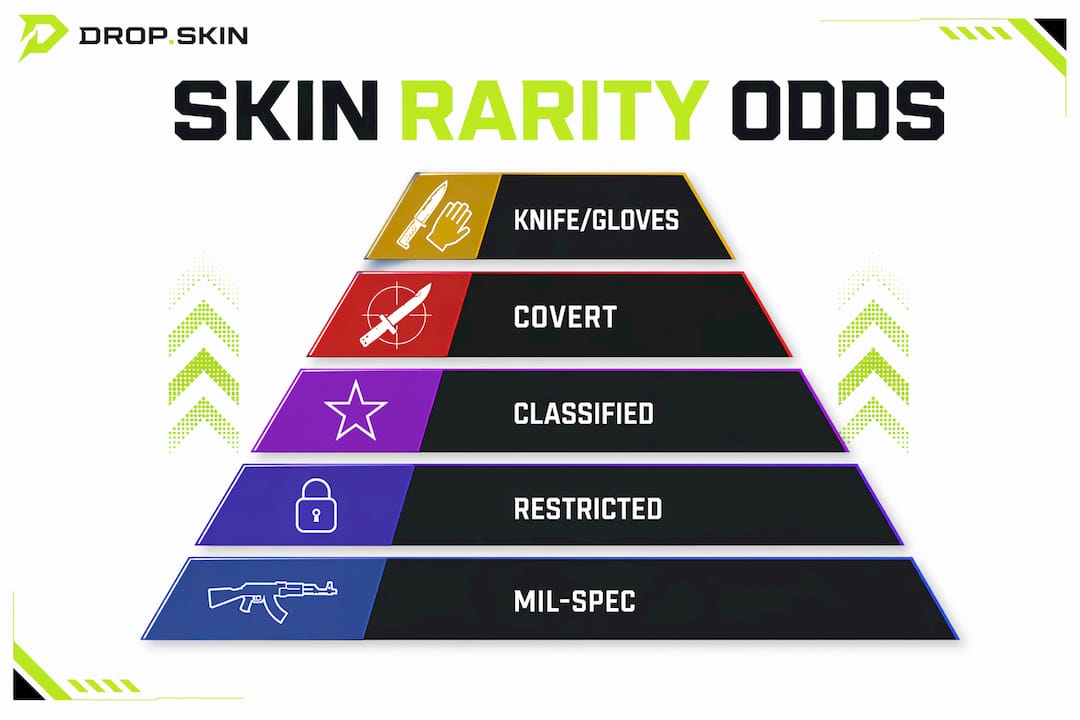
The five tiers and their official drop rates break down as follows:
| Rarity tier | Color | Drop rate | Odds (1 in X) |
|---|---|---|---|
| Mil-Spec | Blue | 79.92% | ~1 in 1.25 |
| Restricted | Purple | 15.98% | ~1 in 6.25 |
| Classified | Pink | 3.20% | ~1 in 31 |
| Covert | Red | 0.64% | ~1 in 156 |
| Gold (Knife/Glove) | Gold | 0.26% | ~1 in 385 |
The Mil-Spec tier dominates at nearly 80%, which means the vast majority of your opens will land on blue skins. The Gold tier sits at 0.26%, or roughly 1 in 385 cases, which is why knife unboxings feel like genuine events when they happen on stream.
Pro Tip: When you see "1 in 385" odds for a knife, that does not mean you are guaranteed one after 385 opens. Each case is an independent event. You could open 1,000 cases and never see a knife, or you could get one on your very first try.
These rates apply uniformly across all standard weapon cases, from the CS:GO Weapon Case to the Revolution Case. The skin pool inside each case changes, but the rarity percentages stay the same. This is what makes the CS:GO skin rarity list predictable in structure even when individual outcomes are random.
How StatTrak and float values affect your skin's rarity and value
StatTrak and float values are two additional probability layers that sit completely outside the base rarity roll. Understanding them separately is the key to calculating the true odds of getting a specific skin in a specific condition.
StatTrak probability
StatTrak has a roughly 10% drop chance that is applied after your rarity tier is determined. The two rolls are statistically independent, meaning the rarity roll does not influence whether you get StatTrak, and vice versa. The combined probability of a StatTrak Covert skin is calculated by multiplying the two independent probabilities: 0.64% × 10% = 0.064%. For a StatTrak knife, the math drops even further to approximately 0.026%, or 1 in 3,850 cases.
Float value and wear condition
Float values determine the wear condition of your skin and are rolled independently of both rarity and StatTrak. The approximate wear distribution across all drops looks like this:
- Factory New: ~3%
- Minimal Wear: ~24%
- Field-Tested: ~33%
- Well-Worn: ~24%
- Battle-Scarred: ~16%
Factory New is the rarest wear condition at just 3%, which is why Factory New Covert skins command significant price premiums on the Steam Community Market. A Field-Tested skin is statistically the most common outcome within any given rarity tier.
Pro Tip: Your rarity roll tells you nothing about what float value you will receive. A Covert skin is just as likely to drop Battle-Scarred as Factory New, proportionally speaking. The float roll is a completely separate random event.
The practical implication here is significant. If you want a Factory New StatTrak Covert skin, you are combining three independent probabilities: 0.64% (Covert) × 10% (StatTrak) × 3% (Factory New). That combined probability is roughly 0.00192%, or about 1 in 52,000 cases. This is why specific high-tier skins in perfect condition can sell for thousands of dollars on the secondary market.
Expected value, profitability, and the economics of case opening
Case opening is a negative expected value activity by design. The math is not ambiguous on this point. Typical case opening returns 40 to 60% of the combined cost of the case and key, meaning the average player loses between $1.50 and $2.50 per open before accounting for market fees.
The economic structure works like this:
- Valve takes a 21% cut on every case sale, plus a 15% marketplace fee on any skin you sell afterward. This house edge means the expected return is structurally below the cost of entry before a single case is opened.
- The median outcome is far below the mean. Because rare high-value drops skew the average upward, most players see results well below what the "average expected value" suggests. The mean is pulled up by the rare player who unboxes a $1,500 knife.
- Variance is enormous. There is a 97.43% chance of no knife in 10 case openings. Even across 100 openings, the probability of zero knives remains statistically significant.
- The rare big win sustains the ecosystem. Streamers unboxing knives generate millions of views, which drives new players to open cases. The excitement of the outlier outcome is the product being sold, not the skin itself.
"Case opening outcomes have enormous variance dominated by rare high-value drops; most players see results far below the average expected value." — CS2REF Insights
Players often treat case opening as a form of investment, but the economics of skin trading show it functions more like a lottery with a steep house edge. The correct frame is entertainment spending, not asset acquisition.
How weapon cases compare to souvenir packages and other containers
Not all CS2 containers use the same odds structure. Souvenir packages, sticker capsules, and weapon cases each operate under different probability systems, and confusing them leads to badly miscalibrated expectations.
Souvenir packages vs. weapon cases
Souvenir packages drop during CS2 Major tournaments and contain tournament-specific skins with souvenir stickers applied. They look similar to weapon cases but behave very differently. The most important difference: souvenir packages contain no knives or gloves. The top rarity is Covert, but the odds of hitting it are far more restrictive than in a standard weapon case.
| Container type | Top rarity | Top rarity odds | Knives/Gloves |
|---|---|---|---|
| Weapon case | Gold (Knife/Glove) | ~0.26% (1 in 385) | Yes |
| Souvenir package | Covert | ~0.0256% (1 in 3,906) | No |
| Sticker capsule | Extraordinary | Varies by capsule | No |
The Covert odds in souvenir packages are roughly 25 times worse than the knife odds in a standard weapon case. This surprises many players who assume souvenir packages are just cases with different skins. The rarity compression in souvenir packages makes them a particularly high-variance container type.
Sticker capsules
Sticker capsules use a separate rarity system with Extraordinary autograph stickers at the top. Odds vary by capsule and are not always publicly disclosed at the same level of detail as weapon cases. Autograph stickers from Major tournaments can reach significant market values, particularly for popular players, but the underlying probability mechanics follow the same independent-event structure as weapon cases.
The key takeaway across all container types is that how case odds work differs by container. Always check the specific odds for the container you are opening rather than assuming weapon case rates apply universally.
Key takeaways
CS:GO and CS2 skin odds are fixed, published probabilities where Mil-Spec drops dominate at 79.92% and Gold tier items like knives land at just 0.26%, making every case opening a negative expected value activity with no pity timer or memory effect.
| Point | Details |
|---|---|
| Rarity tiers are fixed | Mil-Spec drops at 79.92%; knives and gloves drop at 0.26%, or 1 in 385 cases. |
| StatTrak is independent | StatTrak adds a separate ~10% roll; a StatTrak Covert skin has roughly 0.064% combined odds. |
| Float values are separate | Factory New is the rarest wear condition at ~3% and is rolled independently of rarity and StatTrak. |
| Case opening loses money | Expected returns are 40 to 60% of cost; Valve takes a 21% cut plus a 15% marketplace fee. |
| Souvenir packages differ | Covert odds in souvenir packages are ~0.0256%, roughly 25 times worse than knife odds in weapon cases. |
Why most players misread the odds (and what that costs them)
At Dropskin, we have watched thousands of players open cases with the same misunderstanding baked in: they believe that a long streak of bad opens means a good drop is "due." It is not. Each case opening is a fully independent event with no pity timer, no warm state, and no memory of previous results. The system does not care how many cases you have opened. The 385th case has exactly the same knife probability as the first.
The gambler's fallacy is the single most expensive cognitive error in this space. Players who believe in streaks or "due" drops tend to open far more cases than they planned, chasing a statistical correction that will never come. The math does not owe you anything.
What we have found actually useful is treating the odds as a budget tool rather than a prediction tool. If you know a knife drops at 0.26%, you can calculate the expected cost of attempting to unbox one: 385 cases at roughly $2.50 each puts the expected spend at around $960, with no guarantee of success. That number reframes the decision immediately. Some players decide it is worth it for the entertainment. Others decide to buy the knife directly on the Steam Community Market for a fraction of that cost.
The players who enjoy case opening most are the ones who treat it as a form of entertainment with a known cost, not as a path to profit. Understanding the advantages and risks of case opening before you spend is the most practical thing you can do. Responsible play also means knowing when to stop. Resources like safe gaming guides exist for a reason, and there is no shame in using them.
— DROPSKIN
Open CS2 cases and upgrade skins on Dropskin
If you want to put this knowledge to work, Dropskin gives you a platform built specifically for CS2 players who understand the odds and want to engage on their own terms. You can open CS2 cases across an extensive catalog, use the skin upgrader to trade up lower-tier skins toward higher rarities, and participate in battle matches where you set the stakes yourself.
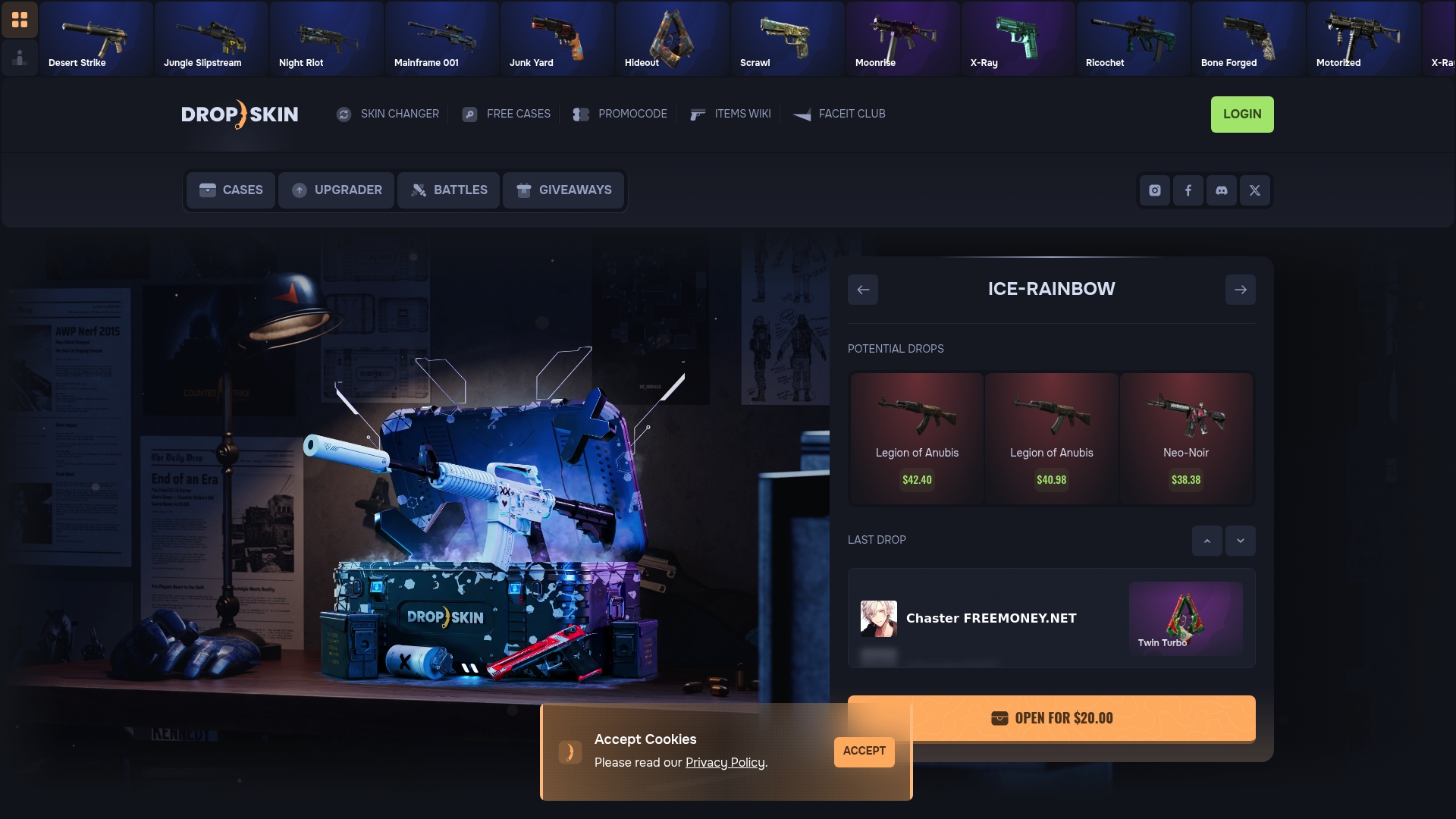
Dropskin also runs regular giveaways and promocodes that reduce the effective cost per open, which directly improves your expected value compared to opening cases at full price. The skin upgrader is particularly useful if you have accumulated a stack of Mil-Spec blues and want a shot at something higher without opening a fresh case. The platform is designed for players who treat skin collecting as a hobby, not a get-rich scheme, and the interface reflects that.
FAQ
What are the exact CS:GO skin odds for each rarity tier?
Mil-Spec drops at 79.92%, Restricted at 15.98%, Classified at 3.20%, Covert at 0.64%, and Gold (knives and gloves) at 0.26%. These rates have been stable since 2017 and apply to all standard weapon cases.
Does opening more cases improve your odds of getting a knife?
No. Each case opening is an independent random event with no pity timer or memory effect. Opening 384 cases does not increase your probability on the 385th open. The knife odds remain 0.26% every single time.
How do StatTrak odds work in CS2 cases?
StatTrak is a separate ~10% probability roll applied after your rarity tier is determined. The two rolls are independent, so a StatTrak Covert skin has combined odds of roughly 0.064%, and a StatTrak knife drops at approximately 0.026%.
Are souvenir package odds the same as weapon case odds?
No. Souvenir packages have no knives or gloves, and the Covert tier drops at approximately 0.0256%, which is roughly 25 times rarer than the knife odds in a standard weapon case.
Is case opening profitable in CS2?
Case opening returns 40 to 60% of the combined case and key cost on average, making it a negative expected value activity. Valve takes a 21% cut on case sales plus a 15% marketplace fee on resold skins, so the house edge is structural and unavoidable.