Some CS2 skins sell for more than a luxury car. A single Karambit Case Hardened recently traded hands for around $1.5 million, and that is not a fluke. Skin rarity in CS2 is a layered system where drop rates, float values, and pattern indexes all stack on top of each other to create wildly different price points. If you are trading, collecting, or even just opening cases, understanding how rarity actually works is the difference between making smart moves and burning your balance chasing something you barely understand.
Table of Contents
- What makes a skin rare in CS:GO and CS2?
- CS2 skin drop odds and the reality of case openings
- What drives a skin's value? Pattern, float, and collector demand
- Trade-up contracts: Upgrading rarity and maximizing value
- Making smart decisions: When to open, trade, or buy skins
- Level up your CS2 skin game with DROP.SKIN
- Frequently asked questions
Key Takeaways
| Point | Details |
|---|---|
| Rarity levels matter | Understanding skin rarity tiers is essential for maximizing your value in CS2 skin trading and collecting. |
| Odds favor the house | Chasing rare skins through case openings is usually less profitable than trading or upgrading. |
| Factors beyond rarity | Pattern and float can raise a skin’s value dramatically, especially for collectors. |
| Smart trade-ups | Mastering trade-up math provides better odds than cases and enables profit for disciplined players. |
| Data-driven collecting | Relying on odds, data, and market knowledge leads to better returns than luck alone. |
What makes a skin rare in CS:GO and CS2?
Rarity in CS2 is not just a label. It is a mechanical system built into every case, collection, and souvenir package in the game. Each skin belongs to a rarity grade, and that grade determines how often it can drop. The higher the grade, the lower the odds, and the higher the market price tends to be.
The five main rarity grades you need to know are:
- Mil-Spec (blue): The most common drop, making up the bulk of what you get from cases.
- Restricted (purple): Noticeably less common, but still relatively accessible.
- Classified (pink): Getting into genuinely rare territory here.
- Covert (red): Very rare, and these are the skins that start commanding serious money.
- Exceedingly Rare (gold): Knives and gloves. The top of the food chain.
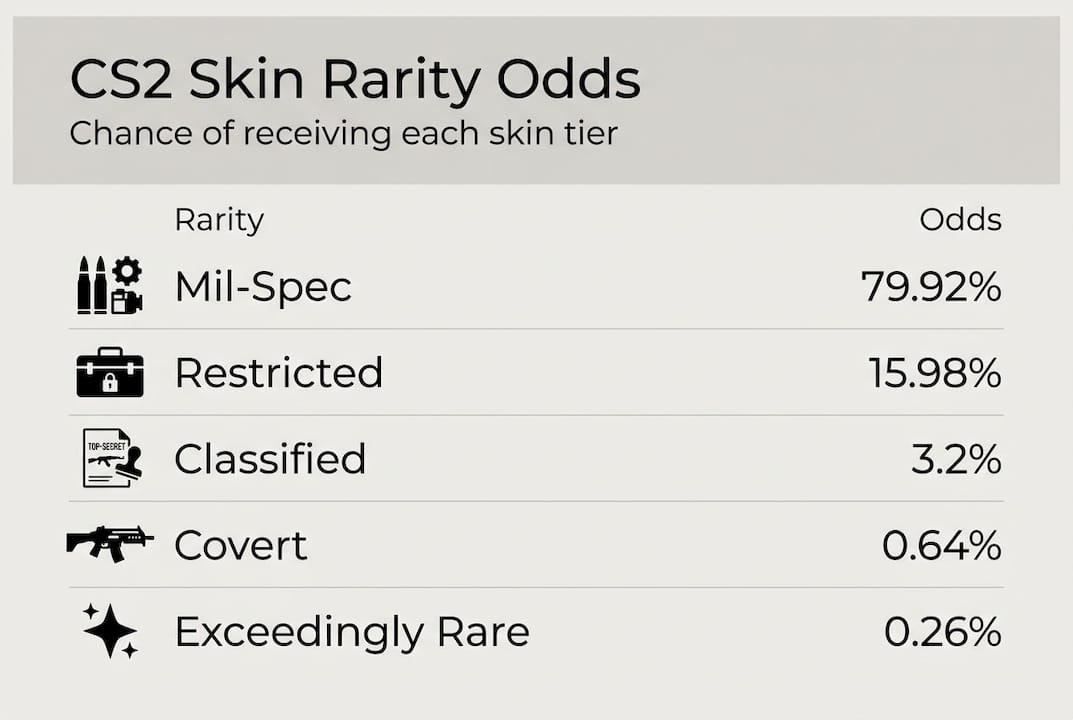
According to Valve-confirmed drop rates, Mil-Spec skins drop at 79.92%, Restricted at 15.98%, Classified at 3.2%, Covert at 0.64%, and Exceedingly Rare items like knives and gloves at just 0.26%. That means you are opening roughly 385 cases on average before you see a knife.
| Rarity grade | Drop rate | Approx. cases needed |
|---|---|---|
| Mil-Spec | 79.92% | 1 in 1.25 |
| Restricted | 15.98% | 1 in 6 |
| Classified | 3.20% | 1 in 31 |
| Covert | 0.64% | 1 in 156 |
| Exceedingly Rare | 0.26% | 1 in 385 |
Beyond the rarity grade itself, two more variables shape a skin's real-world value: float and pattern. Float is a number between 0 and 1 that determines how worn a skin looks. Pattern is an index number that controls how the skin's texture is placed on the weapon. For some skins, these two factors matter more than the rarity grade itself. You can learn more about how these layers interact in this CS2 skin rarity levels breakdown, or explore how they factor into building a skin collection from scratch.
CS2 skin drop odds and the reality of case openings
Knowing the rarity tiers is one thing. Feeling the weight of those odds in practice is another. Standard cases already make rare skins hard to get, but souvenir packages push the difficulty even further.
| Rarity grade | Standard case odds | Souvenir package odds |
|---|---|---|
| Mil-Spec | 79.92% | ~79.92% |
| Restricted | 15.98% | ~15.98% |
| Classified | 3.20% | ~3.20% |
| Covert | 0.64% | ~0.026% |
| Exceedingly Rare | 0.26% | Not available |
The souvenir Covert drop rate is not a typo. At roughly 0.026%, you are looking at odds that make standard case knives seem generous by comparison. That scarcity is exactly why certain souvenir skins carry enormous price tags.
Opening 385 cases at an average cost of $2.50 each means spending roughly $962 just for a statistically average shot at a knife. The average knife is worth around $400. The math does not work in your favor.
The market benchmark for 2026 shows that while an average knife sits around $400, a single pattern-perfect Karambit Case Hardened can reach $1.5 million. That gap exists because rarity alone does not set the price. Pattern and float do the heavy lifting at the top end.
Pro Tip: Case opening is entertainment, not investment. If you go in knowing the case opening advantages and limits, you can enjoy it responsibly. But if your goal is to acquire a specific valuable skin, buying or trading almost always beats opening cases on pure expected value. Understanding the full case opening process helps you set realistic expectations before you spend a single dollar.
What drives a skin's value? Pattern, float, and collector demand
Two skins can share the exact same rarity grade and still have a price difference of $100,000 or more. That is not hype. That is pattern and float doing exactly what they are designed to do.
Float controls wear. A Factory New skin with a float of 0.001 is visually cleaner than one at 0.069, and collectors pay a premium for the lowest possible number. For certain skins, the difference between a float of 0.01 and 0.06 can mean thousands of dollars.
Pattern controls texture placement. For skins like Case Hardened, Fade, or Doppler, the pattern index determines which part of the texture lands on the weapon. A Case Hardened with a mostly blue blade (the so-called Blue Gem) is worth far more than one with a mostly gold blade, even at identical float values.
Here is how the hierarchy plays out in practice:
- Case Hardened / Fade / Doppler: Pattern dominates value. A Blue Gem pattern #661 in Factory New can exceed $100,000, while an average pattern FN sits around $1,000.
- Static skins (solid colors, simple designs): Float dominates. The lower the number, the higher the price.
- Collector tier: The rarest items combine a top-tier pattern with an extreme low float. These are 1-of-1 pieces that collectors chase for years.
Pro Tip: Before buying or trading a Covert or knife skin, always check both the float and the pattern index. A skin that looks identical in screenshots can be worth ten times more or ten times less depending on those two numbers. Use this knowledge when choosing valuable skins to trade or add to your inventory.
Understanding these layers gives you a real edge. Most casual players ignore pattern entirely and only glance at condition labels. Serious collectors who study skin collecting tips and learn to pick winning skins consistently find undervalued pieces that others overlook.
Trade-up contracts: Upgrading rarity and maximizing value
You do not have to rely on case luck to climb the rarity ladder. Trade-up contracts let you combine 10 skins of the same rarity into one skin of the next rarity tier. Done right, this is one of the few methods in CS2 where math can actually work in your favor.
Here is how a trade-up works step by step:
- Select 10 skins of the same rarity grade (e.g., 10 Restricted skins).
- All 10 must be from the same StatTrak category. You cannot mix StatTrak and normal skins.
- The output skin is pulled from the collections represented in your inputs. If 7 of your 10 skins come from Collection A, you have a 70% chance of getting a Collection A output.
- The output skin's float is calculated as the average of your input floats, plus a random value between 0 and 0.07, capped by the target skin's float range.
- You cannot trade up Covert skins. That tier is the ceiling.
According to trade-up contract mechanics, this system allows for positive expected value plays of 20 to 50% profit when you control collection weighting and float carefully. That beats case opening expected value, which runs at roughly negative 70%.
| Input composition | Chance of target collection output |
|---|---|
| 10/10 from one collection | 100% |
| 7/10 from one collection | 70% |
| 5/10 from one collection | 50% |
| 3/10 from one collection | 30% |
Pro Tip: Professionals running trade-up strategies track batches of 50 or more contracts to smooth out variance. A single trade-up can go wrong even with perfect math. Volume is what makes the edge real. Pair this with a solid understanding of the skin economy and you will spot profitable setups much faster. The esports skin collecting guide also covers how to source cheap inputs without overpaying.
Making smart decisions: When to open, trade, or buy skins
You now have the full picture. Here is how to apply it without making the mistakes that cost most players money.
Your three main options, ranked by expected value:
- Buying directly: Highest control, clearest pricing. You know exactly what you are getting and at what float and pattern. Best for targeting specific skins.
- Trade-up contracts: Positive EV when executed with math and discipline. Best for players who want to climb rarity tiers without pure luck.
- Case opening: Negative EV long-term. Case opening loses money compared to buying or trading. Best treated as entertainment with a fixed budget, not a strategy.
Common mistakes that drain your inventory:
- Chasing losses by opening more cases after a bad run.
- Overpaying for hype skins without checking if the pattern or float justifies the price.
- Ignoring collection weighting when running trade-ups and getting surprised by the output.
- Buying a skin based on condition label alone without checking the actual float number.
- Assuming all skins in the same rarity tier hold value equally over time.
Top collectors use data and patience. They monitor price trends, understand what drives demand for specific patterns, and never rush a purchase. The smart skin collecting tips that separate profitable collectors from casual ones all come back to the same principle: know what you are buying before you buy it.
Level up your CS2 skin game with DROP.SKIN
You have the knowledge. Now you need the right tools to put it into practice. DROP.SKIN is built specifically for CS2 players who want more than just luck on their side. Whether you want to open CS2 cases with full transparency on odds or use the online skin upgrader to move your inventory up the rarity ladder, the platform gives you real options backed by clear mechanics.
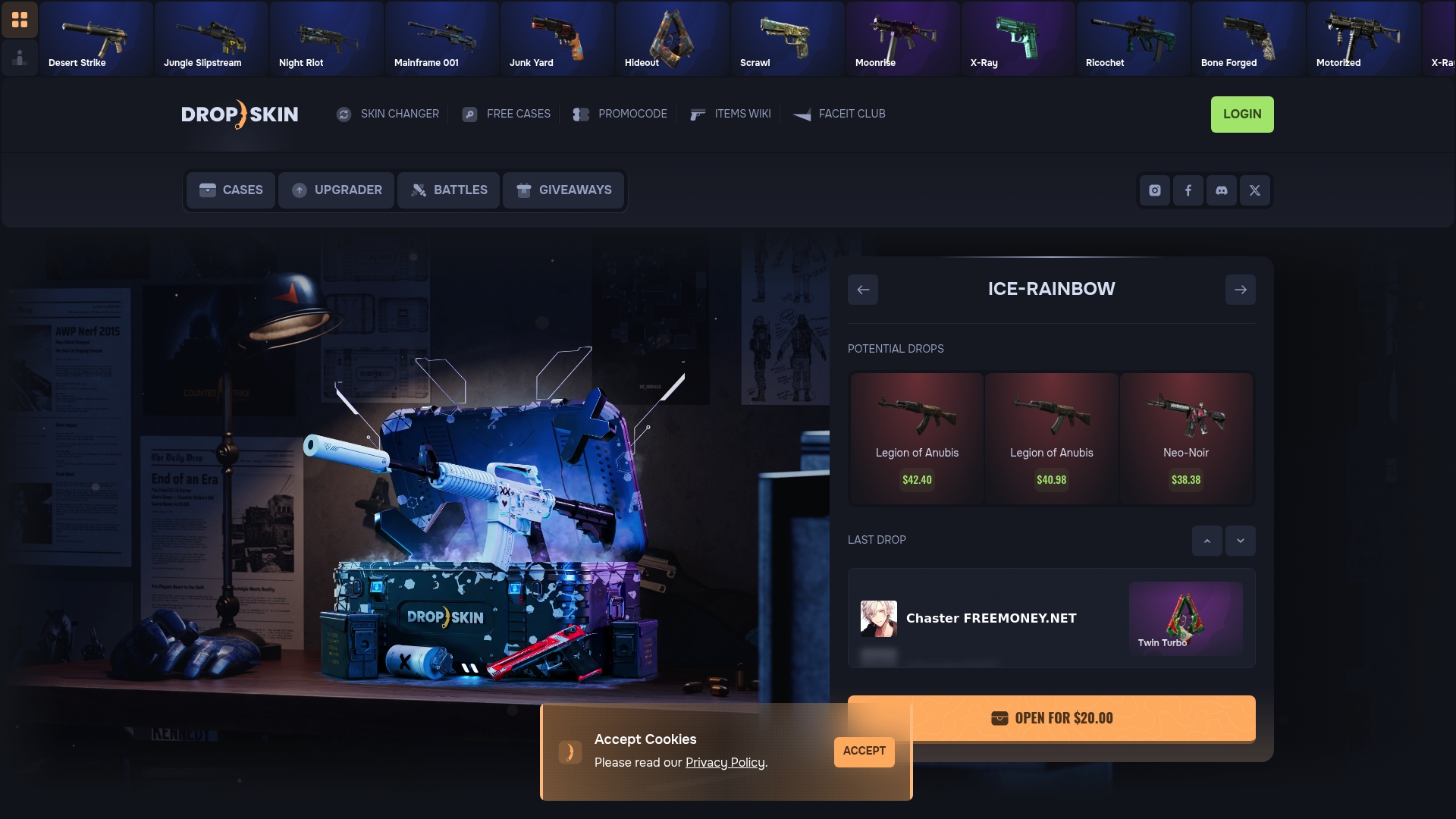
The upgrader is especially powerful for players who have absorbed everything in this article. You can target specific rarity tiers, set your risk level, and make calculated moves instead of blind ones. DROP.SKIN also runs regular giveaways and promo codes, so there are ways to stretch your budget further while you build toward the skins you actually want. Responsible, informed play beats pure luck every time.
Frequently asked questions
What is the rarest type of CS2 skin?
Exceedingly Rare items like knives and gloves have drop rates as low as 0.26%, and souvenir Covert skins drop at roughly 0.026%, making them even scarcer.
Are trade-up contracts better than opening CS2 cases?
Yes. Well-planned trade-ups can generate 20 to 50% profit through collection weighting and float control, while case opening typically runs at negative 70% expected value.
How do float and pattern affect skin value?
For pattern-dependent skins like Case Hardened, a top-tier pattern can push value from $1,000 to over $100,000. Collectors chase 1-of-1 extremes that combine the best pattern with the lowest float.
Is it possible to beat the odds and consistently profit from skin cases?
No. The long-term math on cases favors the house. Buying or trading skins directly is consistently more efficient for building a valuable inventory.
Why do some skins sell for over $1 million?
The Karambit Case Hardened #387 FN sold for approximately $1.5 million because it combines the rarest pattern index with a Factory New float on one of the most iconic knife skins in the game. Scarcity plus demand at the extreme end creates prices that defy normal logic.