
You might think a skin's rarity is all about how good it looks, but visual appeal accounts for less than 30% of what makes a skin rare. The real drivers are official classification tiers and drop rates, factors that directly determine market value and gambling odds. Understanding this distinction separates profitable traders from those chasing hype, especially when CS2 skins influence gameplay decisions and investment strategies.
Table of Contents
- CS2 Skin Rarity Tiers And Classification
- Factors Beyond Tiers That Affect Skin Rarity
- Common Misconceptions About Skin Rarity
- How Rarity Influences Market Value And Gambling Odds
- Framework To Understand Skin Rarity
- Practical Tips For Trading And Gambling With Rare Skins
- Explore DROP.SKIN For CS2 Skins And Upgrades
Key Takeaways
| Point | Details |
|---|---|
| Seven Official Tiers | CS2 uses Consumer, Industrial, Mil-spec, Restricted, Classified, Covert, and Exceedingly Rare categories with defined drop rates. |
| Multiple Rarity Factors | Tier, drop rate, wear condition, event exclusivity, and market demand all shape a skin's rarity. |
| Common Myths Mislead | Many traders mistakenly believe rarity is purely visual or that all Covert skins share equal scarcity. |
| Direct Price Impact | Rarity tier and drop rates create predictable price premiums and gambling probability patterns. |
| Framework for Assessment | A systematic four-factor model helps evaluate skins consistently for smarter trading decisions. |
CS2 Skin Rarity Tiers and Classification
CS2 organizes skins into seven distinct rarity tiers, each with specific drop probabilities that determine how often you'll encounter them. These tiers form the foundation of the entire rarity system, dictating everything from case opening odds to market pricing. The structure applies universally across all cases and collections, though individual skins within each tier can still vary in actual scarcity.
The official tiers run from most common to most rare:
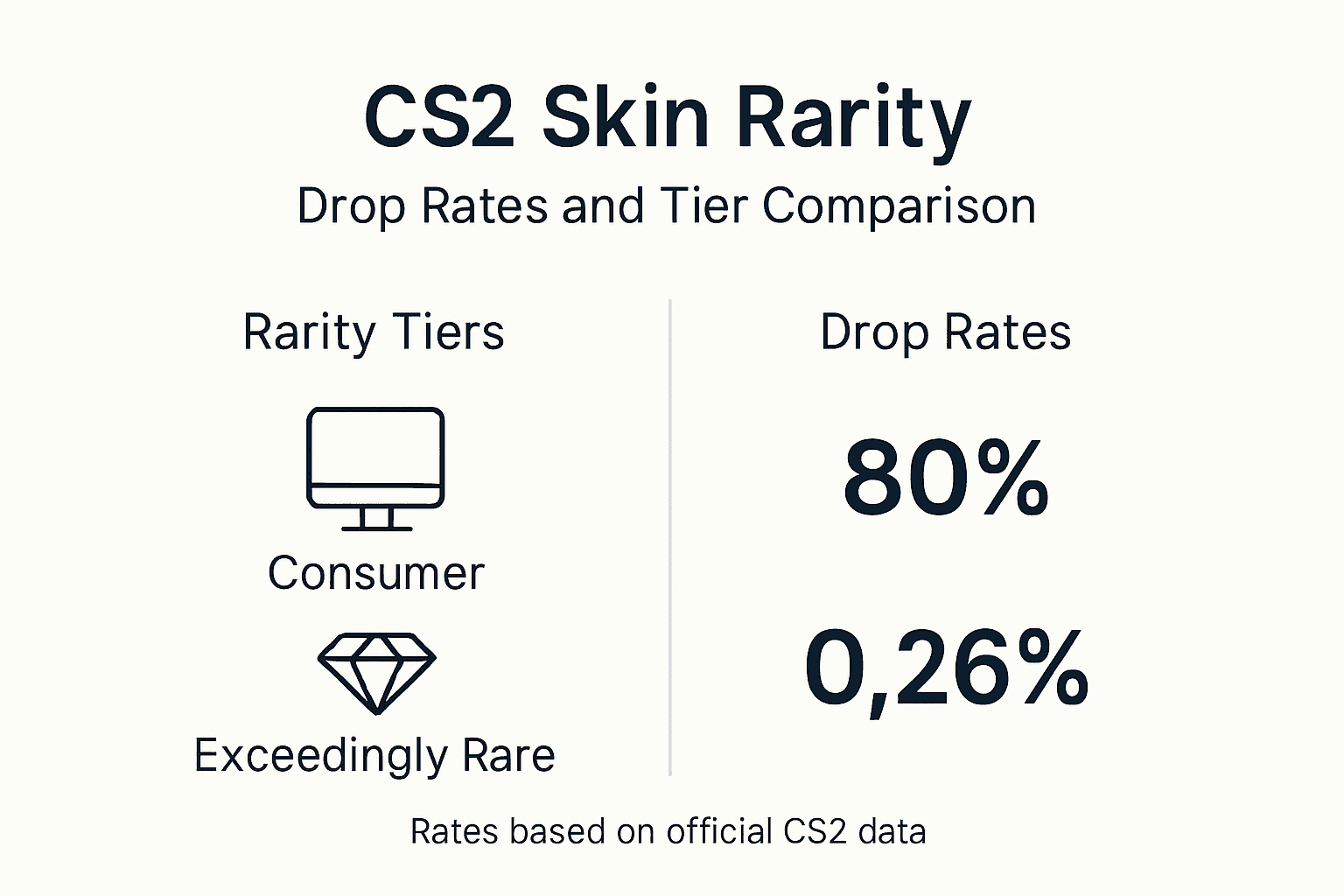
- Consumer Grade (White): Most common tier with approximately 80% drop rate
- Industrial Grade (Light Blue): Common tier with roughly 16% drop rate
- Mil-Spec (Blue): Moderate rarity at about 3.2% drop rate
- Restricted (Purple): Uncommon tier near 0.64% drop rate
- Classified (Pink): Rare tier around 0.32% drop rate
- Covert (Red): Very rare at approximately 0.26% drop rate
- Exceedingly Rare (Gold): Ultra-rare category for knives and gloves, also near 0.26% drop rate
| Rarity Tier | Drop Rate | Example Skins |
|---|---|---|
| Consumer | ~80% | P250 Sand Dune, FAMAS Colony |
| Industrial | ~16% | AK-47 Safari Mesh, M4A4 Desert Storm |
| Mil-Spec | ~3.2% | AK-47 Blue Laminate, AWP Worm God |
| Restricted | ~0.64% | AK-47 Redline, M4A4 Desolate Space |
| Classified | ~0.32% | AK-47 Fuel Injector, AWP Hyper Beast |
| Covert | ~0.26% | AK-47 Fire Serpent, AWP Dragon Lore |
| Exceedingly Rare | ~0.26% | Karambit Fade, Butterfly Knife Doppler |
The CSGO vs CS2 skins comparison shows these tiers remained consistent across both games. The Exceedingly Rare category exclusively contains knives and gloves, which explains their premium market prices despite sharing similar drop rates with Covert weapons. This classification system provides the baseline for understanding rarity, but it's only part of the story.
Factors Beyond Tiers That Affect Skin Rarity
A skin's official tier tells only half the rarity story. Visual complexity, wear conditions, and exclusive events layer additional scarcity on top of base drop rates, creating massive value gaps even between skins sharing the same tier. These secondary factors often determine whether a Covert skin sells for $50 or $5,000.
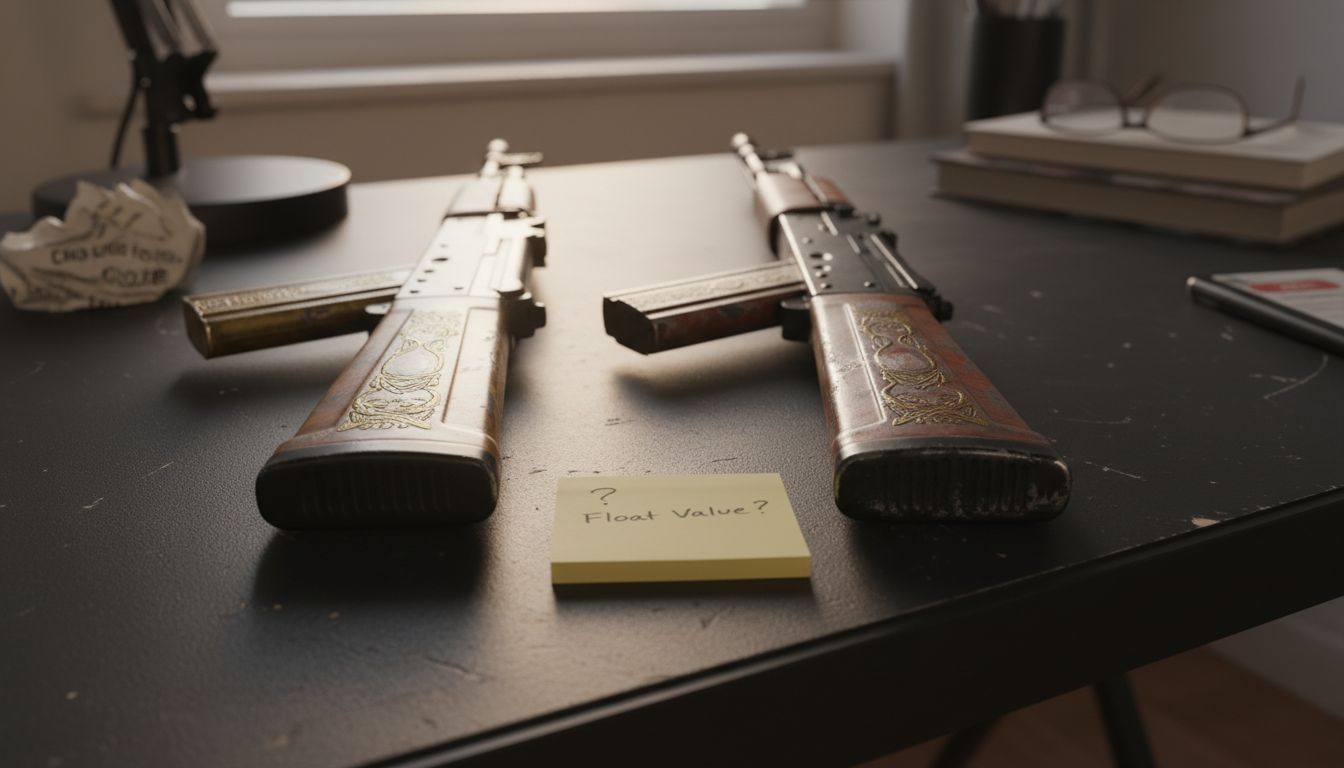
Wear condition dramatically impacts rarity within each tier. Factory New and Minimal Wear versions appear far less frequently than Battle-Scarred variants, especially for skins with wide float value ranges. A Factory New AWP Dragon Lore is exponentially rarer than a Well-Worn version, despite both being Covert tier. The premium skin factors analysis shows condition often matters more than base tier for high-end trading.
Souvenir and event-exclusive skins introduce artificial scarcity through limited availability windows. Major tournament drops, operation-exclusive collections, and discontinued cases create supply constraints independent of drop rate percentages. These time-limited releases can transform even Industrial-tier skins into valuable collectibles years later.
Market demand fluctuates constantly based on professional player preferences, meta shifts, and community trends. A Classified skin used by top esports players can command prices exceeding some Covert alternatives. Visual appeal, popularity, and cultural cachet shape perceived rarity beyond mathematical drop probabilities.
Pro Tip: Always check a skin's wear range and float value before trading. Some skins can't exist in Factory New condition, making Minimal Wear the rarest achievable grade and dramatically increasing value compared to tier alone.
Common Misconceptions About Skin Rarity
Three major myths about CS2 skin rarity lead traders and gamblers into costly mistakes. Clearing up these misunderstandings protects your investment decisions and gambling strategies from common pitfalls that plague uninformed players.
Myth 1: Rarity is purely about visual appeal. Reality shows drop rates dominate rarity classification. A visually plain Covert skin remains objectively rarer than a beautifully designed Consumer skin because it appears 300 times less frequently in drops. The tier system prioritizes mathematical scarcity over subjective aesthetics, though skin value in the CS2 market shows both factors influence final pricing.
Myth 2: All skins within a tier share identical rarity. Individual Covert skins vary wildly in actual scarcity due to collection size, case retirement, and float value distributions. An AWP Dragon Lore from the discontinued Cobblestone Collection is far rarer than a current-case Covert weapon, despite identical tier classification. Supply dynamics create massive rarity gaps within tiers.
Myth 3: Higher rarity guarantees stable or increasing prices. New Covert skin releases often see dramatic price drops in the first weeks as supply floods the market from case openings. Rarity provides price support long term, but short-term volatility affects all tiers. The rarest skins can lose 40-60% of their value immediately post-release before stabilizing months later.
How Rarity Influences Market Value and Gambling Odds
Rarity directly translates into price premiums and gambling probabilities through straightforward mathematical relationships. Understanding these connections helps you predict value trends and optimize betting strategies based on drop rate data.
Higher rarity tiers command exponentially larger price premiums. Moving from Mil-Spec to Restricted doubles average prices, while jumping from Classified to Covert often increases values 5-10x. The Exceedingly Rare category pushes this further, with knives starting at hundreds of dollars purely due to 0.26% drop rates. These premiums reflect supply scarcity meeting consistent demand from collectors and traders.
Gambling odds mirror official drop rates, making rarity the foundation of case opening profitability calculations. A Covert skin appears roughly once every 385 case openings mathematically, while Restricted items show up every 156 cases. This relationship between the role of skins in CSGO gambling and rarity tiers determines expected returns and variance in skin betting activities.
| Rarity Tier | Typical Price Range | Cases Needed (Avg) | Gambling Edge |
|---|---|---|---|
| Mil-Spec | $1-$10 | 31 cases | Lowest returns |
| Restricted | $5-$50 | 156 cases | Small profit potential |
| Classified | $20-$200 | 313 cases | Medium risk/reward |
| Covert | $100-$5,000+ | 385 cases | High variance plays |
| Exceedingly Rare | $400-$50,000+ | 385 cases | Extreme volatility |
New skin releases create temporary market disruptions that savvy traders exploit. Initial supply surges from mass case openings depress prices for 2-4 weeks before natural scarcity reasserts itself. Why skins are valuable explains how rarity underpins long-term appreciation despite short-term noise.
Pro Tip: Track case opening volumes during new releases. When opening rates drop 60-70% from peak, prices typically stabilize and begin recovery, signaling optimal entry points for rarity-based investments.
Framework to Understand Skin Rarity
A systematic four-factor model eliminates guesswork when evaluating skin rarity for trading or gambling decisions. This framework combines official classifications with market realities to produce consistent, data-driven assessments.
| Factor | What to Evaluate | Example Application |
|---|---|---|
| Official Tier | Base drop rate and tier classification | Covert tier = 0.26% drop rate baseline |
| Drop Rate Context | Case availability and retirement status | Discontinued case = increased scarcity multiplier |
| Visual/Event Exclusivity | Wear condition, souvenir status, operation ties | Factory New souvenir = extreme rarity boost |
| Market Demand | Current pricing, trade volume, trend direction | High player usage = sustained demand premium |
Apply the framework systematically:
- Start with the official tier to establish baseline rarity and drop probability
- Adjust for supply factors like case retirement or limited-time availability
- Layer in condition and exclusivity modifiers that affect actual obtainability
- Verify against current market prices and volume to confirm demand alignment
This skin rarity evaluation framework prevents emotional trading decisions. Using all four factors together reveals when a skin is genuinely rare versus artificially hyped, protecting you from overpaying for perceived scarcity that doesn't exist. The model works equally well for quick flip trades and long-term collection building.
Practical Tips for Trading and Gambling with Rare Skins
Translating rarity knowledge into profitable action requires specific strategies that account for both mathematical probabilities and market psychology. These approaches help you capitalize on rarity dynamics while avoiding common traps.
Identify genuinely rare skins by cross-referencing tier classification with supply constraints. Look for combinations like Covert tier plus discontinued case plus Factory New condition, which multiply scarcity factors. Single rarity elements rarely justify premium prices, but stacked factors create legitimate investment opportunities.
Leverage rarity data to improve case opening and CS2 skin gambling outcomes:
- Focus bankroll on cases with favorable Covert/Exceedingly Rare item distributions
- Calculate break-even points using exact drop rates before opening cases in volume
- Target newly released cases when Covert skin prices remain inflated from initial scarcity
- Avoid aged cases where all tiers have depreciated below opening costs
Monitor market timing around major updates and tournaments. New operation launches temporarily depress existing skin values as attention shifts. Major championship events boost souvenir package demand but crater regular skin prices short term. These predictable cycles create buying opportunities for patient traders focused on fundamental rarity.
Pro Tip: Resist FOMO trades when rare skins spike 40%+ in a single week. These moves rarely sustain without fundamental rarity changes, and buying at peaks guarantees losses when prices normalize within days.
Explore DROP.SKIN for CS2 Skins and Upgrades
Applying your new rarity expertise becomes simpler with the right platform. DROP.SKIN combines educational resources about why skins are valuable with practical tools for upgrading and trading based on rarity tiers. The marketplace lets you filter by exact rarity classifications, making it easy to find undervalued skins where tier and condition create hidden opportunities.
The CS2 Skin Upgrader feature helps you move up rarity tiers systematically, transforming common skins into restricted or classified alternatives through strategic upgrades. Understanding the CSGO vs CS2 skins differences ensures you're targeting the right rarity combinations for maximum value appreciation.
FAQ
What Are the Official Rarity Tiers in CS2?
CS2 uses seven tiers: Consumer, Industrial, Mil-Spec, Restricted, Classified, Covert, and Exceedingly Rare. Each tier has specific drop rates ranging from 80% for Consumer down to 0.26% for Covert and Exceedingly Rare items. These classifications determine how often skins appear in case openings and directly influence market prices.
How Does Wear Affect Skin Rarity?
Wear condition shows the visual quality of a skin's surface, ranging from Factory New to Battle-Scarred. Better conditions appear less frequently due to float value distributions, making Factory New and Minimal Wear significantly rarer than lower grades. A Factory New Covert skin can be 10x rarer than a Battle-Scarred version of the same weapon.
Are All Covert Skins Equally Rare?
No, Covert skins vary substantially in actual scarcity. Factors like case retirement, collection size, and float value ranges create massive differences within the tier. An AWP Dragon Lore from a discontinued collection is exponentially rarer than a current-case Covert weapon, despite sharing identical tier classification.
Can Skin Rarity Predict Gambling Outcomes?
Rarity tiers directly determine gambling probabilities since they reflect official drop rates. A 0.26% Covert drop rate means you'll statistically unbox one every 385 cases. Higher rarity increases potential win values but decreases win frequency, creating the risk/reward balance in skin gambling. Understanding these odds helps set realistic expectations and bankroll management strategies.
Recommended
- Skin Value in CS2 – What Drives Worth and Demand
- 6 Smart CS2 Skin Collecting Tips for Maximized Value
- CSGO vs CS2 Skins: What Changes and Why It Matters
- Defining Premium Skins: What Sets Them Apart
- Special Edition Comics: Rarity, Value, and Risks – The Mansion Press