
TL;DR:
- Diversifying skin assets involves balancing a CS2 portfolio across stable, growth, and niche skins to manage risk. Tracking metrics like Realized P&L, Unrealized P&L, and ROI helps collectors assess true value and liquidity. Following the 60/30/10 rule with disciplined rebalancing and cross-platform holdings safeguards against market shifts and enhances resilience.
Diversifying skin assets is the process of intentionally curating a balanced CS2 portfolio to maximize both aesthetic variety and investment potential. Collectors who treat their inventory as a managed portfolio, rather than a random accumulation, consistently achieve better value and lower exposure to market swings. Knowing how to diversify skin assets means tracking three core metrics: Realized P&L, Unrealized P&L, and ROI. These numbers tell you what your collection is actually worth versus what it looks like on paper. The collectors who master this distinction are the ones who build lasting, resilient inventories.
How to diversify skin assets: the essential prerequisites
Skin asset management starts with the right tools and vocabulary. Before you allocate a single item, you need a clear picture of what you already own and how each piece performs.
The three metrics every serious collector tracks are:
- Realized P&L: The actual profit or loss from completed trades and sales.
- Unrealized P&L: The current paper value of skins you still hold, before fees and liquidity spread.
- ROI: The percentage return on your total invested capital across the portfolio.
Balancing these metrics is the foundation of professional skin asset management. A skin worth $500 on paper may only net $380 after platform fees and a slow market. That gap between unrealized and realized value is where most collectors lose money without realizing it.
CS2 skin management tools in 2026 let collectors schedule skin rotations and visually simulate loadouts, turning a static inventory into a living wardrobe. Features like cloud sync and automated rotation calendars make it practical to manage a large, varied collection without losing track of what you own. Regularly updating your transaction history is not optional. Accurate records are the only way to produce a trustworthy health assessment of your portfolio at any given moment.
| Metric | What it measures | Why it matters |
|---|---|---|
| Realized P&L | Profit from completed sales | Shows actual cash performance |
| Unrealized P&L | Current paper value of held skins | Reveals gap between value and liquidity |
| ROI | Return on total invested capital | Benchmarks overall portfolio efficiency |
| Liquidity score | Trading volume for a specific skin | Flags items that are hard to sell quickly |
How does the 60/30/10 rule apply to skin portfolio diversification?
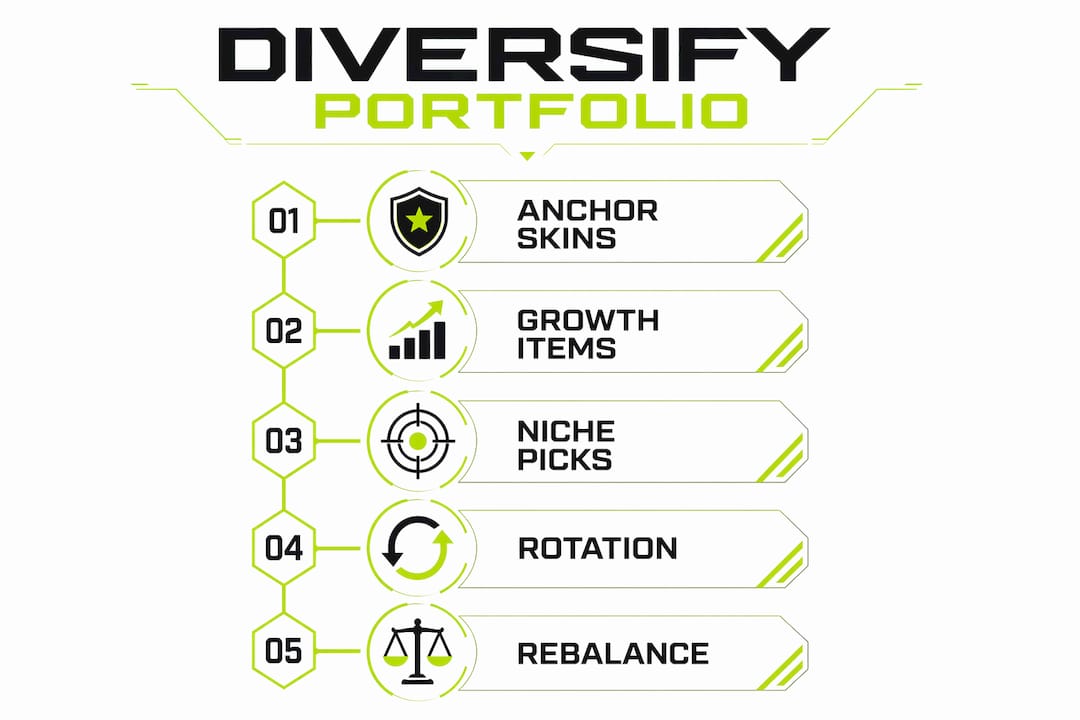
The 60/30/10 split is the most practical framework for balancing a skin portfolio. It divides your holdings into three tiers by function and risk level.
The breakdown works like this:
- 60% anchor skins. These are your stable, consistently traded items. Think popular weapon finishes with high daily trading volume, like the AK-47 Redline or M4A4 Howl tier of skins. They hold value through market corrections and sell quickly when you need liquidity.
- 30% growth skins. These are emerging items with upward price momentum. New operation drops, recently discontinued cases, and skins tied to rising pro players fall into this category. They carry more risk but offer the strongest appreciation potential.
- 10% specialty or niche skins. Rare patterns, unusual float values, and sticker combinations belong here. They define the character of your collection and can generate outsized returns, but they are the hardest to sell fast.
The 60/30/10 portfolio framework was validated by 2026 industry standards as a method for mitigating market shift risks while maintaining steady growth. The logic is simple: your anchor tier funds your ability to hold growth and specialty items through downturns.
Pro Tip: Identify your two strongest anchor skins first. Every other purchase in your portfolio should either support those anchors or occupy a clearly different tier. Mixing tiers without intention is how collectors end up with cluttered, low-liquidity inventories.
| Portfolio tier | Allocation | Primary function |
|---|---|---|
| Anchor skins | 60% | Stability and liquidity |
| Growth skins | 30% | Appreciation and trend exposure |
| Specialty/niche skins | 10% | Rarity, identity, and upside |
The hero product principle reinforces this structure. Your portfolio should have one or two anchor items that define its value and identity, with supporting assets amplifying those heroes. Doubling down on hero skins reduces noise and makes every acquisition decision clearer.
What are the best practices for executing skin asset diversification?
Execution is where most collectors fall short. Knowing the framework is one thing. Applying it consistently to a real inventory requires discipline and a repeatable process.
Follow these steps to build and maintain a diversified skin portfolio:
- Audit your current holdings. List every skin, its current market price, its trading volume, and which tier it belongs to. This single step reveals over-concentrations immediately.
- Identify redundant assets. True diversification means selecting one dependable option per useful category, not owning five variations of the same rifle finish. Redundant assets dilute your portfolio without adding variety or value.
- Rebalance quarterly. Market conditions shift. A growth skin that appreciated strongly may now belong in your anchor tier. A specialty skin that lost trading volume may need to be sold before liquidity dries up entirely.
- Spread holdings across multiple platforms. Holding assets across platforms reduces your exposure to account bans, policy changes, and platform-specific outages. Treat this as a basic hedge, not an advanced tactic.
- Track market trends without chasing them. New operation skins and pro scene drops create short-term price spikes. Buying into a spike without a clear exit plan turns a growth asset into a stranded specialty item.
Pro Tip: Build your collection like a wardrobe. Prioritize aesthetic synergy and functional versatility across loadouts. A knife and glove combination that works visually across multiple rifles holds sustained demand far longer than a single flashy item with no supporting context.
Professional collectors avoid rare skins with low trading volume despite high theoretical value. Liquidity during corrections is what separates collectors who profit from those who watch paper gains evaporate. The gap between a skin's listed price and what you actually receive after fees and a slow market is the real cost of poor liquidity planning.
Wardrobe-style rotation scheduling keeps your collection feeling fresh without requiring constant new purchases. Rotating which skins appear in your active loadout maintains engagement with your inventory and surfaces underused items that may be candidates for sale or trade.
How does diversification protect your portfolio against market risk?
A concentrated portfolio is the single biggest risk in skin collecting. Collectors who hold 80% of their value in one category, one operation's skins, or one platform face catastrophic losses when that segment corrects.
Diversification hedges supply-side risks by ensuring no single market source, category, or trend dominates your holdings. When one segment drops, the rest of your portfolio absorbs the impact rather than collapsing with it.
The specific risks that diversification addresses include:
- Category concentration: Owning only knife skins, for example, exposes you entirely to knife market sentiment.
- Platform risk: Holding everything on one platform means a single policy change can freeze your entire collection.
- Trend dependency: Building a portfolio around one pro player's signature skins ties your value to that player's career trajectory.
- Liquidity traps: Specialty skins that look valuable on paper but trade infrequently can lock up capital for months.
"Diversified portfolios protect against supply shocks and localized market crashes by ensuring no single category or platform dominates holdings."
Liquid anchor skins are your portfolio's shock absorbers. When the market corrects, you can sell anchor items quickly to free up capital for buying growth skins at lower prices. That cycle, selling high-liquidity items at stable prices and reinvesting in temporarily discounted growth assets, is how experienced collectors build value through downturns rather than losing it.
Intentional curation beats sheer quantity every time. A well-curated CS2 collection of 20 carefully selected skins across all three tiers outperforms a 100-item inventory of randomly acquired items in both liquidity and long-term value retention.
Key Takeaways
A diversified skin portfolio built on the 60/30/10 framework, tracked with Realized P&L, Unrealized P&L, and ROI, consistently outperforms concentrated or randomly assembled collections in both value and resilience.
| Point | Details |
|---|---|
| Use the 60/30/10 split | Allocate 60% to anchor skins, 30% to growth items, and 10% to specialty pieces. |
| Track three core metrics | Monitor Realized P&L, Unrealized P&L, and ROI to assess true portfolio health. |
| Prioritize liquidity | Avoid rare skins with low trading volume; liquidity determines real sellable value. |
| Spread across platforms | Hold assets on multiple platforms to hedge against account or policy issues. |
| Curate, do not accumulate | One strong skin per category beats five redundant variations every time. |
Dropskin's take on building a skin portfolio with intention
The most common mistake collectors make is confusing activity with progress. Buying more skins feels productive. It rarely is. What actually builds a strong portfolio is the discipline to say no to a skin that does not fit your current tier structure, even when the price looks attractive.
Hero skins matter more than most collectors admit. Your one or two anchor items are not just the most valuable things you own. They are the identity of your collection. Every other purchase should either reinforce that identity or occupy a clearly separate role. When you lose sight of that, you end up with a cluttered inventory that is hard to value, hard to sell, and hard to enjoy.
Rotation scheduling changed how I think about collection management. Cycling skins through active loadouts on a regular schedule surfaces items you have forgotten about and creates natural decision points. If a skin has sat unused for two full rotation cycles, that is a signal. Either it does not fit the collection anymore, or it belongs in a different tier.
The market will always produce noise. New drops, pro scene drama, and case updates create constant pressure to react. The collectors who build lasting value are the ones who filter that noise through a clear portfolio framework and only act when the move fits their structure. Patience is the actual edge in skin asset management.
— Dropskin
Dropskin's CS2 tools for growing your skin portfolio
Dropskin gives collectors a direct path from strategy to execution. The platform's CS2 Skin Upgrader lets you trade up lower-tier skins for higher-value items, making it one of the fastest ways to rebalance your portfolio toward anchor and growth tiers without starting from scratch.
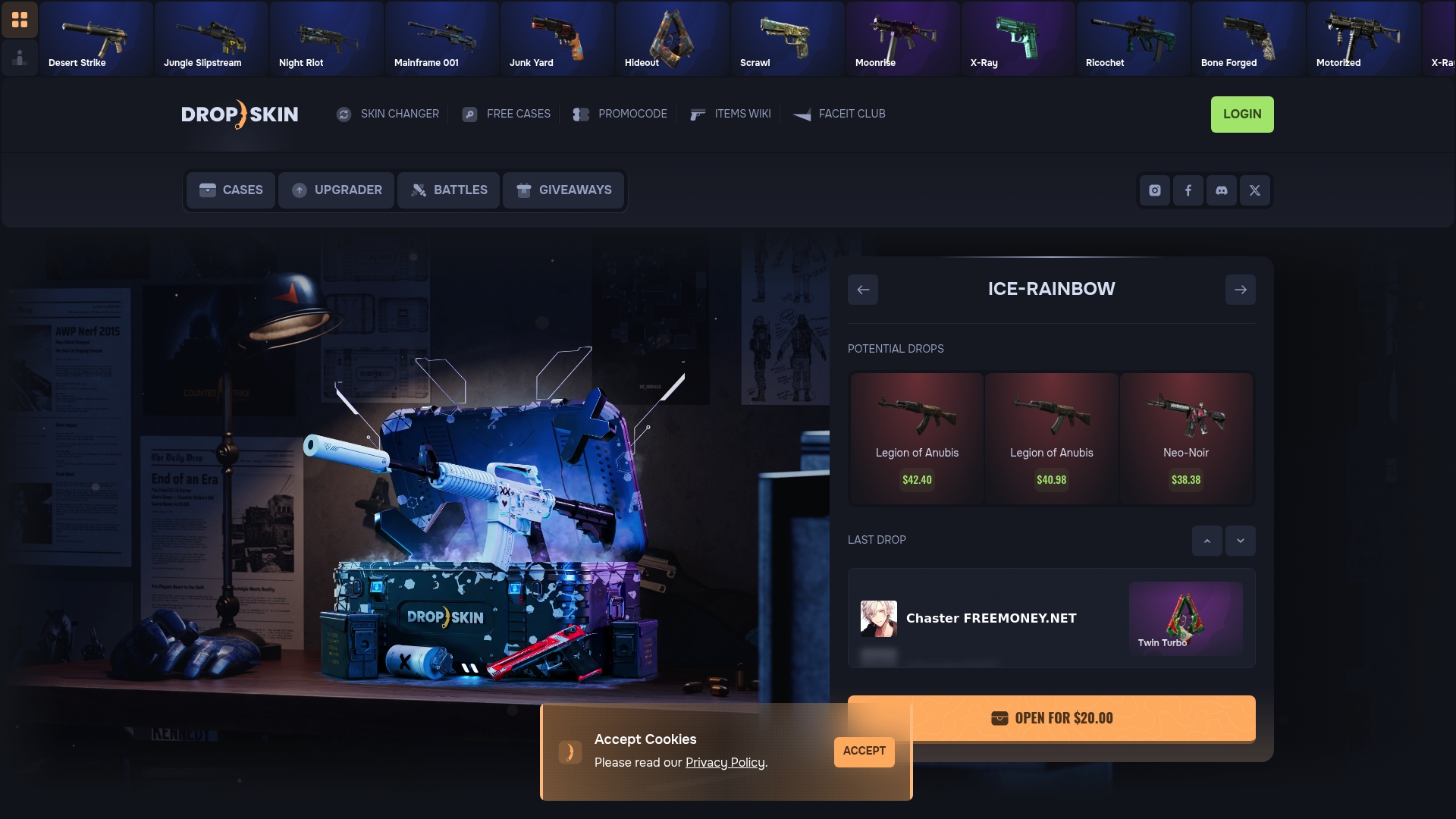
Case openings on Dropskin add specialty and niche skins to your collection at a fraction of the market price, which is exactly how the 10% specialty tier should be built. Giveaways and promo codes lower the cost of acquiring new pieces, freeing up capital for the anchor skins that hold your portfolio together. If you are ready to put the 60/30/10 framework into practice, Dropskin's tools are built for that exact process.
FAQ
What does it mean to diversify skin assets?
Diversifying skin assets means intentionally distributing your CS2 collection across stable anchor skins, growth-oriented items, and specialty pieces to balance risk and value. The goal is a portfolio that performs across different market conditions, not just one.
What is the 60/30/10 rule for skin portfolios?
The 60/30/10 rule allocates 60% of your portfolio to stable, high-liquidity anchor skins, 30% to growth items with appreciation potential, and 10% to rare or niche skins. This split balances steady value with upside exposure.
Why does liquidity matter more than rarity?
A rare skin with low trading volume cannot be sold quickly during a market correction. Professional collectors prioritize liquidity because the gap between a skin's listed price and its actual realized cash value determines real portfolio performance.
How often should I rebalance my skin portfolio?
Rebalancing quarterly is the standard practice. Market conditions shift fast enough that a skin's tier classification can change within a single operation cycle, and quarterly reviews catch those shifts before they damage your allocation.
What is the biggest mistake collectors make when diversifying?
The most common mistake is owning redundant assets across the same category instead of selecting one strong option per tier. Redundancy dilutes portfolio value without adding variety, liquidity, or identity.