TL;DR:
- Luck exclusively determines every skin gambling outcome through RNG, making skillless chance the dominant factor.
- Managing exposure, choosing transparent platforms, and setting limits are essential strategies players use to mitigate luck's psychological and financial impacts.
Luck is the single governing force behind every skin gambling outcome, from CS2 case openings to coinflip battles and jackpot rounds. No amount of game sense, market knowledge, or pattern recognition changes what a random number generator (RNG) produces on any given spin or draw. The role of luck in skin gambling is absolute at the moment of the outcome, yet the decisions surrounding that moment, such as platform choice, bankroll size, and exit strategy, are where informed players separate themselves from impulsive ones. This guide breaks down the mechanics, psychology, legal debates, and practical strategies every CS:GO and CS2 skin collector needs to understand.
How does randomness work in skin gambling?
Skin gambling outcomes are determined entirely by RNG, where players wager skins and wins derive from chance rather than skill. The RNG is a computational system that produces statistically unpredictable results on every event, whether that event is a roulette wheel spin, a jackpot pot draw, or a case opening animation. Understanding how each format uses RNG clarifies exactly where luck operates and where it does not.
The most common skin gambling formats each rely on randomness in a distinct way:
- Roulette: Players deposit skins or credits and bet on color outcomes. The RNG selects the result independently of bet size or timing.
- Coinflip: Two players wager skins of roughly equal value. A random draw determines the winner, giving each side close to a 50% probability.
- Jackpot: Multiple players deposit skins into a shared pot. The winner is selected proportionally by total value deposited, but the draw itself is random.
- Case openings: Players pay a fixed price to open a case containing skins at disclosed rarity tiers. The specific skin received is determined by RNG within those tiers.
Skins carry real market value and flow freely between in-game inventories and third-party gambling ecosystems, which is what makes randomized outcomes financially meaningful rather than purely cosmetic. A player who opens a case and receives a StatTrak AK-47 Redline can sell it on the Steam Community Market or trade it on external platforms. That convertibility is what gives luck its economic weight in this space.
Pro Tip: Check whether a platform publishes its RNG seed or hash before you play. Sites that expose pre-committed seeds allow you to verify each result independently, which is the only way to confirm the randomness is genuine and not manipulated.

Case opening odds are disclosed by Valve for official CS2 cases, but disclosure does not make outcomes predictable. Knowing a Covert skin drops at roughly 0.64% probability tells you the long-run frequency, not when your next opening will hit. That gap between known odds and unknown timing is precisely where the gambling luck factor lives.
What psychological effects does luck have on skin gamblers?
The psychological impact of randomized rewards on skin gamblers goes well beyond simple excitement. A study of 433 Polish gamers found that riskier loot box use correlates positively with daily spending, immersion, craving, and gaming disorder symptoms, while correlating negatively with self-control. This means the more a player engages with luck-based skin rewards, the weaker their behavioral brakes tend to become.
Four psychological mechanisms drive this pattern:
- Variable-ratio reinforcement: Skin gambling platforms deliver rewards on unpredictable schedules, which creates anticipation and entices repeated engagement far more effectively than fixed-reward systems. Slot machines use the same principle.
- Flow and immersion: The visual and audio design of case opening animations pulls players into a focused state where time distortion occurs and rational cost assessment weakens.
- Craving cycles: After a near-miss or a small win, dopamine activity increases the desire to repeat the behavior, even when the player consciously knows the next outcome is statistically independent.
- Perceived luck rituals: Many players develop superstitions around timing, server selection, or account age. These rituals have zero effect on RNG but increase emotional investment and session length.
"High-risk loot box use is less about winning the next outcome and more about immersion, craving, and weakened goal maintenance impacting player control." — When Gaming Becomes Like Gambling
Skin gambling risks are also heightened for younger players and frequent users, where peer pressure and the social status attached to rare skins increase susceptibility to problem gambling behaviors. The desire to show off a Karambit Doppler or an AWP Dragon Lore is a social motivator that compounds the purely financial one, making the psychological pull of luck even stronger for this demographic.
How do legal definitions shape the role of luck in skin gambling?
Legal frameworks interpret luck in skin gambling through the lens of three core gambling elements: stake, risk, and prize. Whether a skin gambling activity qualifies as illegal gambling under any jurisdiction depends on how regulators define those three terms in the context of virtual items.
| Perspective | Position on luck and gambling | Key argument |
|---|---|---|
| Valve's legal stance | Loot boxes are deterministic transactions | Odds are disclosed; players always receive one skin; skins cannot be cashed out directly for money |
| Critics and regulators | Randomized outcomes with resale value constitute gambling | Third-party markets convert skins to cash, creating real financial risk |
| Player experience | Luck feels identical to gambling regardless of legal framing | Emotional and financial stakes are real even if legal classification is disputed |
Valve argues that loot box openings are deterministic transactions with disclosed odds and no legal risk or stake, contesting the classification of skin gambling as illegal gambling under New York law. The company's position rests on the fact that Steam Wallet credit, not cash, is the only official redemption path for sold skins. Critics counter that the existence of third-party trading sites and skin cash-out services renders that distinction meaningless in practice.
The legal debate hinges on a definitional question: does luck become gambling only when a cash prize is possible, or does the presence of randomized outcomes with real economic value suffice? Different jurisdictions answer this differently. Belgium and the Netherlands have classified loot boxes as gambling. The United States has not reached a federal consensus. For CS2 players, the practical implication is that the regulatory environment around skin betting odds and outcomes remains inconsistent and subject to change.
Pro Tip: Before depositing skins on any third-party platform, verify the site's licensing status and jurisdiction. A platform operating without a gambling license in a regulated market carries legal and financial risk that no lucky outcome can offset.
What strategies help players manage luck in skin gambling?
Players cannot influence RNG outcomes, but they can strategically manage their skin portfolio by selecting when and how to enter or exit gambling markets to reduce losses and optimize expected value. The distinction matters. Luck vs skill in gambling is not a binary choice. Skill operates in the decisions surrounding the random event, not inside it.
Practical strategies that experienced CS2 skin gamblers use include:
- Set a hard session budget before opening any case or entering any pot. Decide the maximum value of skins you are willing to lose before you start, and treat that number as a withdrawal limit, not a suggestion.
- Track your actual return rate over time. Most players overestimate their win rate because memorable wins anchor memory more strongly than losses. A simple spreadsheet tracking deposits and withdrawals reveals the real picture.
- Avoid chasing losses with tradable wins. Winning skins that are immediately tradable amplify bankroll and accelerate engagement loops, increasing the risk of re-entering gambling cycles before rational assessment occurs. Cash out or trade out after a significant win rather than reinvesting immediately.
- Choose platforms with provably fair systems. Without verifiable RNG, luck claims are trust-based and unverifiable. Platforms that publish pre-committed hashes give you the ability to audit results after the fact.
- Use skin upgrades as a controlled alternative. Upgrading a lower-value skin toward a higher-value target has a defined probability and a defined cost, making it easier to model expected value than open-ended jackpot formats.
Pro Tip: Treat bankroll management as your primary skill in skin gambling. The RNG decides the outcome, but you decide how much exposure you carry into each session. That decision is entirely within your control.
The impact of chance in gambling is permanent and irreducible. No strategy eliminates it. What strategy does is reduce the financial and psychological damage that variance can cause over a long session or a long career of skin betting.
Key takeaways
Luck governs every skin gambling outcome through RNG, and the only real skill is managing your exposure, platform choice, and psychological response around that fixed randomness.
| Point | Details |
|---|---|
| RNG controls all outcomes | Coinflip, jackpot, roulette, and case openings are all determined by random number generators with no skill input. |
| Psychology amplifies risk | Variable-ratio reinforcement and craving cycles make luck-based rewards psychologically addictive beyond their financial value. |
| Legal status is contested | Valve frames loot boxes as deterministic; critics argue resale markets create real gambling stakes. |
| Strategy lives outside the RNG | Bankroll limits, provably fair platforms, and exit rules are where informed players exercise actual control. |
| Younger players face higher risk | Peer pressure and social status tied to rare skins increase susceptibility to problem gambling behaviors in younger demographics. |
Dropskin's take on luck and skin gambling
The community conversation around luck in skin gambling tends to fall into two camps. One camp insists skill can beat the RNG if you study patterns long enough. The other dismisses skin gambling entirely as pure chance with no strategic dimension. Both positions miss the real picture.
What we have observed across thousands of case openings and skin upgrade sessions is that the players who sustain their hobby longest are not the luckiest. They are the most disciplined about separating the random event from the surrounding decisions. They set session limits before they open the platform. They withdraw wins rather than recycling them immediately. They choose sites with transparent RNG rather than trusting a flashy interface.
Luck perception is also worth examining honestly. Players who feel "on a streak" are experiencing a cognitive illusion, not a statistical reality. The RNG has no memory of your last ten openings. Rituals, timing, and account history do not move the odds by a single decimal point. Recognizing that clearly does not make skin gambling less entertaining. It makes it safer, because you stop chasing a pattern that does not exist.
The psychological design of skin gambling interfaces is genuinely sophisticated. The animations, sound effects, and near-miss visuals are not accidental. They are engineered to heighten the sense that luck is just about to turn in your favor. Knowing that mechanism exists is the first step toward not being controlled by it. Play for the entertainment value. Set your limits. And never mistake a hot streak for a skill advantage.
— DROPSKIN
Try skin gambling with full transparency at Dropskin
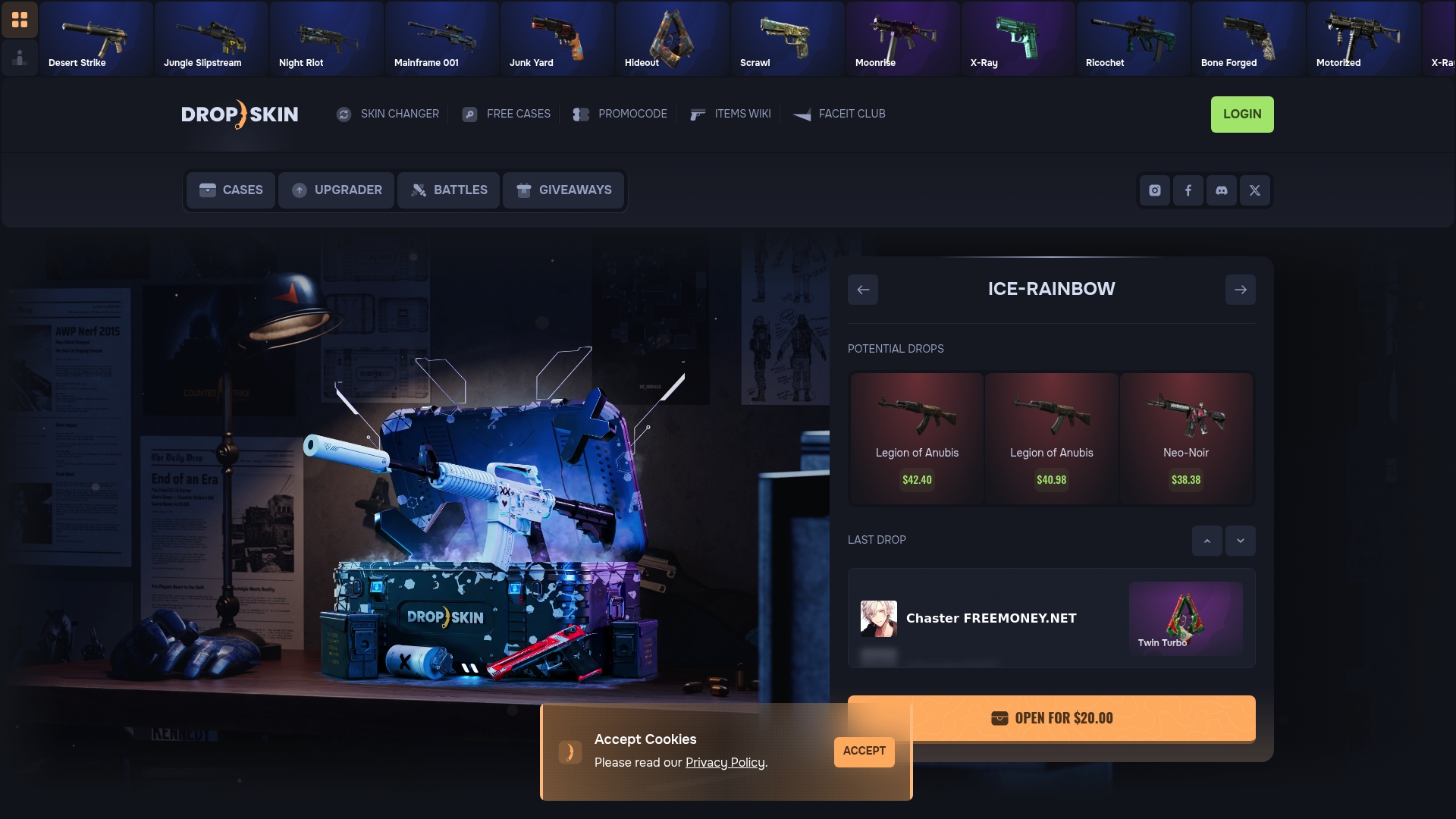
Dropskin gives CS:GO and CS2 players a platform where the mechanics behind every outcome are clear before you commit a single skin. Open CS2 cases with disclosed odds, use the skin upgrader to target specific value tiers with defined probabilities, and explore case battles where you set the stakes and fight for rewards on your terms. Every feature is built for players who want the excitement of randomized rewards without the opacity that makes luck feel like a trap. Use Dropskin's skin upgrader tool to convert lower-value skins into higher-value targets at a probability you can calculate in advance. Check out Dropskin's giveaways and promo codes to extend your session budget without increasing your financial exposure.
FAQ
Does luck matter in skin gambling?
Luck is the only factor that determines the outcome of any skin gambling event, including case openings, coinflip, roulette, and jackpot formats. RNG produces each result independently of player behavior, timing, or history.
Can skill improve your results in skin betting?
Skill does not influence RNG outcomes, but it does govern the decisions surrounding each bet, including bankroll management, platform selection, and exit strategy. Players who manage variance effectively lose less over time even though they cannot change individual results.
What are provably fair systems in skin gambling?
Provably fair systems use pre-committed cryptographic hashes or seeds that players can verify after each result to confirm the RNG was not manipulated. Sites that publish these hashes provide the only objective evidence of genuine randomness.
How does randomness in skin betting affect problem gambling risk?
Variable-ratio reinforcement schedules in skin gambling create craving and repeated engagement that correlate with gaming disorder symptoms, particularly in players who spend heavily or gamble daily. Setting hard session limits before playing is the most effective behavioral safeguard.
Are CS2 loot boxes legally considered gambling?
The legal status varies by jurisdiction. Valve argues loot boxes are deterministic transactions with disclosed odds and no direct cash prize, but Belgium and the Netherlands have classified similar mechanics as gambling due to the real economic value of skins on secondary markets.