
Most Counter-Strike 2 players confuse case collections with the cases themselves, missing crucial insights that could transform their trading strategies and skin values. A case collection refers to the themed set of weapon skins contained within a specific case, not the container you open. This distinction matters because understanding collections unlocks strategic advantages in Trade Up Contracts, helps you identify valuable archived cases, and reveals why opening cases often destroys value while targeted trading builds it. This guide breaks down everything you need to know about CS2 case collections, from basic definitions to advanced profit strategies.
Table of Contents
- Understanding CS2 Case Collections And Cases
- Categories And Rarity: How Cases Affect Skin Availability And Value
- Trade Up Contracts: Maximizing Value With Single-Collection Skins
- Balancing The Thrill And Economics Of CS2 Case Openings
- Discover Premium CS2 Case Openings And Skin Upgrades
- What Is A CS2 Case Collection?
Key takeaways
| Point | Details |
|---|---|
| Collections vs cases | A collection is a themed skin set; a case is the container that holds one collection's skins |
| Trade Up advantage | Using 10 skins from the same collection in Trade Up Contracts gives you control over output rarity upgrades |
| Case rarity impacts value | Prime, Rare, Archived, and Limited cases have different drop rates affecting skin availability and market prices |
| Opening has negative ROI | Average case opening returns 70% to 90% loss; buying skins directly or trading is more cost effective |
| Hold rare cases | Archived and limited cases appreciate over time since they no longer drop in game |
Understanding CS2 case collections and cases
Grasping the terminology prevents costly mistakes. CS2 case collections refer to the themed sets of skins contained within specific weapon cases in Counter-Strike 2. Each case unlocks skins exclusively from its associated collection, such as the Falchion Case containing the Falchion Collection. When you open a case, you receive one random skin from that case's linked collection based on rarity percentages.
The confusion arises because players often use "case" and "collection" interchangeably. Collections differ from cases: a collection is a broader set of thematically linked skins released together, while cases are containers that typically hold one collection's skins. Some collections exist without cases, like Armory or souvenir collections. Understanding this separation helps you navigate the marketplace intelligently and build a strategic skin collection based on value rather than impulse.
Here's what you need to remember:
- Collections group thematically similar skins released as a set
- Cases act as loot boxes containing one collection's items
- Not all collections have associated cases
- Each case links to a specific collection for predictable outputs
This knowledge foundation prepares you for smarter decisions when opening cases, executing trade ups, or investing in skins for long term appreciation.
Categories and rarity: how cases affect skin availability and value
Case classification determines how often skins appear and their eventual market value. Cases are categorized as Prime, Rare, Archived, and Limited, each with distinct drop mechanics. Prime cases drop regularly for Prime status players and include 2026 additions like Kilowatt, Revolution, and Recoil cases. Rare cases have approximately 1% drop chance, making their contents more valuable due to scarcity. Archived cases no longer drop in game and exist only through trading or Steam Market purchases. Limited cases tied to operations have restricted availability windows.
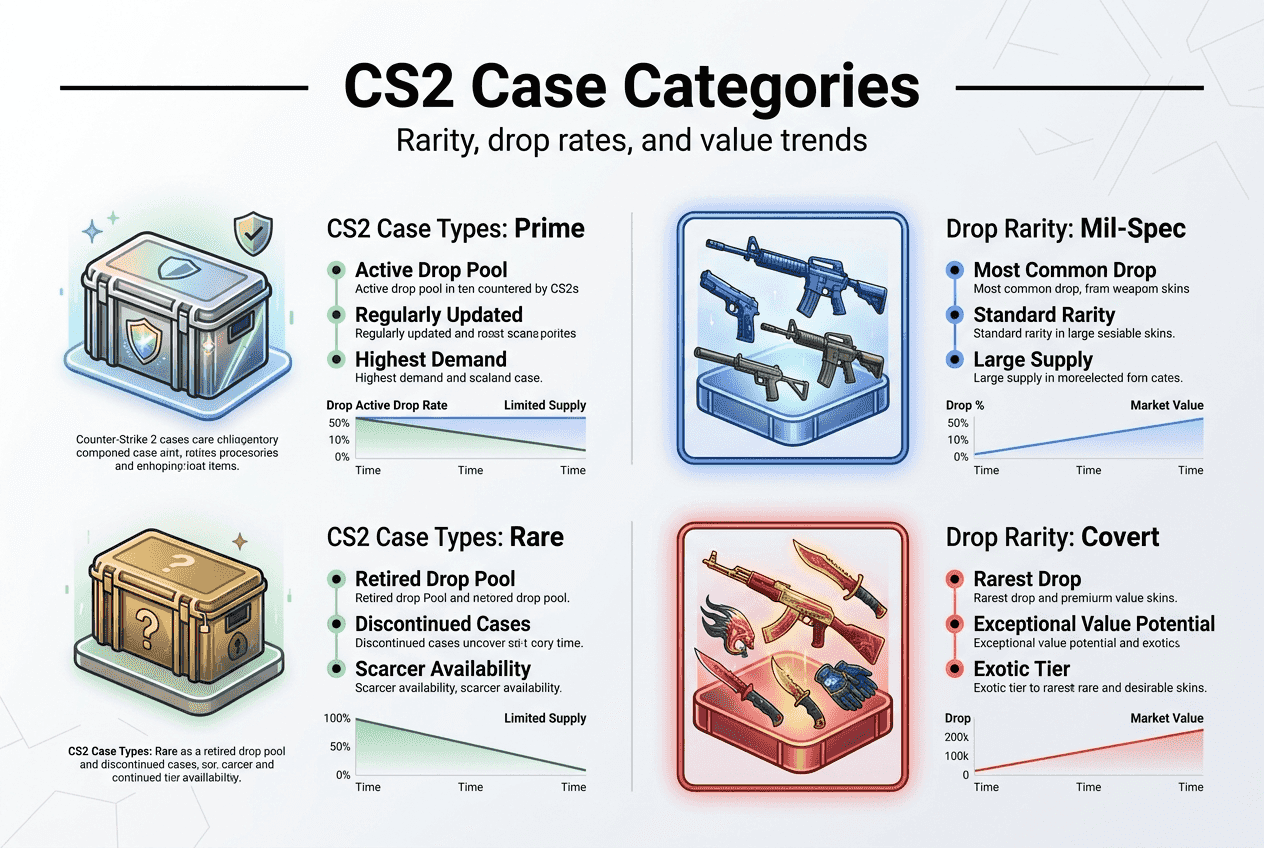
Rarity tiers within cases follow strict probability distributions. Case opening drop rates show Mil-Spec at 79.92%, Restricted at 15.98%, Classified at 3.2%, Covert at 0.64%, and Gold knives or gloves at 0.26%, roughly one in 385 cases. These percentages create predictable scarcity that drives skin pricing. A Covert skin from an archived case commands premium prices because both the case and the high rarity tier are scarce.
Here's how case categories stack up:
| Category | Drop Rate | Availability | Value Trend |
|---|---|---|---|
| Prime | Common for Prime users | High supply | Stable, lower |
| Rare | ~1% drop chance | Medium supply | Moderate appreciation |
| Archived | No drops | Limited, declining | Strong appreciation |
| Limited | Operation specific | Time restricted | Variable, often high |
The return on investment from opening cases tells a harsh story. Average ROI ranges from negative 70% to negative 90%, meaning you lose most of your investment. Buying specific skins directly costs less than gambling for them through case openings. The math favors targeted purchases over random chance.
Pro Tip: Focus on archived and rare cases for holding investments. Their declining supply against steady demand creates natural price appreciation, especially for cases containing popular collections with desirable Covert or Gold tier skins.
Explore the full CS2 case collection catalog to identify which cases align with your collecting or trading goals based on rarity and current market trends.
Trade Up Contracts: maximizing value with single-collection skins
Trade Up Contracts offer the most controllable path to upgrading skin value. Skins from the same collection are required: 10 skins of identical rarity from one collection yield a higher rarity skin from that collection. The output skin's float value follows a formula: maximum float minus minimum float, multiplied by average input float, plus minimum float. This calculation lets you predict wear condition outcomes when you choose inputs carefully.
Single collection trade ups give you precise control. If you input 10 Mil-Spec skins from the Falchion Collection, you're guaranteed a Restricted skin from that same collection. Mixing collections creates unpredictable outputs from multiple possible results, diluting your control and often reducing profit potential.
Follow these steps for profitable trade ups:
- Identify a collection with a valuable Covert or Classified skin you want to target
- Purchase 10 identical rarity skins from that collection at low market prices
- Calculate expected output float using the formula to predict wear
- Execute the Trade Up Contract through your CS2 inventory
- Sell the upgraded skin when market conditions favor higher prices
Real world example: buying 10 Mil-Spec skins from the Gamma Collection at $0.50 each costs $5 total. Trading up yields a Restricted skin valued at $8 to $12, netting $3 to $7 profit after Steam Market fees. Scaling this strategy across multiple collections builds consistent returns.
Pro Tip: Research which collections have the best value gaps between input and output rarities. Some collections offer 200% to 400% returns on successful trade ups, while others barely break even due to oversupply of higher tier skins.
Master the mechanics through our complete trading guide and apply advanced collecting strategies to maximize every trade up opportunity.
Balancing the thrill and economics of CS2 case openings
Case opening delivers entertainment but rarely delivers profit. The psychological rush of watching the spin and hoping for a rare drop keeps players engaged, yet the economics tell a different story. Opening for thrill accepts negative expected value as the cost of entertainment, while trading or buying for profit offers safer returns through liquid markets like Buff163 or Skinport. Prime drops provide free cases weekly but limit your ability to target specific collections or skins.
The statistics reinforce buying over opening. With Mil-Spec drops at 79.92% and Gold items at 0.26%, you'll open hundreds of cases before hitting a valuable knife or glove. Meanwhile, direct purchases let you acquire exactly the skins you want at current market rates, avoiding the gambling variance entirely. Case opening becomes a luxury expense, not an investment strategy.
Compare your options:
| Method | Cost Control | Value Certainty | Entertainment | Profit Potential |
|---|---|---|---|---|
| Case Opening | Low | Very Low | High | Negative 70% to 90% |
| Direct Purchase | High | Very High | Low | Neutral, market dependent |
| Trading | Medium | High | Medium | Positive 10% to 50% |
| Trade Up Contracts | High | Medium | Medium | Positive 50% to 200% |
Smart players separate entertainment spending from investment capital. Allocate a small budget for case opening fun, treating it like buying a movie ticket. Use the majority of your skin budget for strategic purchases, trade ups, and holding valuable archived cases that appreciate over time.
Key considerations:
- Set a strict entertainment budget for case openings
- Never chase losses by opening more cases to recover value
- Track your actual ROI across all case openings to see real costs
- Prioritize buying specific skins when you want guaranteed results
- Use free Prime drops as bonus opportunities without additional spending
Discover why case opening remains popular despite negative returns, and learn how to leverage promotional opportunities to offset costs when you do decide to open cases for entertainment.
Discover premium CS2 case openings and skin upgrades
Now that you understand case collections, rarity mechanics, and trade up strategies, put that knowledge into action. DROP.SKIN provides a trusted platform where you can open CS2 cases and upgrade skins with transparency and fair odds. Whether you're hunting for that elusive Covert skin or testing trade up theories, the platform offers controlled environments to execute your strategies.
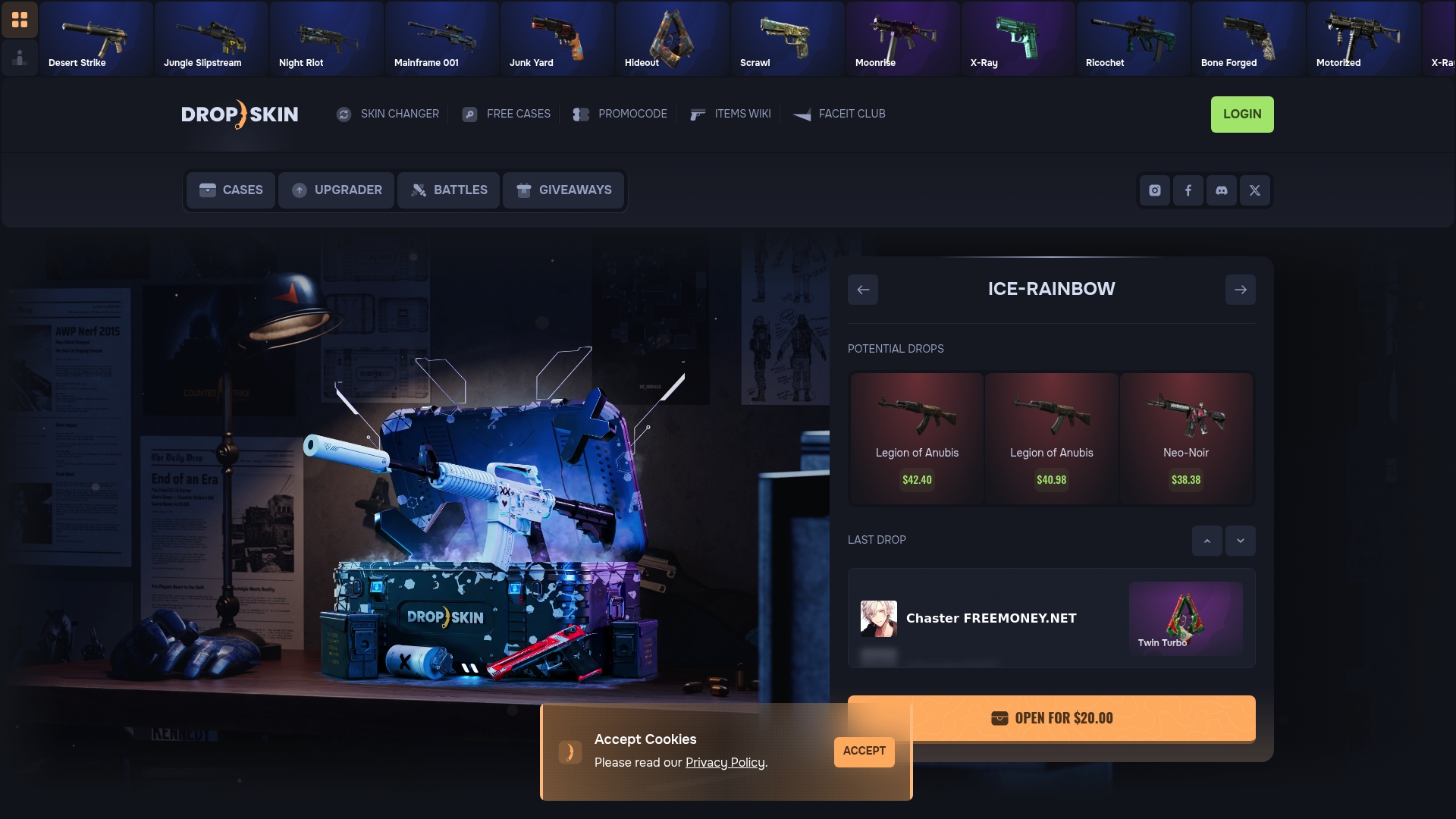
The CS2 skin upgrader lets you transform lower value skins into premium items using the same collection based logic covered in this guide. You'll find extensive case collections, promotional opportunities, and community features that support both casual enjoyment and serious collecting. Apply what you've learned about single collection trade ups, case rarity, and value optimization through a platform designed for gamers who want more control over their CS2 skin investments.
What is a CS2 case collection?
A CS2 case collection is a themed set of weapon skins found exclusively inside a specific case in Counter-Strike 2. Each collection groups skins with similar visual themes or design elements, released together as a cohesive set. Collections are distinct from cases, which act as containers for those skins. Understanding this difference helps you make informed decisions about which cases to open, which skins to trade, and how to execute profitable Trade Up Contracts that require matching collection skins.
How do Trade Up Contracts work in CS2?
Trade Up Contracts combine 10 skins of identical rarity from the same collection to yield one higher rarity skin from that collection. This process allows players to upgrade skins strategically rather than relying on random case openings. The output skin's wear condition depends on the average float value of your 10 input skins, calculated using a specific formula. Successful trade ups can generate 50% to 200% returns when you target collections with valuable output skins and buy input skins at low market prices.
Are CS2 case openings profitable?
Opening CS2 cases has a negative expected value, with average ROI ranging from negative 70% to negative 90%. The extreme rarity of Gold tier items at 0.26% drop rate means you'll likely receive common Mil-Spec skins worth less than the key cost. Buying skins directly or trading is generally a safer, more profitable approach that guarantees you get exactly what you want at known prices. Some players open cases for entertainment rather than profit, treating the cost as an expense for the thrill of the spin rather than an investment strategy.
What are archived and limited cases?
Archived cases are discontinued and no longer drop in game, available only via Steam Market or peer to peer trading. Their supply shrinks over time as cases get opened and removed from circulation, driving prices upward. Limited cases include operation specific releases with restricted availability windows, creating artificial scarcity. Both types tend to appreciate in value over time, making them attractive for collectors and investors who hold cases unopened as speculative assets rather than opening them for skins.