TL;DR:
- The CS2 skin market has experienced extreme volatility, with large swings in market cap and value.
- Regulatory changes, Valve updates, and platform fees greatly influence skin prices and trading strategies.
- Trading with data discipline and investing in blue-chip skins outperform gambling for long-term value.
The CS2 skin market isn't the guaranteed gold rush many players assume it is. In October 2025, market cap hit $6B before a single update wiped out $1.8 billion in value within 24 hours. That kind of swing separates players who understand market dynamics from those who get burned chasing hype. Whether you're into skin gambling, trading, or just trying to build a collection that holds value, knowing what's actually driving the market in 2026 is no longer optional. This article breaks down the real trends, regulatory shifts, and strategies that matter.
Table of Contents
- The evolution of skin gambling markets
- Skin gambling's role and regulatory pressures
- Strategies for maximizing your skin value
- Market nuances and expert tactics for 2026
- Why trading outperforms gambling for skin value
- Elevate your trading and skin upgrade experience
- Frequently asked questions
Key Takeaways
| Point | Details |
|---|---|
| Market volatility insights | Major swings driven by platform updates and regulation affect skin prices and gambling volumes. |
| Trading beats gambling | Trading skins delivers higher, predictable returns compared to betting, with less house edge. |
| Diversify with blue-chips | Investing in blue-chip skins and using low-fee platforms helps you maximize long-term skin value. |
| Regulations impact strategy | Recent bans and policy shifts shape how—and where—you can trade and bet skins safely. |
| Chinese market drives trends | Demand from China on Buff163 creates volatility and unique trading opportunities for savvy players. |
The evolution of skin gambling markets
The CS2 skin market has gone through a wild ride since 2024, and most players still don't fully grasp the scale of what happened. The market cap fluctuated between $6 billion and $4.2 billion throughout 2025, eventually stabilizing in the $4.5 to $5 billion range. That's not a minor correction. That's the kind of volatility you'd expect from emerging tech stocks, not cosmetic items in a video game.
What's driving this? Valve updates are the single biggest factor. When the developer changes how skins enter or exit the supply chain, prices react fast. High-end knives and gloves are especially sensitive because their supply is tightly capped and demand is emotional, not just functional. A single patch can shift a $3,000 knife's value by hundreds of dollars overnight.
Beyond volatility, something more interesting is happening. The skin market is maturing into a legitimate investment asset class, with blue-chip skins outperforming the S&P 500 over multi-year periods. That's not marketing spin. That's a data-backed reality that serious collectors and traders are already acting on. If you want to understand what makes a skin hold or grow in value, our skin value factors guide covers the fundamentals.
| Year | Market cap peak | Market cap low | YoY trading volume growth |
|---|---|---|---|
| 2023 | $3.1B | $2.4B | +18% |
| 2024 | $4.8B | $3.6B | +27% |
| 2025 | $6.0B | $4.2B | +34% |
"The CS2 skin market has quietly built a shadow economy larger than most casinos, with annual trading volumes now rivaling mid-sized financial markets."
Here's why the market stays volatile even as it matures:
- Valve policy changes can instantly alter supply and pricing with no warning
- Regulatory pressure from governments targeting skin gambling creates uncertainty
- Supply shocks from new case releases or Trade Up rule changes flood the market
- Speculative demand from new players entering during esports hype cycles inflates prices temporarily
- Platform fee differences across Steam, Buff163, and CSFloat affect where volume concentrates
For a deeper look at how collecting strategy fits into all of this, the esports skin collecting guide is worth your time.
Skin gambling's role and regulatory pressures
Skin gambling isn't just buying cases. It covers a wide ecosystem: third-party betting sites, case battles, crash games, roulette, and jackpot formats. Each carries its own risk profile, and the regulatory landscape around all of them is shifting fast.

The biggest regulatory move came in December 2025. Valve officially banned skin gambling promotions at official CS2 tournaments, cutting off a major marketing pipeline for third-party betting platforms. Sponsorships, stream integrations, and on-site promotions at Valve-sanctioned events are now off the table. This doesn't shut down gambling sites, but it changes how they reach new players.
| Factor | Pre-2025 | Post-ban (2026) |
|---|---|---|
| Tournament sponsorships | Widely allowed | Banned by Valve |
| Skin betting site visibility | High | Reduced significantly |
| Regulatory scrutiny | Moderate | Increasing globally |
| Player awareness of risk | Low | Growing |
The esports gambling market is projected at $2.8 billion in 2025, with CS2 accounting for a major share. But volume is shifting toward platforms with stronger transparency and provably fair systems as players get smarter about where they put their skins.
Here's how the regulatory picture has evolved:
- 2023: Several European countries classify skin gambling as real-money gambling, requiring licenses
- 2024: UK Gambling Commission increases pressure on unlicensed skin betting operators
- 2025 Q2: Multiple platforms exit regulated markets to avoid compliance costs
- 2025 Q4: Valve bans tournament-level gambling promotions and sponsorships
- 2026: Regional enforcement tightens; players in some markets lose access to major platforms
Understanding how skins influence your overall gameplay experience matters too. Our breakdown of skin betting influence covers the psychological and strategic side. And if you want to know how promos can work in your favor, the skin promo profits guide is practical reading.
Pro Tip: Always prioritize platforms with provably fair systems. These use cryptographic verification so you can confirm every outcome wasn't manipulated. It's the single best way to reduce your exposure to rigged house edges.
Strategies for maximizing your skin value
Knowing the market and regulatory landscape is step one. Knowing how to act on that knowledge is what separates profitable players from everyone else.
Trade Up contracts are one of the most underused tools in the CS2 economy. When executed correctly, Trade Up contracts can deliver ROI between 20% and 50%. The key is selecting input skins carefully: you need consistent float values, the right collection, and a target output skin with strong market demand. Most players rush this and lose value instead of gaining it.
Blue-chip skins are the long-term play. Knives, gloves, and rare StatTrak items from older collections have historically appreciated 15 to 30% annually, and 2026 projections continue that trend for the top tier. These aren't skins you flip quickly. They're skins you hold.
Platform fees eat into your profits more than most players realize. Fee structures vary widely: Steam charges 15%, Buff163 charges around 2.5%, and CSFloat sits at approximately 2%. On a $500 skin, that's a $75 loss on Steam versus a $12.50 loss on CSFloat. Over time, that gap is enormous.
Here's a quick comparison of platform fee impact on a $500 skin sale:
| Platform | Fee | Net received |
|---|---|---|
| Steam | 15% | $425 |
| Buff163 | 2.5% | $487.50 |
| CSFloat | 2% | $490 |
For building a skin portfolio, consider allocating 40 to 50% of your budget to blue-chip skins and keeping the rest liquid for opportunities. Concentrated bets on single skins or collections are how players get wiped out during flash crashes. Our skin collecting tips and skin demand drivers guides go deeper on portfolio construction.
Top strategies for maximizing skin value:
- Use Trade Up contracts only after calculating expected value on every input skin
- Hold blue-chip skins through short-term dips rather than panic-selling
- Sell on low-fee platforms whenever possible to protect margins
- Diversify across weapon types and collections to reduce crash exposure
- Track float values closely since low-float skins command significant premiums
Pro Tip: Before any trade, calculate your expected value. Take the probability of each outcome, multiply by its value, and compare to your input cost. If the math doesn't work, the trade doesn't work. Emotion is the enemy here.
Market nuances and expert tactics for 2026
The core strategies above work. But the players who consistently outperform understand the nuances that most guides skip over.
The October 2025 Trade Up update is the clearest example. Valve allowed knives and gloves to be used in Trade Up contracts for the first time. The result: a $1.8 billion crash in 24 hours as oversupply flooded the high-end market. Players holding concentrated positions in knives lost 20 to 40% of value overnight. Those with diversified portfolios absorbed the hit and recovered faster.
Liquidity matters more than most players acknowledge. A skin worth $800 on paper is worth nothing if you can't sell it when you need to. Prioritize skins with active trading volume on multiple platforms. Low-float skins in popular categories (AK-47, M4A4, AWP) tend to stay liquid even during downturns.
The Chinese Buff163 market deserves special attention. Chinese demand patterns often move independently of Western markets, creating arbitrage windows where the same skin trades at meaningfully different prices across platforms. Experienced traders monitor Buff163 pricing alongside Steam and CSFloat to spot these gaps.
"Skin upgrade bots and data-driven trading strategies consistently outperform gambling ROI when you account for house edge, variance, and long-term compounding."
Expert tactics for managing risk and volatility in 2026:
- Set price alerts on your key holdings so you can react quickly to sudden moves
- Never hold more than 30% of your portfolio in a single skin category
- Track Valve patch notes as closely as you track prices
- Use Buff163 pricing as a benchmark even if you don't sell there
- Treat skin gambling bankroll separately from your trading portfolio
For context on how CS2 skins differ from their CS:GO predecessors and why that matters for value, our CSGO vs CS2 skin changes breakdown is essential reading.
Pro Tip: Set up Google Alerts or follow CS2 community channels for policy news. Valve rarely announces changes in advance. Players who hear about updates first have a real edge in repositioning before the broader market reacts.
Why trading outperforms gambling for skin value
Here's a frank take: gambling is entertainment, not a value strategy. The house edge on most skin gambling platforms runs between 3% and 7%. That means every dollar you bet, you statistically lose 3 to 7 cents. Over hundreds of sessions, that compounds into real losses.
Trading, done with data and discipline, operates differently. Trading delivers predictable ROI when you apply supply analysis, float tracking, and fee optimization. It's not guaranteed, but the variance is manageable in a way that gambling variance simply isn't.
The market maturing into an investment asset class is the most important trend of the past two years. Players who adopt a portfolio mindset, treating their skin collection the way an investor treats a stock portfolio, are consistently outperforming those chasing jackpots. Our skin collecting mastery guide lays out exactly how to build that mindset.
Gambling has its place for entertainment. But if your goal is to maximize skin value over time, trading is the smarter vehicle.
Pro Tip: Adopt a portfolio mindset. Track your skin holdings the same way you'd track investments: entry price, current value, target exit price. This single habit will change how you make decisions.
Elevate your trading and skin upgrade experience
The strategies in this article are only as good as the platform you use to execute them. Dropskin.com gives you the tools to put these concepts into practice immediately, whether you're upgrading skins to higher-value tiers or opening cases to build your collection.
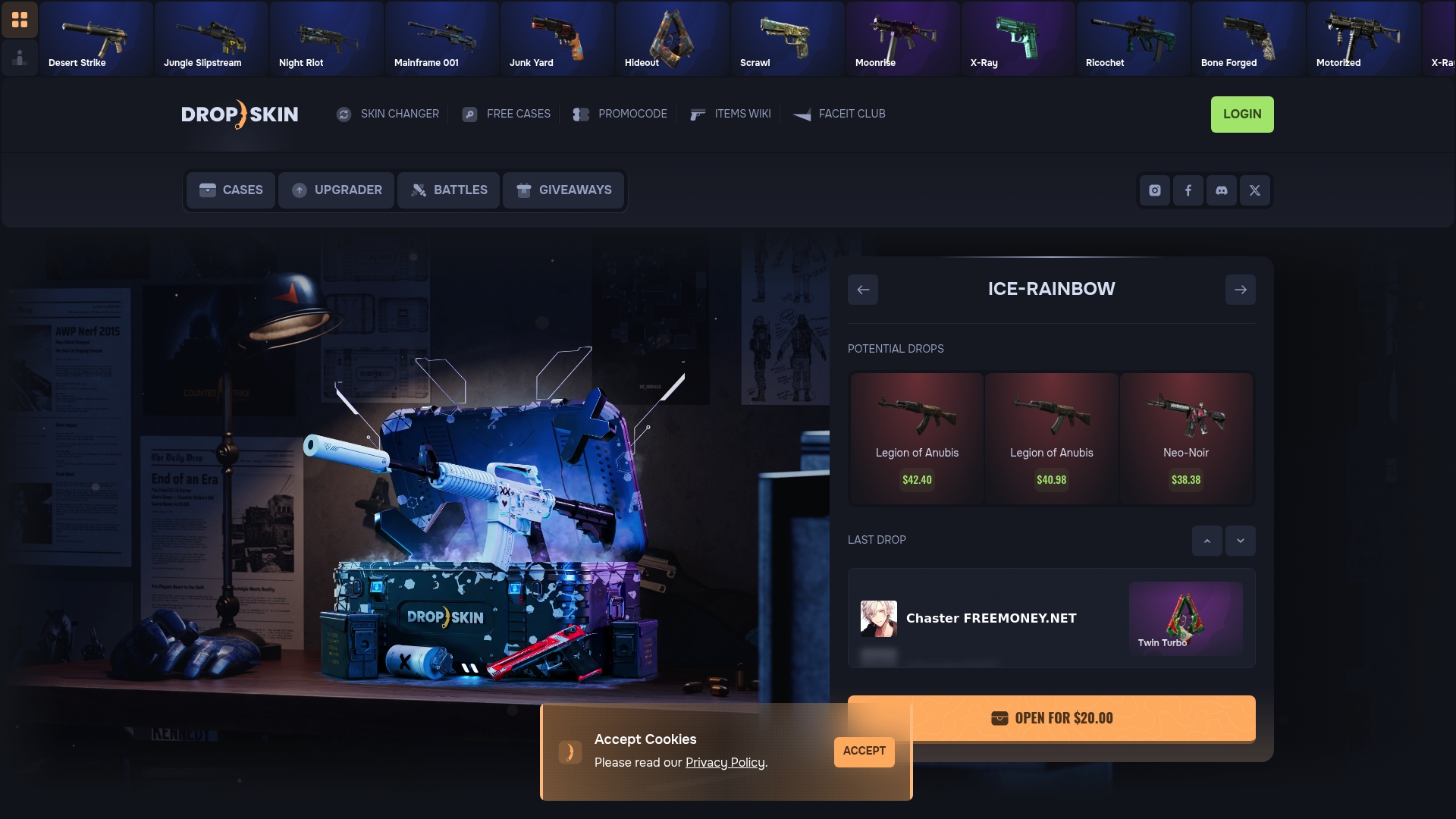
The skin upgrader lets you convert lower-value skins into premium ones using a transparent upgrade system built for players who want real value, not just luck. If you want to grow your collection from scratch, opening CS2 cases on Dropskin gives you access to an extensive case library with competitive odds. And if trading is your focus, the full trading platform connects you to a community of active skin traders. Start applying what you've learned today.
Frequently asked questions
What caused the CS2 skin market crash in late 2025?
Valve's Trade Up update allowed knives and gloves to be upgraded for the first time, causing oversupply and a market cap drop of $1.8 billion within 24 hours.
Are skin gambling sites still allowed in 2026?
Valve banned gambling promotions and sponsorships at official CS2 tournaments, but third-party real-money sites continue to operate with regulation varying by region.
What are the best strategies for maximizing skin value?
Trade Up contracts, blue-chip skin investing, low-fee platform selection, and portfolio diversification are the most effective approaches for consistent long-term gains.
How does the Chinese market influence CS2 skin gambling?
Demand and trading activity on Buff163 drive price volatility and create arbitrage opportunities, making Chinese players a significant force in global skin valuations.
What is the average ROI difference between trading and gambling skins?
Data-driven trading yields predictable ROI in the 20 to 50% range, while skin gambling carries a 3 to 7% house edge that compounds into losses over time.