
TL;DR:
- CS2 trade-ups offer traders greater control and profitability by applying calculated strategies rather than relying on luck or case openings.
- Understanding key metrics like expected value, collection timing, and float control is crucial for successful, data-driven trades across various risk levels.
CS2 trading offers far more control over your skin portfolio than most players realize. If you rely solely on case openings, you are leaving money on the table. Understanding real examples of CS2 trades changes that. Each trade-up contract is a math problem with a defined input cost, a set of possible outputs, and a calculable expected value. Get that math right, and you are no longer gambling blindly. You are investing. This guide breaks down three concrete, practical CS2 trade examples across different risk levels, so you can see exactly how each works and which fits your goals.
Table of Contents
- Key criteria for profitable CS2 trade-ups
- Example 1: Low-risk safe grind trade-up with Tec-9 Brother
- Example 2: High-risk, high-reward Karambit Doppler trade-up
- Example 3: Float manipulation master class with Printstream FN craft
- Comparing CS2 trade-up strategies: low risk vs. high risk vs. expert float manipulation
- Best practices for successful CS2 trading and avoiding common pitfalls
- The hidden truth about CS2 trade-ups: why most players lose and how to win
- Upgrade your CS2 skins and trade confidently with DROP.SKIN
- Frequently asked questions
Key Takeaways
| Point | Details |
|---|---|
| Understand expected value | Calculating expected value helps identify profitable CS2 trade-ups before investing. |
| Use float strategically | Input skin float influences output quality and potential profitability significantly. |
| Balance risk and reward | Choose trade-ups matching your risk tolerance from low-risk steady gains to high-risk jackpots. |
| Track and analyze trades | Maintain records to improve your trading decisions and avoid emotional losses. |
| Leverage reliable platforms | Using trusted services like DROP.SKIN ensures secure and efficient skin upgrades and trades. |
Key criteria for profitable CS2 trade-ups
To grasp practical trade examples, first understand which criteria make a trade profitable.
Not every trade-up is worth running. The ones that consistently make money share a few measurable characteristics that separate disciplined traders from players who drain their inventory chasing upgrades.
Expected value (EV) is the single most important metric. TAKE.SKIN experts stress the formula Σ(Prob × Price) minus Input Cost, meaning you multiply each possible outcome's probability by its market price, sum those results, then subtract what you paid for your inputs. If that number is positive, the trade is worth running over time.
Here are the core criteria to check before any trade-up:
- EV calculation: Always run the numbers before buying inputs. A positive EV does not guarantee a win on every attempt, but it means profitability over a series of trades.
- Collection timing: Targeting new skin collections before prices stabilize is a real edge. Output prices are still high while sellers are still pricing input skins low.
- Float value: The wear level of your input skins directly determines the output skin's float range, which affects how the skin looks and what it sells for.
- StatTrak versions: StatTrak skins carry roughly 150% price markups. If a trade-up can output a StatTrak Factory New skin, even a low probability of hitting one can flip the EV sharply positive.
Pro Tip: Before buying any input skin, check the collection's output skin prices on the Steam Community Market. If the cheapest output is worth less than your input cost, stop right there.
Example 1: Low-risk safe grind trade-up with Tec-9 Brother
Let's explore a concrete safe example illustrating how to apply these criteria in practice.
This is the trade-up for players who want steady, repeatable gains without sweating a potential big loss. It is the kind of setup that works for building a CS2 skin collection methodically over weeks.
The setup:
- Collect 10x Tec-9 | Brother (Field-Tested) from the Fracture Collection
- Target an average input float between 0.15 and 0.20 for the best output results
- Aim for a total input cost of approximately $5.20
- Submit the trade-up contract and receive one Classified skin from the Fracture Collection
Why this works:
- The Fracture Collection is a guaranteed 100% output pool, meaning all outputs come from that same collection
- There are three Classified skin possibilities in the pool, and CSDelta's 2026 guide details that this specific contract produces positive expected value with those three output chances
- At a $5.20 input cost, even the lowest-value Classified output frequently exceeds break-even
- The float targeting (0.15 to 0.20 average) keeps outputs in Field-Tested condition, which is the most liquid wear tier for mid-range skins
Stat to know: This contract produces 100% Fracture Collection outputs with three Classified possibilities, making the outcome distribution completely predictable.
This is the entry point most experienced traders recommend. Run it enough times and you see the EV working in your favor. Start here before attempting anything more complex.
Example 2: High-risk, high-reward Karambit Doppler trade-up
After understanding a stable strategy, consider a contrasting high-stakes example involving big risk and reward.
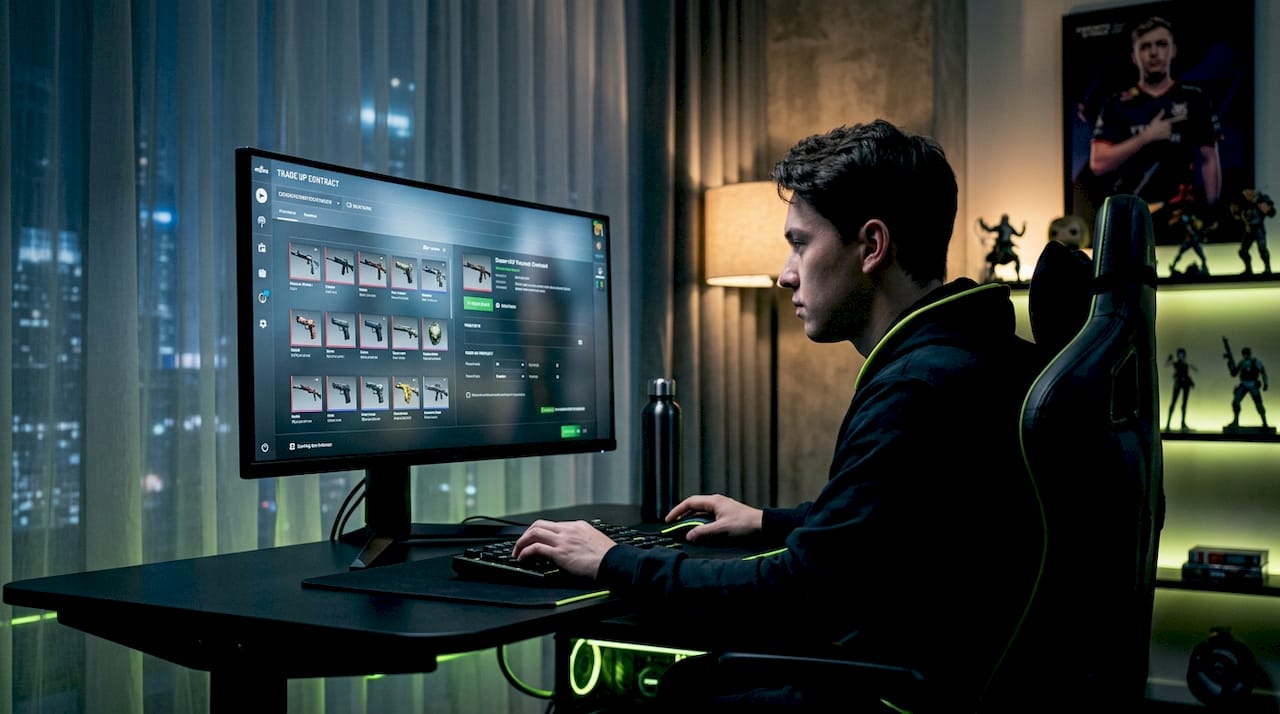
Knife trade-ups are a different game entirely. The inputs cost more, the variance is enormous, and most runs end in a loss. But the 10% moonshot makes it worth studying as one of the most cited cs2 trade examples in the community.
The setup:
- Assemble nine cheap Classified skins priced around $8 each (total: ~$72)
- Add one expensive Classified skin priced around $200 to skew the float average
- Total input cost lands near $272
- Submit and receive one Covert skin or knife from the applicable collection
The math breakdown:
- 90% chance of outputs worth $50 to $200, most of which represent a net loss on the $272 spent
- 10% chance at a Karambit Doppler valued between $1,200 and $2,000, which CSProfit identifies as driving a positive EV despite very high variance
- The one expensive input skin pulls the float average into a range that makes the Doppler output possible at all
Stat to know: A single 10% Karambit Doppler hit at $1,600 average value contributes $160 in expected value against a $272 cost, which needs to be weighed against the 90% loss scenarios.
This trade-up suits collectors who already have a solid base inventory and can absorb repeated losses before that one hit lands. Running it once or twice is a gamble. Running it 20 times with proper bankroll management turns it into a calculated cs2 trading strategy. Check top CS2 trading platforms before sourcing inputs to get the best prices.
Example 3: Float manipulation master class with Printstream FN craft
Advanced traders can use float manipulation to maximize profit margins, as seen in this example.
Float manipulation is what separates casual traders from pros. It is not a cheat or exploit. It is using the game's own mechanics precisely. The output skin's float is a weighted average of your 10 inputs, so if you carefully select inputs with very low float values, you can push the output into Factory New territory.
The setup:
- Source 10 Classified-tier input skins from the correct collection, each with floats below 0.05
- Target filler inputs priced at $6 to $8 each to keep total costs near $80
- The output target is an M4A1-S | Printstream in Factory New condition
- Selecting very low float inputs boosts the probability of a Factory New output, which CSProfit explains enables a 150% markup opportunity
Why Factory New matters here:
- A Printstream FN trades for approximately $150 or more, while the same skin in Minimal Wear drops to $60 to $80
- The gap between FN and MW on this skin alone justifies the precision required
- 60% probability of a Factory New output at $150 value, with lower-tier wear outcomes still maintaining modest value
- Total EV is positive when float averaging is executed correctly
Pro Tip: Use a trade-up calculator that shows output float ranges before you buy a single input. The difference between an average float of 0.04 and 0.08 can mean the difference between a Factory New output and a Minimal Wear one. This is where most traders leave money behind. Check out skin collecting strategies for more on sourcing float-specific skins efficiently.
Comparing CS2 trade-up strategies: low risk vs. high risk vs. expert float manipulation
Now that we have detailed examples, let's compare their risk profiles and profitability to inform your trade decisions.
| Strategy | Input cost | Risk level | Float control needed | Expected value |
|---|---|---|---|---|
| Tec-9 Brother grind | ~$5.20 | Low | Moderate (0.15 to 0.20 avg) | Consistently positive |
| Karambit Doppler jackpot | ~$272 | Very high | Basic average management | Positive but high variance |
| Printstream FN float craft | ~$80 | Medium | Advanced (below 0.05 per input) | Positive with precision |
A few takeaways from the comparison:
- Low-risk trade-ups generate modest, steady profits. They are ideal for grinding portfolio value without stress.
- High-risk trade-ups offer life-changing hits but will bleed your inventory dry if you treat them like a daily habit without strict limits.
- Float manipulation sits in the middle on cost but demands the most knowledge. The returns are strong when executed well.
TradeUpSpy practitioners recommend tracking every contract you run and reviewing ROI and win rate weekly. This keeps you from making emotional decisions after a few bad runs and helps you identify which contract types are actually profitable for your style.
You can dive deeper into execution with a dedicated how to trade CS2 skins guide to sharpen your process before committing real inventory.
Best practices for successful CS2 trading and avoiding common pitfalls
Beyond examples, mastering trading mechanics and avoiding common errors is key to consistent success in CS2.
Good examples only help you if the infrastructure around your trades is solid. Here is what that looks like in practice:
- Enable Steam Guard Mobile Authenticator. Bot-based platforms with authenticators enable instant trades, eliminating the 15-day hold that standard Steam trades impose. Timing matters in volatile markets.
- Track every trade-up in a spreadsheet. Record input cost, output received, output sale price, and net profit or loss. After 20 trades, patterns emerge that gut feel will never show you.
- Use trusted platforms only. Scam trades and phishing sites are real. Stick to platforms with verified reputations, fast payouts, and clear fee structures.
- Start small. Run the Tec-9 Brother grind 10 times before touching the Karambit contract. Build the habit of calculating EV, not just eyeballing it.
"The biggest mistake new traders make is skipping the tracking step. Without data, every loss feels like bad luck and every win feels like skill. Neither is accurate." — Shared widely in the CS2 trading community
Pro Tip: Set a hard stop limit per session. Decide before you open your trade tool exactly how many contracts you will run. Once you hit that number, stop. Chasing losses is how profitable traders become unprofitable ones.
Read through these CS2 skin collecting tips to round out your approach with inventory management methods that pair well with active trading.
The hidden truth about CS2 trade-ups: why most players lose and how to win
Here is the uncomfortable reality: the examples above are not secret knowledge. The EV formulas are public. The collection data is available to everyone. Yet most players running trade-ups still lose money over time. The reason has nothing to do with math.
The real problem is emotional decision-making. A player runs the Tec-9 Brother grind three times, gets below-average outputs, and decides the contract is broken. They abandon a positive-EV trade because variance felt like failure. Then they dump that budget into a high-risk knife contract chasing a quick recovery. That is the cycle that drains inventories.
Successful traders treat trade-ups as high-variance investments, not slot machines. They understand that a positive EV trade can produce three losing runs in a row and still be the correct trade to run. Discipline over dozens of contracts, not luck over one, is what produces results.
Most casual players also completely ignore float values on inputs. They grab the cheapest version of the required skin without checking its float, accidentally capping their output at Minimal Wear when they could have hit Factory New with slightly more expensive inputs. The cost difference is often $2 per skin. The output value difference can be $50 or more.
There is also the issue of collection research. Markets shift. A collection that had a positive-EV contract in January 2026 may have tipped negative by March as output prices dropped. The traders who update their tracking weekly, as tracking contract metrics demonstrates, consistently outperform those who run the same contracts on autopilot.
Use the skin collecting process guide alongside your trading to build an inventory system that supports repeatable, data-backed decisions rather than reactive ones.
Upgrade your CS2 skins and trade confidently with DROP.SKIN
Ready to apply these trade strategies? DROP.SKIN gives you the tools to put these examples into action right now.
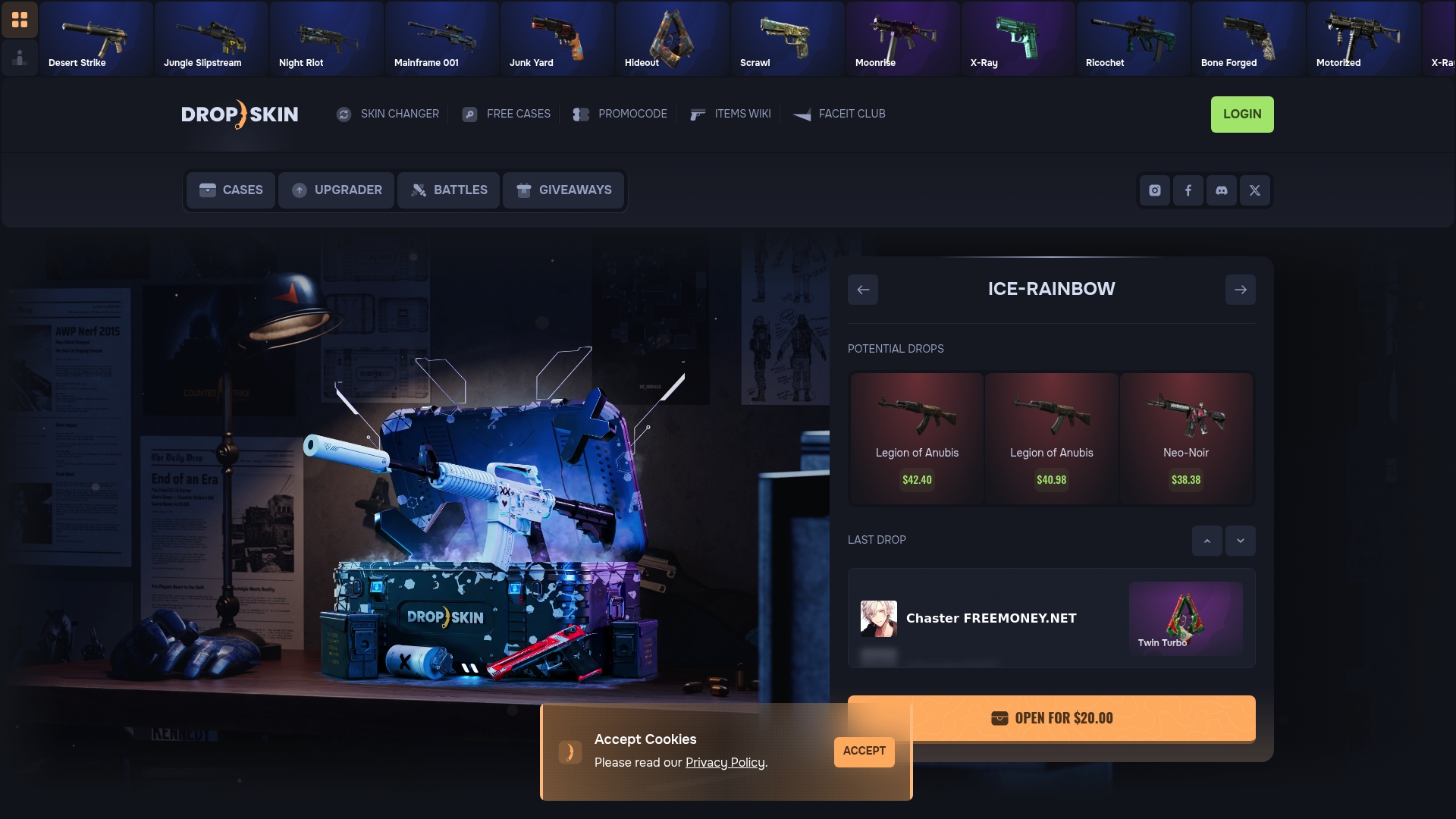
The CS2 skin upgrader on DROP.SKIN lets you trade up skins instantly without navigating in-game limitations or dealing with Steam trade holds. You pick your target skin, stake your current inventory, and see the outcome immediately. It is built for exactly the kind of trader this guide describes: someone who wants to grow their portfolio with intent, not accident. You can also browse DROP.SKIN's full case catalog to source specific skins for your input builds at competitive prices, with instant delivery backed by a trusted platform. Your next profitable trade is already set up. All you need is the strategy to run it.
Frequently asked questions
What is a CS2 trade-up contract?
A Trade Up Contract lets you exchange 10 weapon skins of the same quality tier for one skin from the next higher tier, giving you a deterministic upgrade path without pure luck.
How does float value affect CS2 trade-ups?
The output float is calculated from the average float of your 10 input skins, with minimum and maximum float caps applied per collection, directly influencing the output skin's wear condition and market price.
Do trade holds delay CS2 skin trades?
Yes, standard Steam trades trigger holds, but bot-based marketplaces with authenticators enable instant trade delivery, which is critical when you need to time a trade around market price movements.
Are all CS2 trade-ups profitable?
No. Most random contracts lose money long-term. Only trade-ups with a calculated positive expected value, proper float targeting, and up-to-date output pricing are worth running consistently.