
TL;DR:
- Luck completely determines the outcome of every CS:GO and CS2 case opening, with no influence from timing or account history. Most rare skins, including knives and gloves, drop roughly 1 in 385 cases, and the chances of getting a StatTrak version are an additional 10 percent. Opening more cases does not improve individual odds; every pull is an independent event with a fixed probability, making case opening primarily an entertainment expense.
Luck is the sole determinant of every case opening outcome in CS:GO and CS2. Each time you click that open button, a server-side random number generator fires instantly and assigns your item before the animation even starts spinning. No ritual, no timing trick, no account age gives you an edge. The role of luck in case openings is absolute, and understanding exactly how it works will change the way you spend, play, and feel about every single pull.
What are the exact odds and probabilities behind case openings?
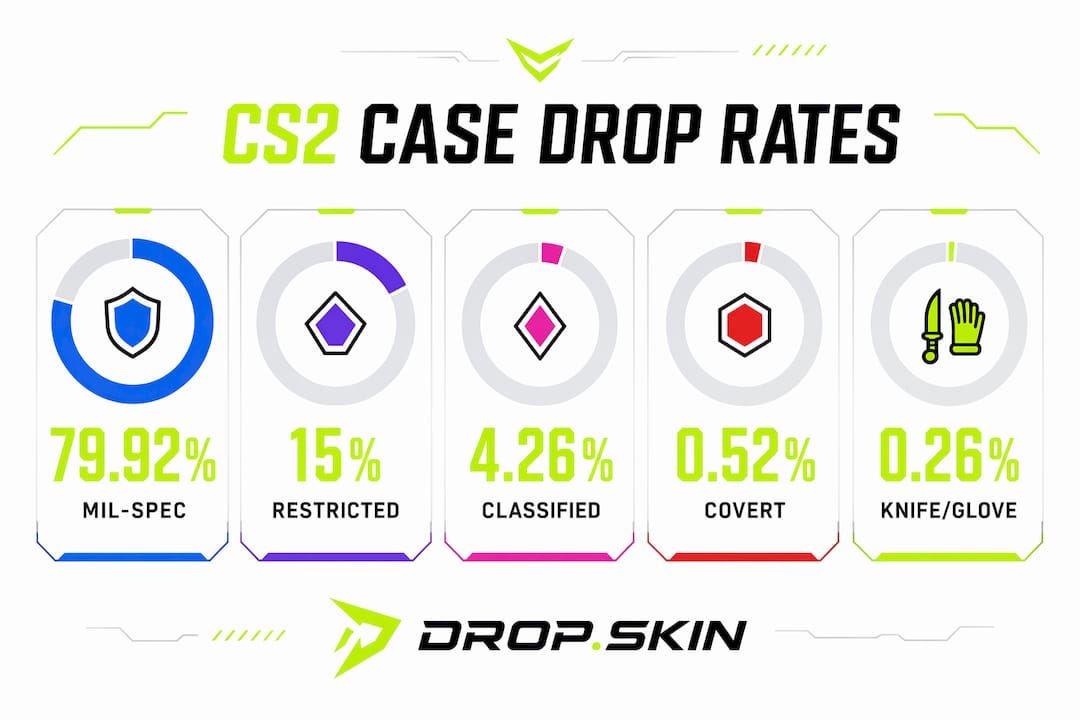
Every CS2 case uses a fixed probability distribution across five rarity tiers. Mil-Spec items drop 79.92% of the time. Restricted items follow at 15.98%. Classified items appear 3.20% of the time, Covert items at 0.64%, and Exceedingly Rare items, which include knives and gloves, at just 0.26%. That last number means roughly 1 in every 385 cases produces a knife or glove.
Those numbers look small on paper. In practice, they mean most players open dozens of cases and never see a knife. The gap between Covert and Exceedingly Rare is not a small step. It is a cliff.
| Rarity Tier | Drop Rate | Approximate 1-in-X |
|---|---|---|
| Mil-Spec | 79.92% | 1 in 1.25 |
| Restricted | 15.98% | 1 in 6 |
| Classified | 3.20% | 1 in 31 |
| Covert | 0.64% | 1 in 156 |
| Exceedingly Rare | 0.26% | 1 in 385 |
StatTrak is a separate luck layer on top of the rarity roll. Any weapon skin that drops has an independent 10% chance of being StatTrak. That means a StatTrak knife requires two separate lucky rolls: first landing the 0.26% knife drop, then hitting the 10% StatTrak roll. StatTrak versions typically sell for two to ten times the base skin price on the Steam Community Market.
Float value adds a third layer. Every skin has a wear condition, from Factory New to Battle-Scarred, determined by a random float number assigned at drop. Two players can open the exact same knife from the same case and receive visually different results. Float value affects appearance and market price, and you have zero control over it.
Pro Tip: Before you open a case, check the CS2 skin rarity breakdown for that specific case. Some cases have stronger Covert pools than others, which changes the practical value of your pulls even if the rarity percentages stay fixed.
How do case opening myths mislead players?
The gambler's fallacy is the most damaging belief in the CS2 community. Players assume that after a long losing streak, a knife must be "due." It is not. Each case opening is a fully independent random event, meaning previous results have zero effect on the next pull. Opening 384 cases without a knife does not raise your odds on case 385. You still face the same 0.26% chance every single time.
The math on this is brutal. Getting a 50% chance of landing at least one knife requires opening roughly 267 cases. Getting a 90% chance requires around 886 cases. Those are not guarantees. They are probabilities. You could open 886 cases and still walk away empty.
Common myths players believe, and why they are wrong:
- New accounts have better odds. False. Valve's RNG does not factor in account age, level, or history. The server does not know or care how old your account is.
- Clicking at the right moment changes the result. False. The rolling animation is purely cosmetic. The server decides your item the instant you click open, not when the animation stops.
- Opening cases at certain times of day improves luck. False. Server-side RNG runs identically at 3 a.m. and 3 p.m.
- Rituals or lucky charms influence drops. False. Human brains are wired to find patterns in random data. That is psychology, not probability.
Pro Tip: If you feel like you are "on a hot streak," write down your last 20 results and calculate the actual hit rate. The data almost always shows you are well within normal variance, not experiencing genuine luck.
What is the expected value of opening cases?
Expected value, or EV, is the average return you get per dollar spent over many openings. For CS2 cases, that number is consistently negative. Returns typically land between 40% and 85% of the combined case plus key cost, and that is before Steam's market fees cut into any skins you try to sell.
The house edge across CS2 cases runs roughly between 25% and 60% depending on the specific case. No case has a positive expected value for the player. That is not a design flaw. It is the design.
| Scenario | Cost | Average Return | Net Result |
|---|---|---|---|
| Single case opening | ~$2.50 | ~$1.50–$2.10 | Loss of $0.40–$1.00 |
| 10 case openings | ~$25.00 | ~$15–$21 | Loss of $4–$10 |
| 100 case openings | ~$250.00 | ~$150–$210 | Loss of $40–$100 |
Opening more cases does not fix the math. Large sample sizes reduce variance, which means your results get closer to the true expected value. The true expected value is a loss. Bulk opening just makes that loss more predictable, not smaller.
Rare wins do happen. A $1,500 knife from a $2.50 case is real. But that win is the statistical outlier that funds thousands of losing pulls by other players. The house edge exists because the math guarantees it across the full player base.
What you are actually buying when you open a case is the thrill of variance. The excitement of not knowing, the possibility of a life-changing drop, the story you get to tell. That experience is the real product, not the skin itself. Recognizing that changes how you budget for it.
How should players approach case openings given the luck factor?
The smartest approach treats case openings as an entertainment expense, not a profit strategy. Here is a practical framework for getting the most out of the experience without burning your wallet.
-
Set a hard budget before you open anything. Decide the maximum you are willing to spend in a session and treat it like a movie ticket. Once it is gone, the session ends. This prevents the "just one more" spiral that turns a $10 session into a $100 one.
-
Use a case opening simulator first. Free simulators let you run hundreds of virtual openings with real odds. Seeing 300 simulated cases produce zero knives is far cheaper than learning that lesson with real money.
-
Buy the skin you want directly from the Steam Community Market. If you want a specific knife, the direct purchase price is almost always lower than the expected cost of opening enough cases to get it. The market is more efficient than luck.
-
Watch streamer clips with skepticism. Streamer rare wins represent extreme variance, not average results. Content creators open hundreds or thousands of cases for entertainment. Their highlight reels are not representative of what you will experience in a typical session.
-
Choose platforms that give you tradable items. Platforms delivering tradable Steam items let you sell or trade what you win on the open market. Site-only credits have no real-world value and lock you into a closed ecosystem. Always check whether your winnings are actually yours to use.
-
Track your actual results. Keep a simple log of what you spend and what you receive. Most players who do this are surprised by how closely their results match the expected negative return over time.
Understanding the odds behind skin drops does not make case openings less fun. It makes them honest. You go in knowing what you are paying for and why, which removes the frustration of feeling cheated when a knife does not appear after 50 pulls.
Key takeaways
Luck in CS2 case openings is a fixed mathematical system, not a force you can influence, and every player who understands that spends smarter and enjoys the game more.
| Point | Details |
|---|---|
| Odds are fixed and public | Knife and glove drops land at 0.26%, or roughly 1 in 385 cases, every time. |
| Each opening is independent | Previous results never affect future drops; the gambler's fallacy does not apply here. |
| Expected value is always negative | Returns average 40%–85% of cost before fees; no case opening strategy beats the house. |
| StatTrak and float add variance | A 10% StatTrak roll and a random float value each add separate luck layers to every drop. |
| Treat it as entertainment | Setting a budget and buying skins directly from the market is the most cost-effective approach. |
Dropskin's take on luck and why knowing the odds is freeing
I have opened a lot of cases over the years, and the single biggest shift in my experience came when I stopped treating each pull as a test of my luck and started treating it as a purchase of excitement. The first time I understood that a knife required roughly 385 openings on average, I stopped feeling cheated after 50 dry pulls. That knowledge did not make the game less thrilling. It made the thrill honest.
The players I see get the most frustrated are the ones chasing losses. They open ten cases, get nothing above Restricted, and convince themselves the eleventh will be different. The math says it will not be. The gambler's fallacy is not a personality flaw. It is a cognitive bias every human shares. Knowing it exists is the only defense against it.
My honest advice: if you love the rush of a case opening, budget for it the same way you budget for any entertainment. Decide what the experience is worth to you before you spend, not after. The rare wins are real and genuinely exciting. They are also genuinely rare. Enjoy them when they happen. Do not plan your finances around them.
Understanding drop rates turned case openings from a source of frustration into a source of fun for me. That is the real value of knowing the numbers.
— Dropskin
Dropskin: open CS2 cases with full transparency
Dropskin gives CS2 players a case opening experience built on real odds and live market prices. Every item you win is a tradable skin with genuine Steam market value, not a locked credit that disappears when you close the tab.
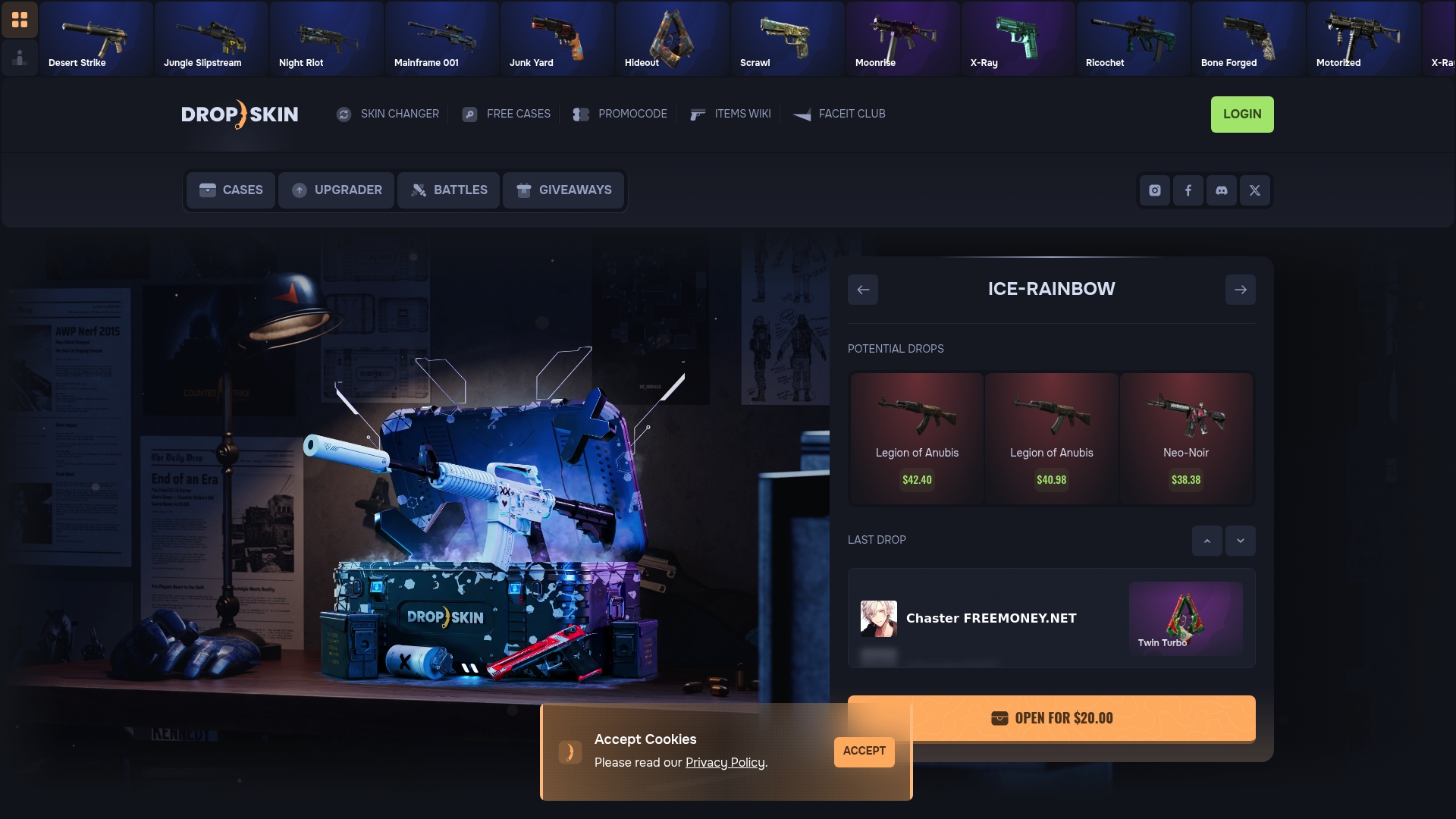
The Dropskin case collection covers a wide range of CS2 cases with clearly displayed drop rates so you always know what you are paying for before you open. If you already have skins and want to move up in value, the skin upgrader lets you trade existing skins toward rarer ones with transparent odds. Dropskin also runs regular giveaways and promo codes, giving players additional ways to get value without extra spend. For players who want a fair, transparent platform, Dropskin is the place to start.
FAQ
What is the knife drop rate in CS2 cases?
The knife and glove drop rate in CS2 cases is fixed at 0.26%, or approximately 1 in every 385 cases. This rate does not change based on account history, timing, or how many cases you have previously opened.
Do case openings depend on luck or skill?
Case openings depend entirely on luck. The outcome is determined by a server-side random number generator the instant you click open, and no player action or strategy can influence the result.
Does opening more cases improve your odds of getting a rare skin?
Opening more cases does not improve your per-opening odds. Each pull carries the same fixed probability. More openings simply give you more chances at the same fixed rate, which increases cumulative probability but never changes the individual drop chance.
Is there a pity timer in CS2 case openings?
CS2 does not have a confirmed pity timer or guaranteed drop system for rare items. Unlike some other loot box systems, each CS2 case opening is fully independent with no hidden luck accumulation mechanic.
Are StatTrak skins harder to get than regular skins?
Yes. StatTrak requires two separate lucky outcomes: first landing the base skin at its rarity tier, then hitting the independent 10% StatTrak roll. A StatTrak knife is therefore roughly ten times rarer than a standard knife drop.