
TL;DR:
- Item value in CS:GO reflects a skin’s market worth based on condition, rarity, pattern, and demand. It is not fixed and fluctuates with float, pattern, and community interest, especially for high-value skins. Accurate valuation requires checking float, rarity, recent sales, and understanding market differences.
Item value in CS:GO is the estimated market worth of an in-game skin or item based on its condition, rarity, pattern, and current demand. Understanding this concept separates players who trade confidently from those who consistently undersell or overpay. The CS:GO skin market is not casual. Combined skin value across public inventories worldwide exceeds $1.3 billion as of 2026, with approximately 560 million skins in circulation. That scale means even small valuation mistakes cost real money.
What is item value in CS:GO and what drives it?
Item value in CS:GO, formally called market price or skin valuation, is the price a buyer will actually pay for a specific item at a specific moment. It is not a fixed number. It shifts with float value, rarity grade, pattern index, sticker condition, and overall market demand.
Four factors set the foundation for any skin's price. Float value controls visual wear and creates the biggest price swings. Rarity grade sets the floor price. Pattern index determines whether a skin carries a premium for visual uniqueness. Demand, driven by community interest and pro player usage, sets the ceiling. Every skin you own sits at the intersection of all four.
One critical distinction separates new players from experienced traders. Steam wallet value and real cashout value are not the same number. Your inventory's Steam value is typically 20–35% higher than what you can actually receive in real currency from third-party platforms. Knowing this difference is the starting point for any honest inventory assessment.
How float value determines skin wear and pricing
Float value is a decimal number between 0.00 and 1.00 assigned permanently to a skin at the moment it is created. It never changes with use. The number maps directly to one of five wear categories: Factory New (0.00–0.07), Minimal Wear (0.07–0.15), Field-Tested (0.15–0.37), Well-Worn (0.37–0.45), and Battle-Scarred (0.45–1.00).
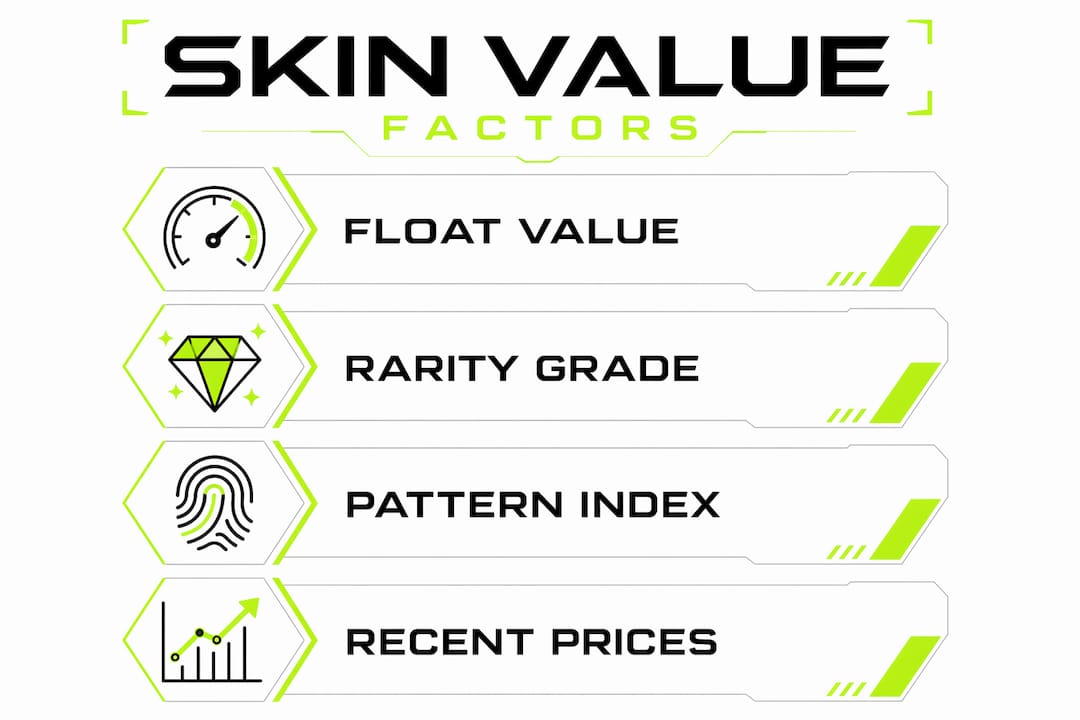
The float value is the main driver of pricing based on visual wear, and rare collector floats fetch 2–10x premiums over standard examples in the same wear tier. A Factory New skin sitting at 0.001 looks dramatically cleaner than one at 0.069, even though both qualify as Factory New. That visual difference translates directly into price. Sub-0.001 floats on desirable skins command exceptional premiums because they represent the cleanest possible version of that item.
Float importance scales with skin price. For skins under $50, the wear tier alone is usually enough for a fair valuation. For skins above $50, the exact float can cause price swings of 2x to 10x. A Karambit Doppler at 0.003 float is worth significantly more than the same knife at 0.065, even though both are Factory New.
Pro Tip: Always check the exact float via an inspect link or a float database before buying or selling any skin priced above $50. Relying on the wear tier label alone will cost you money on higher-value items.
Float wear categories at a glance
| Wear category | Float range | Price behavior |
|---|---|---|
| Factory New | 0.00–0.07 | Highest prices; sub-0.01 floats command top premiums |
| Minimal Wear | 0.07–0.15 | Strong prices; visible wear begins at upper range |
| Field-Tested | 0.15–0.37 | Mid-range pricing; most common tier |
| Well-Worn | 0.37–0.45 | Lower prices; heavy visible wear |
| Battle-Scarred | 0.45–1.00 | Lowest prices; some skins gain niche collector interest |
How rarity, patterns, stickers, and StatTrak affect price
Rarity sets the floor price for any skin, but demand and aesthetic features set the ceiling. A Covert-grade skin starts at a higher base price than a Consumer-grade skin by design. The rarity system runs from Consumer (gray) through Industrial, Mil-Spec, Restricted, Classified, and Covert (red), with Contraband and special knife or glove grades sitting above that. Higher rarity means fewer skins in circulation, which supports price stability over time.
Pattern index is where valuations get extreme. The AK-47 Case Hardened has hundreds of possible pattern variations. Pattern #661, known as a Blue Gem variant, has sold above $100,000, while the base skin trades around $1,000. That is a 100x premium driven entirely by pattern placement. Blue Gems, Fade percentages on knives, and Marble Fade fire-and-ice patterns all follow the same logic. The rarer the visual outcome, the higher the price ceiling.
StatTrak versions track kill counts and carry a consistent price premium. StatTrak variants generally command 15–40% price premiums over standard versions in mid-tier price ranges. That premium shrinks at ultra-high prices, where the base skin's rarity and pattern dominate the valuation. A $10,000 knife is not worth $14,000 just because it has StatTrak.
Stickers add another layer of complexity. Katowice 2014 holos can add $500–$3,000 or more per sticker to an item's value. Scraping those stickers to sell them separately almost always reduces the combined value of the item. A four-sticker craft on a desirable skin can be worth more than the skin and stickers valued individually.
- Rarity grade: Sets the base price floor and long-term price stability.
- Pattern index: Can multiply value by 10x to 100x for rare visual outcomes.
- StatTrak: Adds a 15–40% premium in mid-tier ranges; smaller effect at high tiers.
- Stickers: Katowice 2014 holos add hundreds to thousands per sticker.
- Souvenir status: Adds a modest premium; souvenir versions cannot have StatTrak.
- Nameplates: Minor premium, mostly collector preference.
Pro Tip: Before scraping a sticker off a skin, check the sticker's standalone market price and the skin's value with the sticker applied. Removing a Katowice 2014 holo almost always destroys more value than it recovers.
Why Steam Market prices differ from real cashout value
Steam Market listing prices are not real prices. They represent what sellers hope to receive, not what buyers have actually paid. Steam Market fees sit at 15%, and all proceeds land in your Steam wallet, not your bank account. That wallet currency can only be spent on Steam, which limits its real-world utility.
Third-party marketplaces pay out in real USD, but they price skins accordingly. Steam wallet value is typically 20–35% higher than the cashout value you receive from third-party platforms, with third-party prices running 25–50% lower due to liquidity differences and payout currency. A skin listed at $100 on the Steam Community Market might sell for $65–$75 on a third-party platform in real money.
The gap between listing price and sold price matters just as much. Steam shows current listings, not recent sales. A skin listed at $200 may have last sold at $140 three weeks ago. That $60 gap is not profit waiting to happen. It is the seller's wishful thinking.
Here is how to read pricing data accurately:
- Find the skin's recent sold price history on Steam, not just the lowest listing.
- Cross-reference with recent transaction data from reputable third-party platforms.
- Apply the 20–35% discount to convert Steam wallet value to real cashout expectations.
- Factor in the platform's own fee structure before calculating your net payout.
- Treat the lowest current listing as a ceiling, not a target price.
Recent transaction history on reputable third-party platforms yields more accurate item values than Steam Market listing prices alone. Sold prices reflect what buyers actually paid. Listings reflect seller optimism.
How to check and assess your CS:GO item value accurately
Accurate skin valuation requires three data points working together: float value, rarity context, and recent sold prices across multiple platforms. Missing any one of these leads to consistent mispricing.
Start with float. Use an inspect link to pull the exact float value for any skin you are evaluating. Float databases index specific float values and show comparable sales for skins in the same float range. This step is non-negotiable for any skin above $50. The float-first approach prevents undervaluing rare, low-float items that look identical to average examples in the same wear tier.
Next, check rarity and pattern. For knives and gloves, identify the specific pattern index and compare it against known premium patterns. For rifles and pistols, check whether the skin has a pattern-dependent community following. The skin rarity guide from Dropskin covers how rarity grades interact with demand to produce real price floors.
Finally, cross-reference sold prices. Do not rely on a single platform or a single data point. Check Steam's sold price history, then compare with third-party transaction data. Market demand cycles matter too. A skin tied to a pro player who just won a major will spike in price. That same skin may drop 20–30% once the hype fades.
- Check float via inspect link before any transaction above $50.
- Use float databases to find comparable sales in the same float range.
- Compare Steam sold history against third-party recent transactions.
- Identify pattern index for knives, gloves, and pattern-sensitive rifles.
- Account for sticker value before listing or buying a stickered skin.
- Watch demand cycles tied to pro play, case releases, and community events.
Pro Tip: Inventory value calculators that pull data from multiple marketplaces give you a faster overall picture, but always verify individual high-value skins manually. Automated tools average across listings, not sold prices, which skews results upward.
Key Takeaways
Accurate CS:GO item valuation requires float value, rarity grade, pattern index, and real sold price data working together, not any single factor alone.
| Point | Details |
|---|---|
| Float value is permanent | Float is assigned at creation and never changes; check it precisely for any skin above $50. |
| Steam prices are not cashout prices | Steam wallet value runs 20–35% higher than real-money payouts from third-party platforms. |
| Pattern index drives extreme premiums | Rare patterns like Blue Gems can push prices 10x to 100x above the base skin value. |
| Sold prices beat listing prices | Recent transaction history reflects true buyer willingness; listings reflect seller hope. |
| StatTrak adds a real but limited premium | StatTrak variants carry 15–40% premiums in mid-tier ranges but shrink at ultra-high price points. |
Dropskin's take on CS:GO skin valuation in 2026
The single biggest mistake I see players make is treating their Steam inventory value as real money. It is not. Steam wallet funds are locked inside an ecosystem. The moment you accept that your $500 inventory might net you $350 in real cash, your trading decisions get sharper immediately.
Float-first thinking changed how I approach every skin above $50. Two Factory New skins can look identical in a screenshot but trade at completely different prices because one sits at 0.003 and the other at 0.065. Players who skip the float check consistently leave money on the table or overpay for items that look premium but are not.
Rarity and demand interact in ways that surprise even experienced collectors. A Covert skin with weak community interest can trade below a Classified skin that pros use constantly. Key factors affecting skin value are never just about the grade on the label. The community's relationship with a skin matters as much as its drop rate.
Timing your sales matters more than most guides admit. Selling a skin tied to a major tournament winner in the week after the event captures peak demand. Waiting a month means selling into a market that has already moved on. The same skin, same float, same pattern, but a 20–30% lower price just because the moment passed.
— Dropskin
Put your skin knowledge to work on Dropskin
Understanding CS:GO item value is only useful if you act on it. Dropskin gives you a direct way to apply that knowledge.
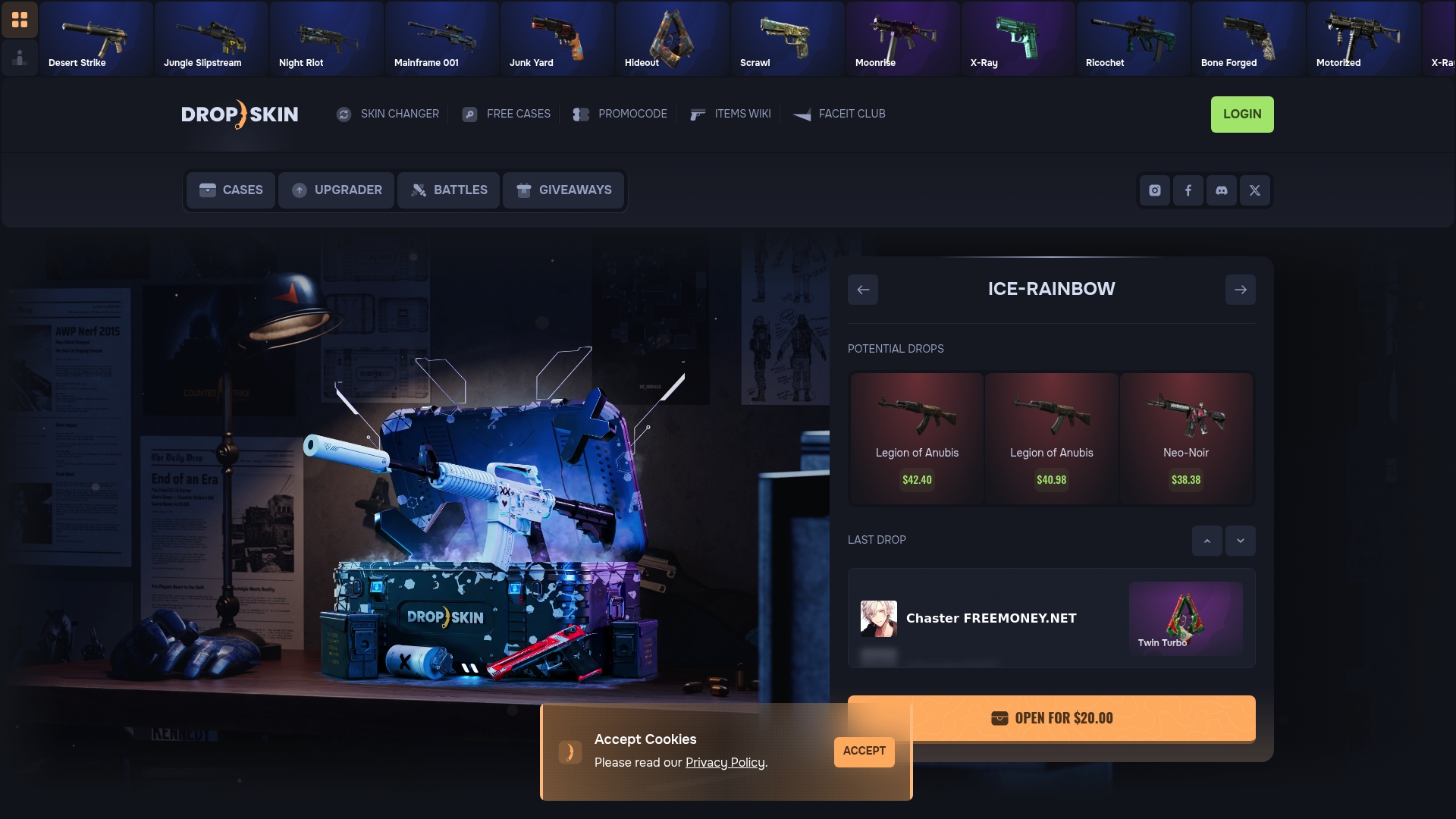
On Dropskin, you can open CS2 cases, upgrade skins from lower tiers to higher-value items, and participate in skin battles where you set the stakes. The platform is built for players who want more than passive inventory watching. Whether you are looking to turn a mid-tier collection into something worth trading or want to test your luck on case openings with real skin rewards, Dropskin puts the tools in your hands. Giveaways and promo codes run regularly, giving you additional ways to build inventory value without starting from scratch.
FAQ
What is item value in CS:GO?
Item value in CS:GO is the estimated market price of a skin based on its float value, rarity grade, pattern index, and current demand. It reflects what a buyer will actually pay, not a fixed in-game number.
How do I check my CS:GO skin's exact value?
Check the skin's float via an inspect link, identify its rarity and pattern index, then compare recent sold prices across Steam and third-party platforms. Listing prices alone are not reliable.
Why is my Steam inventory value higher than what I can cash out?
Steam Market fees total 15%, and all proceeds stay in your Steam wallet. Third-party platforms pay in real currency but price skins 25–50% lower, making Steam wallet value 20–35% higher than real cashout value.
Does StatTrak always increase a skin's value?
StatTrak adds a 15–40% premium for mid-tier skins, but the premium shrinks significantly at ultra-high price points where pattern and float dominate the valuation.
What makes a pattern like a Blue Gem so valuable?
Blue Gems are specific pattern index outcomes on skins like the AK-47 Case Hardened that place blue coloring across the most visible parts of the weapon. The AK-47 Case Hardened #661 has sold above $100,000 compared to a base price of around $1,000, driven entirely by pattern placement.