
Rare CS2 skins have outperformed stocks with annualized returns reaching 66.9% between 2015 and 2025, which means the virtual items sitting in your inventory are closer to financial assets than most players realize. Yet the majority of collectors still treat rarity as a simple luck mechanic, something that determines whether a case opening feels good or bad. The truth is far more interesting. Rarity is the engine behind supply constraints, price floors, trade-up strategies, and even the volatility patterns that serious traders exploit every day. This guide breaks down exactly how rarity shapes value, what factors can override it, and how you can use that knowledge to make smarter decisions in the skin market.
Table of Contents
- Understanding CS2 and CS:GO skin rarity tiers
- How rarity mechanically impacts price: The economics of supply and demand
- Beyond rarity: Factors that can override or boost price
- Trading, gambling, and investing: Rarity's role in skin market strategies
- Common myths and mistakes about skin rarity and value
- Enhance your skin trading with DROP.SKIN
- Frequently asked questions
Key Takeaways
| Point | Details |
|---|---|
| Rarity restricts supply | Skin rarity controls how often items drop and sets the minimum market price for each tier. |
| Other factors influence value | Float, pattern, stickers, and hype can override rarity to make skins much more valuable. |
| Mid-rarity offers liquidity | Mil-Spec and similar tiers are favored for easy trading, while ultra-rare skins are less liquid and more volatile. |
| Knowledge helps maximize returns | Understanding rarity, supply, and demand enables better trades, smarter collecting, and improved skin upgrades. |
Understanding CS2 and CS:GO skin rarity tiers
Before you can decode why rarity shapes price, you need to know how rarity itself is structured in CS2 and CS:GO. The game uses a tiered classification system that directly controls how often a skin can drop from a case, which in turn controls how many copies exist in the market at any given time.
CS2 skins are classified into tiers ranging from Consumer Grade at roughly 80% drop rate all the way down to Exceedingly Rare at just 0.26%, covering knives and gloves. Each tier has a distinct color code and a corresponding scarcity level. You can explore the full breakdown of CS2 skin rarity explained to see how drop rates translate into real market supply.
Here is a quick reference for the main tiers:
| Rarity tier | Color | Approximate drop rate |
|---|---|---|
| Consumer Grade | White | ~80% |
| Industrial Grade | Light blue | ~16% |
| Mil-Spec | Blue | ~3.2% |
| Restricted | Purple | ~0.64% |
| Classified | Pink | ~0.32% |
| Covert | Red | ~0.064% |
| Exceedingly Rare | Gold | ~0.26% |
The key takeaway here is that the system is designed to enforce scarcity. Valve controls supply at the source by making higher-tier skins statistically rare to obtain. This is not accidental. It mirrors how luxury goods markets work, where artificial or structural scarcity keeps prices elevated. Understanding value, odds, and drops gives you a real edge when evaluating whether a skin is priced fairly or overvalued.
Key rarity facts to remember:
- Consumer Grade skins flood the market, keeping prices near zero
- Mil-Spec skins hit a sweet spot of moderate scarcity and high demand
- Covert and Exceedingly Rare skins have extremely limited supply, creating strong price floors
- Every tier above Consumer Grade is roughly 5x rarer than the one below it
How rarity mechanically impacts price: The economics of supply and demand
With the rarity tiers clear, let's see exactly how they shape the economic realities of the skin market. The core mechanic is straightforward: lower drop rates mean fewer skins enter circulation per case opened, which limits supply and pushes prices up.

Lower supply from rarity drives higher prices through scarcity, and discontinued cases amplify this effect permanently. When Valve removes a case from active drops, no new copies of its skins can enter the market. The existing supply becomes fixed, and as skins get traded, lost to inactive accounts, or held by long-term collectors, the circulating supply actually shrinks over time. This is why skins from older discontinued cases often appreciate steadily, even when the broader market dips.
Knives and gloves are the clearest example. Their Exceedingly Rare status means that even during market corrections, their price floors hold firm. Demand from collectors and traders who want these items for status or trade-up purposes keeps bids competitive. Understanding what drives skin value helps you spot these floor dynamics before prices move.
"Discontinued cases create a permanent supply ceiling. Once the case is gone from drops, every trade just redistributes existing copies rather than adding new ones to the pool."
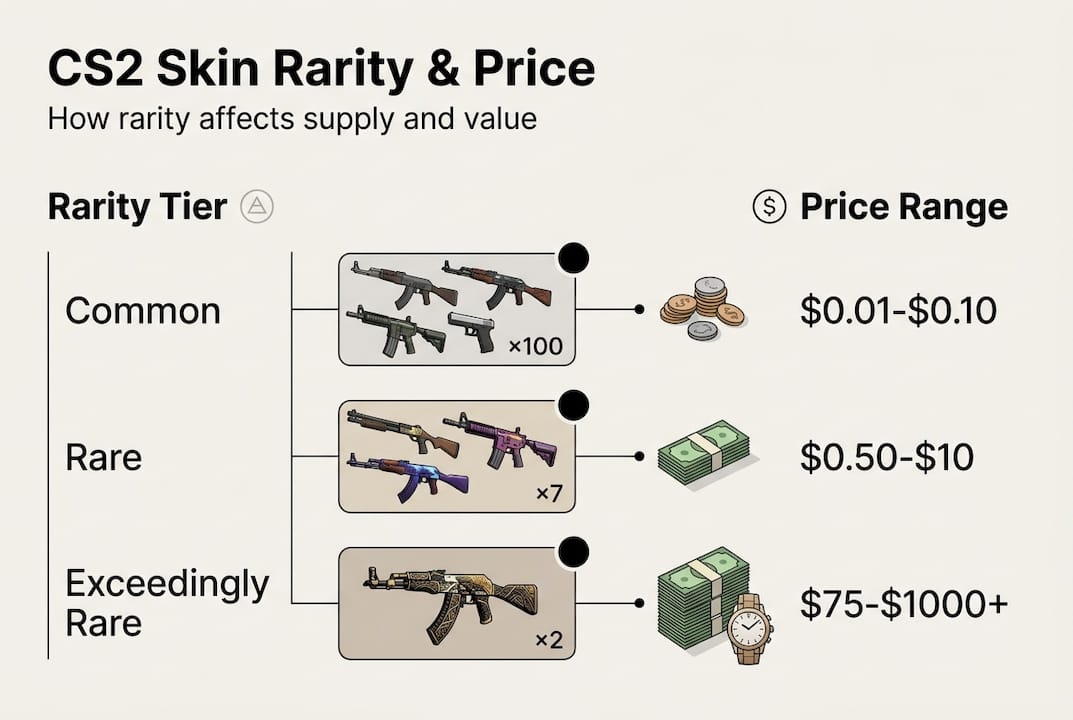
Here is how rarity tiers compare in terms of supply dynamics and typical price ranges:
| Rarity tier | Supply dynamic | Typical price range |
|---|---|---|
| Consumer Grade | Oversupplied | $0.01 to $0.10 |
| Mil-Spec | Moderate supply | $0.50 to $5.00 |
| Restricted | Limited supply | $2.00 to $20.00 |
| Classified | Scarce | $10.00 to $100.00 |
| Covert | Very scarce | $50.00 to $500.00+ |
| Exceedingly Rare | Extremely scarce | $100.00 to $10,000.00+ |
Pro Tip: Track when Valve rotates cases out of active drops. Skins from newly discontinued cases often see a price spike within weeks as the market adjusts to the new supply ceiling. Monitoring factors affecting skin value keeps you ahead of these moves.
Beyond rarity: Factors that can override or boost price
Rarity is just the starting point. Real pricing is a matrix of additional factors that can push a skin far above or below what its rarity tier would suggest.
Rarity alone is not sufficient for determining price. Float, pattern, demand, and stickers all intersect with rarity to create the final market value. Here are the four biggest modifiers you need to understand:
-
Float (wear rating): Every skin has a float value between 0.00 and 1.00. Lower float means less wear and a cleaner look. A Factory New skin with a float of 0.001 can be worth several times more than the same skin at 0.07, even though both are technically Factory New. For high-rarity skins, float differences can mean thousands of dollars.
-
Pattern seed: Some skins use a pattern template that varies by seed number. The AK-47 Case Hardened is the most famous example, where specific blue-heavy patterns called Blue Gems can multiply the skin's value by 10 to 100 times compared to a standard copy. Pattern matters enormously for certain skins.
-
Applied stickers: Historic or expensive stickers applied to a skin add real value, especially if they are from major tournaments or are now discontinued. A common Mil-Spec skin with four Katowice 2014 stickers can be worth more than many Covert skins. Check the esports skin collecting guide for a deeper look at sticker valuation.
-
Demand and hype: Influencer hype and prices are directly linked. When a popular streamer uses a specific skin on stream, demand can spike overnight regardless of rarity tier. Some mid-rarity skins command premium prices purely because of their visual appeal or community status. The skin collecting tips section covers how to track these demand shifts.
Pro Tip: Before buying a skin purely for its rarity tier, check its float, pattern index, and any applied stickers. A lower-rarity skin with a rare pattern or historic stickers can be a smarter buy than a higher-rarity skin with no special attributes.
Trading, gambling, and investing: Rarity's role in skin market strategies
If you're planning to maximize the value of your collection or trade more effectively, you need to know how rarity affects strategies in practice.
Trade-up contracts require 10 skins of the same rarity to produce one skin of the next tier, which sets hard price floors for mid and high-rarity skins. If a Restricted skin drops below the cost of 10 Mil-Spec skins divided by the odds of getting a good outcome, traders will buy it up for trade-ups. This arbitrage keeps prices anchored.
AI trading models actually prefer Mil-Spec rarity for liquidity, since these skins trade frequently and have tight bid-ask spreads. High-rarity skins like Coverts and knives have thinner markets, meaning fewer buyers and sellers at any given time. This creates bigger potential price swings in both directions. CS2 skin portfolios have returned as much as 66.9% annually over the 2015 to 2025 period, but that performance is not evenly distributed across rarity tiers.
Here is what rarity means for your specific strategy:
- For traders: Mil-Spec and Restricted skins offer the best liquidity and fastest turnover. High-rarity skins require patience and a larger capital base.
- For gamblers: Understanding rarity odds helps you evaluate case opening expected value. The CSGO vs CS2 skins comparison shows how market dynamics have shifted between games.
- For collectors: Covert and Exceedingly Rare skins hold value best long-term, especially from discontinued cases. Track skin impact on gameplay and betting to understand how community use affects demand.
- For investors: Diversify across rarity tiers. High-rarity skins offer appreciation potential; mid-rarity skins offer liquidity.
Common myths and mistakes about skin rarity and value
To help you avoid common setbacks, let's clear up some persistent myths and collector mistakes about rarity's true impact.
The biggest myth in the skin market is that higher rarity always equals higher price. It does not. Unpopular rare skins can actually be worth less than trending common skins because demand is the other half of the price equation. A Covert skin with an ugly design that nobody wants to use will sit on the market for weeks at a discount, while a popular Mil-Spec skin with a clean look sells in minutes at a premium.
"Rarity sets the supply ceiling. Demand sets the actual price. You need both working in your favor for a skin to hold or grow its value."
Here are the most common mistakes collectors and traders make:
- Overpaying for rare but undesirable skins: Just because a skin is statistically rare does not mean the community wants it. Always check active listings and recent sales before buying.
- Ignoring liquidity risk: Thin markets for ultra-rare skins mean you might not find a buyer when you need one. This is a real risk if you need to liquidate quickly.
- Assuming scarcity guarantees appreciation: Scarcity helps, but a skin also needs an active buyer base. Some rare skins from obscure collections have barely moved in price for years.
- Neglecting float and pattern: Buying a rare skin without checking its float or pattern is like buying a car without checking the mileage. These details matter enormously for resale value.
Exploring premium skins explained gives you a clearer picture of which rare skins actually carry community prestige versus which ones just have low drop rates.
Enhance your skin trading with DROP.SKIN
Now that you understand the mechanics and strategies surrounding rarity and price, you're ready to put that knowledge to work. Knowing which rarity tier offers the best liquidity, which patterns add real value, and when discontinued cases create buying opportunities gives you a genuine edge over collectors who are just guessing.
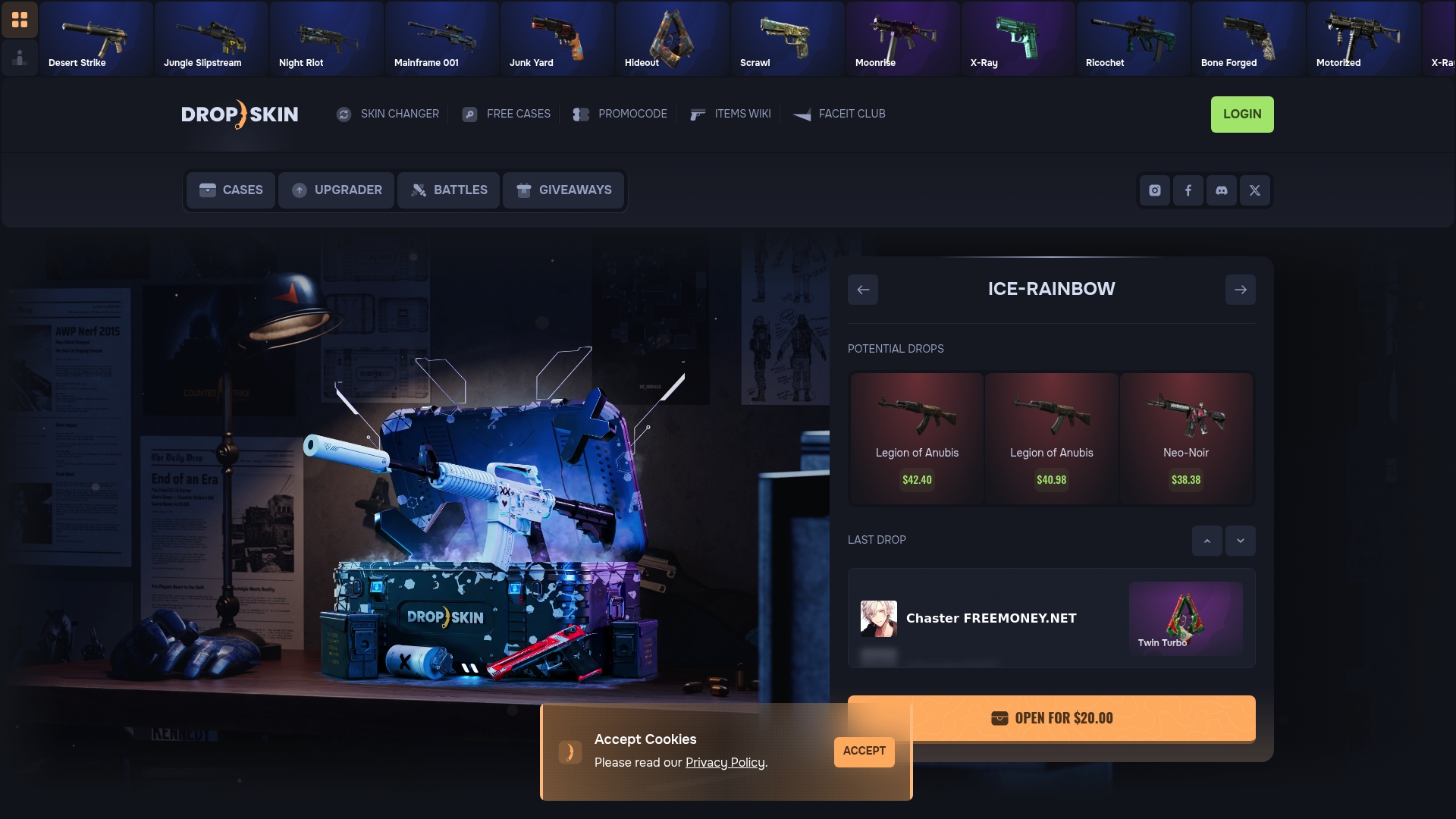
DROP.SKIN is built for exactly this kind of informed trading and collecting. You can open CS2 cases from an extensive catalog that spans multiple rarity tiers, giving you real exposure to the drop mechanics we covered above. If you already have skins and want to move up the rarity ladder, the CS2 Skin Upgrader lets you apply your rarity knowledge directly, trading lower-value skins for a shot at higher-tier items. Whether you're building a collection or chasing that knife, the platform gives you the tools to act on what you now know.
Frequently asked questions
Does higher rarity always mean higher price for CS2 skins?
No. Unpopular rare skins can be cheaper than popular common skins because demand plays an equal role alongside supply in setting market prices.
Why are discontinued CS2 cases and collections so expensive?
Discontinued cases create a permanent supply ceiling, meaning no new copies can enter the market, which steadily increases value as circulating supply shrinks over time.
What are the drop rates for Exceedingly Rare CS2 skins?
Exceedingly Rare skins such as knives and gloves have an approximate drop rate of 0.26%, making them among the hardest items to obtain from standard case openings.
Are mid-rarity skins better for trading than the rarest ones?
Often yes. AI trading models prefer Mil-Spec skins over high-rarity items because they offer significantly higher liquidity, meaning faster sales and tighter price spreads for active traders.