
TL;DR:
- CS:GO skin prices fluctuate due to supply limitations, player demand, and speculative activity influenced by game updates and market psychology.
- Supply mechanics like case drops and trade-up contracts, along with demand drivers such as weapon popularity and esports, directly impact prices, which can shift rapidly.
- Understanding platform differences and using indexes helps traders respond patiently to market cycles, maximizing value through strategic actions.
CS:GO skin prices fluctuate because their market reflects a constant interplay of supply limitations, player demand, and speculative activity. Understanding why CSGO skins fluctuate means looking at forces that mirror real financial markets: case drop rates, weapon meta shifts, Valve updates, and trader psychology all push prices up or down. The Steam Market and third-party platforms like CS2REF and CSMarketCap each capture different slices of this activity. This guide breaks down every major driver so you can read price moves instead of just reacting to them.
Why do CSGO skins fluctuate in price?
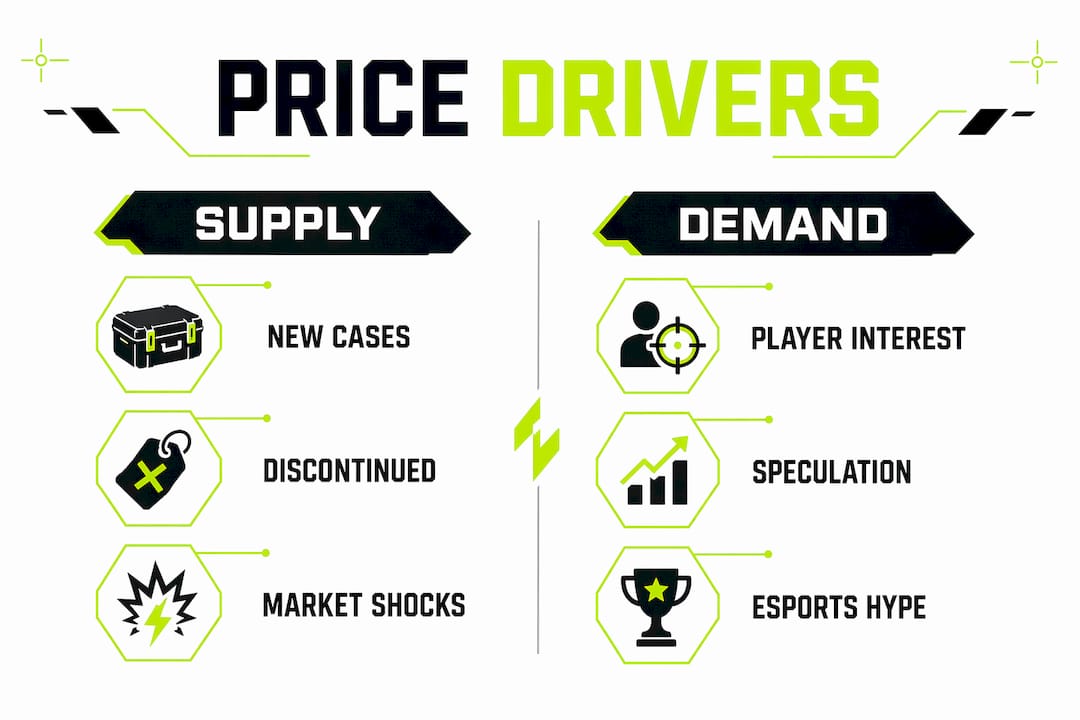
CS:GO skin price fluctuations are driven by three core forces: supply changes, demand shifts, and speculative behavior. None of these operates in isolation. When Valve releases a new case, supply spikes and prices on similar skins often drop within hours. When a weapon becomes dominant in the meta, demand for its skins rises fast. When a streamer or pro player showcases a rare pattern, speculative buying can send a skin's price up 40% overnight.
The skin economy in CS2 and CS:GO is not random. It follows patterns tied to game updates, esports calendars, and collector cycles. Game updates and esports events create demand surges while case availability affects supply tightness. Recognizing those patterns is the difference between buying at a peak and buying at a floor.
How does supply affect cs:go skin prices?
Supply is the most mechanical driver of CSGO skin market fluctuations. Every time Valve adds a new case to the active drop pool, the market absorbs a flood of new skins. Prices on affected items can fall sharply within days. The reverse is equally powerful: when a collection is discontinued, the supply of those skins stops growing, and prices tend to climb steadily over time.

Supply shocks can cause market capitalization to drop or recover by 50% within as little as 38 hours. That speed matters. Traders who miss the first 12 hours of a supply shock often buy at the wrong point in the cycle.
Legacy items tell the clearest story. Pre-2020 discontinued collections have seen 18–35% annual appreciation since 2023. That appreciation is not driven by hype. It is driven by the simple fact that no new copies enter the market.
Three supply mechanics shape prices at every tier:
- Case drops and active pools. While a case is in the active drop rotation, supply grows continuously. Prices stay compressed. Once a case leaves rotation, supply growth stops and prices stabilize or rise.
- Trade-up contracts. Trade-up contracts create demand for specific input skins, setting price floors in mid-tier categories. A skin that feeds a popular trade-up rarely drops below a certain threshold because traders keep buying it as raw material.
- Listing velocity. CS2 skins are durable digital assets. Price moves depend more on listing velocity and seller willingness than on new unboxings alone. When holders stop listing, prices rise even without a demand spike.
Pro Tip: Track whether a case is still in the active drop pool before buying skins from it. A case leaving rotation is one of the most reliable supply signals in the market.
What role does player demand play in skin price changes?
Demand is where the market gets interesting. Rarity alone does not guarantee high prices. Rare but unpopular skins remain inexpensive regardless of their drop odds. Demand is the multiplier that turns rarity into real value.
Four demand drivers consistently move skin prices:
- Weapon meta popularity. When a rifle or pistol becomes the go-to pick in competitive play, demand for its skins rises across all quality tiers. The AK-47 and M4A4 consistently command higher skin prices than weapons that see less play.
- Collector focus on float and pattern. Premiums for low-float Factory New items have grown from 15–25% in 2023 to 40–60% in 2026. Collectors increasingly pay for unique characteristics, not just the skin name.
- Esports spotlight. When a pro player uses a specific skin during a major tournament, community interest spikes fast. That spike is real but short-lived, typically fading within one to two weeks after the event.
- Community hype cycles. Streamers, Reddit threads, and Discord communities can create short-term demand surges that push prices well above their natural level.
"Demand drives multipliers. A skin with a 0.001% drop rate but zero community interest will sit at $2. The same skin featured in a major tournament highlight reel can jump to $50 in 48 hours."
Collectors today focus more on unique float and pattern variants rather than rarity alone. A Karambit with a specific fade pattern or a low-float AWP Dragon Lore carries a premium that no rarity tier can fully explain. Understanding this shift helps you recognize which skins have lasting demand versus which ones are riding a temporary wave.
How do speculation and market transparency shape skin values?
Speculation is the most volatile driver of CSGO skin price trends. It creates the biggest short-term swings and the most painful losses for unprepared traders.
Speculative bubbles and corrections
Speculative bubbles form when traders buy a skin not for its intrinsic value but because they expect someone else to pay more. Skins pumped by speculative bubbles frequently lose 30–50% of their inflated value within days. The correction is fast because the buyers who drove the spike have no attachment to the skin and sell the moment momentum stalls.
How panic selling distorts prices
Price crashes behave differently from price spikes. Price crashes exhibit stickiness with a slow downward grind rather than rapid corrections. Sellers postpone listing because they do not want to realize a loss. That reluctance keeps prices artificially elevated for days or weeks before the market finds its real floor. Panic selling breaks that stickiness suddenly, causing a sharp drop that often overshoots fair value.
Speculation vs. organic demand
| Driver | Price Move Speed | Duration | Recovery Pattern |
|---|---|---|---|
| Organic demand (meta, esports) | Moderate | Weeks to months | Gradual stabilization |
| Speculative bubble | Very fast (hours) | Days | Sharp 30–50% correction |
| Supply shock (new case) | Fast (hours to days) | Weeks | Slow recovery if case stays active |
| Panic selling | Fast (hours) | Days | Overshoot then rebound |
Better market transparency reduces speculative volatility over time. Tools like CSMarketCap publish category indexes that reveal capital rotation invisible on single-item charts. When one category index rises while another falls, it signals that money is moving between segments, not leaving the market. Traders who read indexes instead of individual skin charts avoid most panic-sell traps.
Pro Tip: Before selling a skin during a price drop, check the category index. If the index is flat or rising, the drop is likely a local correction, not a market-wide exit.
Steam market vs. third-party platforms: why prices differ
The platform you use to buy or sell a skin directly affects the price you see. Steam Market and third-party platforms like Skinport or CS.MONEY operate under fundamentally different economic rules.
Steam Market prices carry a liquidity premium because funds cannot be withdrawn as fiat currency. Money spent on Steam stays on Steam. That trapped liquidity inflates prices compared to real-world cash marketplaces. A skin listed at $50 on Steam might sell for $38 on a third-party platform that pays out in real money.
Key structural differences that create pricing gaps:
- Wallet isolation. Steam Wallet funds have no exit to fiat. Buyers accept higher prices because the alternative is letting Steam credit sit idle.
- Listing velocity drives short-term moves. On Steam, the number of active listings and how fast sellers add new ones matters more than total supply. A sudden wave of listings drops the price even if the total supply of that skin has not changed.
- Third-party platforms reflect real-world value. Cash-out platforms price skins against what buyers will pay in actual currency. Those prices are consistently lower than Steam but more accurate for real valuation.
Savvy traders compare Steam prices with third-party markets before buying. The gap between platforms is not a glitch. It is a structural feature of how skin market economics work. Buying on third-party platforms and selling on Steam when the premium is high is one of the oldest arbitrage plays in the CS2 economy.
Understanding how CS:GO skins gain value across both platform types gives you a more complete picture of where a skin actually sits in the market.
Key takeaways
CS:GO skin prices fluctuate because supply mechanics, player demand, speculative behavior, and platform liquidity all interact simultaneously, and reading each force correctly is the foundation of any sound trading approach.
| Point | Details |
|---|---|
| Supply shocks move fast | Market cap can shift 50% within 38 hours; act early or wait for stabilization. |
| Demand beats rarity | Rare skins with no community interest stay cheap; popular skins command lasting premiums. |
| Speculation corrects sharply | Bubble-driven spikes lose 30–50% within days; avoid buying at the top of a hype cycle. |
| Platform prices differ structurally | Steam prices carry a liquidity premium; compare with third-party platforms for accurate valuation. |
| Category indexes reveal capital rotation | A single skin dropping does not mean the market is falling; check the index first. |
What the skin market taught me about patience
Most traders lose money in the CS2 skin market for one reason: they treat every price drop as an emergency. They see a skin they bought at $80 sitting at $65 and list it immediately, locking in a loss that would have recovered in two weeks.
The market rewards patience in a way that most games do not. Supply shocks are temporary. Esports hype fades and then returns. Discontinued collections keep appreciating because the math is simple: fixed supply, growing player base. The traders who understand this hold through the noise and sell into the next demand spike.
What I find most underrated is the category index approach. Single-item charts are misleading. A knife category index rising while a rifle skin drops tells you that money is rotating, not leaving. That distinction changes everything about how you respond.
The other shift worth watching is the collector premium on float and pattern variants. A 40–60% premium for low-float Factory New items is not a bubble. It reflects a maturing market where experienced collectors have moved past rarity tiers and started pricing what actually makes a skin unique. If you are building a collection with long-term value in mind, float and pattern matter more than the color of the rarity border.
The market is not random. It is just faster than most people expect and slower to recover than most people want.
— Dropskin
Upgrade your skins while the market moves
Understanding CSGO skin market fluctuations is one side of the equation. Acting on that knowledge is the other.
Dropskin gives you a direct way to put market knowledge to work. The platform lets you open CS2 cases from an extensive collection and use the skin upgrader to trade up from cheaper skins toward higher-value targets. Instead of waiting for the perfect market window to buy a premium skin outright, you can use the CS2 skin upgrader to work toward it through strategic upgrades. Dropskin also runs regular giveaways and promo codes that lower the cost of entry. If you are tracking supply cycles and demand shifts, Dropskin is a practical complement to that knowledge.
FAQ
What causes cs:go skin prices to drop suddenly?
Supply shocks from new case releases are the most common cause. Speculative bubbles also collapse fast, with inflated skins losing 30–50% of their value within days of the hype fading.
Do discontinued cs:go skins always increase in value?
Not always, but pre-2020 discontinued collections have shown 18–35% annual appreciation since 2023. Discontinued skins need both fixed supply and active collector demand to appreciate consistently.
Why are steam market prices higher than third-party platforms?
Steam Market prices carry a liquidity premium because Steam Wallet funds cannot be converted to real-world currency. Third-party platforms that pay out in fiat consistently show lower but more accurate real-world prices.
Does weapon popularity affect skin prices?
Yes. Weapons used heavily in competitive play generate higher demand for their skins across all quality tiers. Meta shifts driven by Valve balance updates can move skin prices within days of a patch.
What is a float value and why does it affect skin price?
Float value measures a skin's wear level on a scale from 0 to 1. Low-float Factory New skins carry premiums of 40–60% over average-condition versions in 2026, reflecting collector demand for the cleanest possible condition.