
TL;DR:
- Many skin gambling sites prioritize appearance over fairness, risking rigged outcomes and lost skins.
- Provably fair systems use cryptography to verify outcomes, increasing transparency and player trust.
- Unregulated platforms often exploit players with misleading mechanics, emphasizing the importance of choosing verified sites.
Most players pick a skin gambling site the same way they pick a knife skin: by how it looks. Flashy animations, slick interfaces, and big jackpot numbers create an illusion of legitimacy that has nothing to do with actual fairness. The truth is, the real mechanisms that determine whether a platform is honest happen behind the scenes, and most players never check them. Scandals, lawsuits, and rigged outcomes have cost the community millions in skins and trust. This guide breaks down exactly how fairness works, what provably fair systems actually do, and how you can spot safe platforms before you risk a single skin.
Table of Contents
- Why fairness matters in skin gambling
- How provably fair systems work
- What happens without regulation?
- Platform interventions: Valve's role in fairness
- Practical steps for finding fair skin gambling sites
- Why real fairness is the next big test for skin gambling
- Try fair skin gambling with DROP.SKIN
- Frequently asked questions
Key Takeaways
| Point | Details |
|---|---|
| Verify fairness with tools | Always check for provably fair verification and server seed checks before betting your skins. |
| Watch for red flags | Unregulated platforms with near-misses or undisclosed odds present high risk for unfair gambling. |
| Valve’s interventions matter | Trade holds and site bans help reduce manipulation, but also affect legitimate trading speed and access. |
| Apply safe gambling practices | Use checklists and demo modes, avoid high-speed play, and choose transparent platforms. |
Why fairness matters in skin gambling
Skin gambling has a complicated history, and you can't fully understand today's platforms without knowing where things went wrong. Between 2014 and 2016, the CS:GO community lived through a wave of match-fixing history that shook the entire industry. The iBUYPOWER match-fixing scandal, rigged gambling sites, and the CSGO Lotto controversy, where popular influencers secretly owned the sites they promoted, triggered Valve crackdowns, player bans, and seven-day trade holds that frustrated legitimate traders for years.
Those scandals weren't just embarrassing. They revealed a structural problem: when there's no fairness enforcement, platforms can manipulate outcomes, and players have no way to know. The risks of case openings extend beyond bad luck. On a rigged site, your odds are simply wrong, and no amount of strategy or research protects you.
Here's what's actually at risk when you gamble on an unfair platform:
- Rigged odds: The house edge is secretly higher than advertised, making long-term winning mathematically impossible.
- Lost skin value: Skins deposited on fraudulent sites can disappear entirely when a platform shuts down.
- Account bans: Valve can restrict or ban accounts linked to prohibited gambling activity.
- Financial harm: Without transparent odds, players make uninformed decisions that lead to real monetary losses.
- No recourse: Unregulated platforms offer no dispute resolution, so lost skins stay lost.
"The lack of regulatory oversight in skin gambling creates environments where harmful mechanics thrive, increasing the risk of problem gambling, particularly for younger players." This concern has been echoed across government reviews and academic studies examining the skin gambling industry trends shaping the space today.
Fairness matters because real money, real skins, and real wellbeing are on the line. Now that you know why fairness is crucial, let's look at how trustworthy gambling platforms actually prove their integrity.
How provably fair systems work
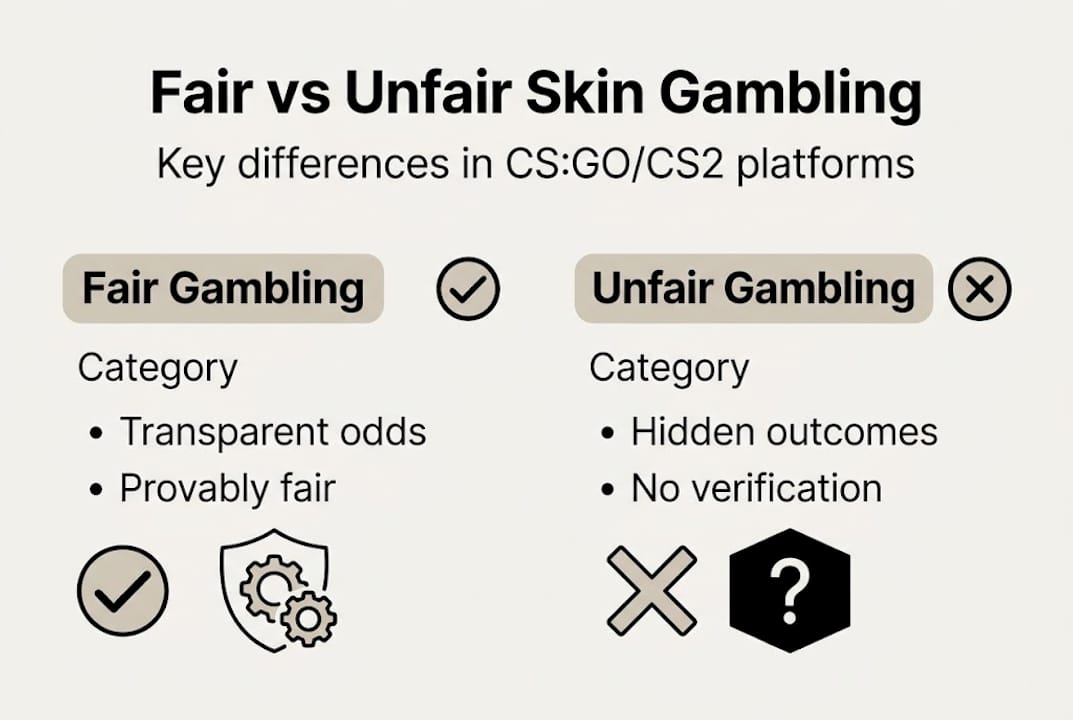
A provably fair system is a cryptographic method that allows players to independently verify that a game outcome was not manipulated. It sounds technical, but the core idea is simple: before the game starts, the platform commits to a secret result using a hashed code. After the game, it reveals the original code so you can confirm nothing changed. If the hash matches, the result was fair.
Here's how the verification process works step by step:
- Server seed is generated. Before your bet, the platform creates a server seed and gives you a hashed version of it. You can't read the seed, but you can record the hash.
- Client seed is added. You (or your browser) contribute a client seed, making the outcome dependent on both parties.
- The game runs. The outcome is determined by combining both seeds through an algorithm.
- Seeds are revealed. After the game, the platform reveals its server seed in full.
- You verify. Run both seeds through the same hashing function and check that the result matches the pre-game hash. If it does, the game was fair.
This system is used in roulette, crash games, and coinflip modes across many platforms. The table below shows the difference between platforms that use provably fair systems and those that don't:
| Feature | Provably fair platform | Standard platform |
|---|---|---|
| Outcome verifiable by player | Yes | No |
| Server seed revealed post-game | Yes | Rarely |
| Independent audit possible | Yes | Platform dependent |
| Risk of hidden manipulation | Very low | High |
| Player trust level | High | Variable |
Before placing a bet, review the skin betting workflow to understand each step and where your skins actually go during a wager.
Pro Tip: Always copy the hashed server seed before your bet and compare it after the round. If the platform doesn't let you access the hash at all, treat that as a red flag and walk away.
Understanding the mechanics is great, but what happens when there are no regulations ensuring every site follows fair practices?
What happens without regulation?
The answer is messy. A UK government review published in 2025 found that skin gambling remains completely unregulated in Great Britain, with more than 50 sites accessible to players with no legal oversight. That number alone should give you pause.
Unregulated platforms don't just lack fairness tools. They actively design mechanics to exploit players. The same review found that features like near-misses, high-speed gameplay, and the illusion of control increase the risk of problem gambling significantly compared to traditional esports betting. When you feel like you "almost won," your brain responds the same way it does to an actual win, pushing you to keep going.
Here's what to watch for on unregulated sites:
- Near-miss animations: Visual effects that make you feel close to winning even on a clear loss.
- Rapid replay: Extremely fast game cycles designed to reduce decision-making time.
- Fake odds displays: Misleading probability numbers that don't match actual outcomes.
- No seed verification: No way to check whether outcomes were predetermined.
- Unclear ownership: No identifiable company or license behind the platform.
Comparing the two environments shows how stark the difference really is:
| Risk factor | Regulated environment | Unregulated environment |
|---|---|---|
| Odds transparency | Legally required | Optional |
| Player age verification | Mandatory | Often absent |
| Dispute resolution | Formal process | None |
| Harmful mechanics | Restricted | Frequently present |
The safe skin gambling tips at Dropskin's blog go deeper on what to watch for, and the 2026 skin gambling guide covers the current platform landscape in detail. If you want to avoid skin betting mistakes, understanding what unregulated platforms do differently is step one.
Some major platforms have responded with their own interventions. Let's look at how companies like Valve have shifted fairness in the skin gambling world.
Platform interventions: Valve's role in fairness
Valve hasn't been passive. Since the 2016 scandals, the company has used multiple enforcement tools to reshape how skin gambling operates. Valve's interventions include seven-day trade holds that reduce the speed of skin transfers, cease-and-desist letters to unregulated gambling sites, bans on professional players caught in match-fixing, and in 2025, restrictions on gambling-related sponsorships in the esports space. Ongoing lawsuits in New York as of 2026 may even push courts to formally classify skins as gambling assets.
Here's a breakdown of how those actions affect everyday players:
- Trade holds: Prevent instant skin transfers, reducing bot-driven manipulation but frustrating legitimate trades.
- Site shutdowns: Several major gambling platforms received cease-and-desist letters, removing risky options but also shrinking the ecosystem.
- Sponsorship bans: Gambling-affiliated teams and influencers face restrictions, reducing exposure-driven recruitment of new gamblers.
- Lawsuit outcomes: If skins are legally redefined as gambling assets, the entire regulatory framework could shift overnight.
The role of skins in CS:GO has always blurred the line between cosmetic items and financial instruments, which is exactly why regulators are paying attention now.

Pro Tip: When navigating trade holds, always use Steam's official trade interface and never accept third-party "hold bypass" offers. Those are almost always scams designed to steal your skins during the waiting period.
Think of Valve's interventions as a partial fix. They reduce the worst abuses but don't create a comprehensive safety net. Understanding skin betting risks means accepting that Valve's reach has real limits.
With all this context, how can you as a player ensure you're choosing fair platforms and maximizing your own safety?
Practical steps for finding fair skin gambling sites
Knowing what fairness looks like in theory only helps if you can apply it when choosing a platform. Here's a concrete checklist you can run through before depositing a single skin:
- Look for a provably fair badge. A legitimate platform displays this prominently and links to detailed documentation.
- Test the verification process. Try verifying a game result yourself before betting real skins. If the tool doesn't work or doesn't exist, leave.
- Read community reviews. Check forums, Reddit threads, and Discord servers for real player experiences, not curated testimonials.
- Check the odds display. Fair platforms show house edge percentages clearly. If you can't find them, the numbers are probably bad for you.
- Try demo modes first. Some platforms offer practice rounds. Use them to understand game speed and mechanics before risking value.
- Avoid high-speed games on unknown sites. As the government review on skins gambling confirmed, rapid replay mechanics in unregulated environments carry higher problem gambling risk than slower esports formats.
Here's a quick reference table for red flags versus green flags:
| Signal | Red flag | Green flag |
|---|---|---|
| Odds transparency | Hidden or vague | Clearly displayed |
| Provably fair system | Absent | Verified and testable |
| Ownership information | Anonymous | Company info visible |
| Speed of games | Extremely fast loops | Reasonable pacing |
| User reviews | Mostly negative or absent | Consistent positive feedback |
For additional guidance, the expert safe gambling tips resource is worth bookmarking. Applying this checklist takes five minutes and could save you significant losses.
You now have the tools. Let's step back and consider what all this means for the community and industry going forward.
Why real fairness is the next big test for skin gambling
Most articles about fairness in skin gambling stop at provably fair algorithms. That's the technical fix. But the bigger challenge is cultural and structural, and it's one that clever cryptography alone can't solve.
The impact of digital skins on gaming culture has outpaced the industry's ability to self-regulate. Players assume that if a platform exists and takes their skins, it must be legitimate. That assumption is exactly wrong. The absence of regulation means platforms can operate legally while doing genuine harm.
Here's what we think the industry consistently gets wrong: it treats fairness as a feature to market rather than a baseline obligation. A provably fair badge becomes a selling point instead of a minimum standard. That's backwards. Ongoing lawsuits as of 2026 could force a legal reckoning that redefines skins as gambling assets, which would change the rules for every platform overnight.
True fairness requires three things working together: transparent algorithms, industry accountability, and an informed player community that demands both. If you're not checking hashes, not reading terms of service, and not asking hard questions about who owns the site you're using, you're part of the problem. The community has to raise its own standards, not just wait for developers or governments to do it.
Try fair skin gambling with DROP.SKIN
Everything you've learned in this guide, from verifying hashes to spotting red flags, becomes much easier when a platform is built with transparency from the ground up. That's what DROP.SKIN is designed to offer.
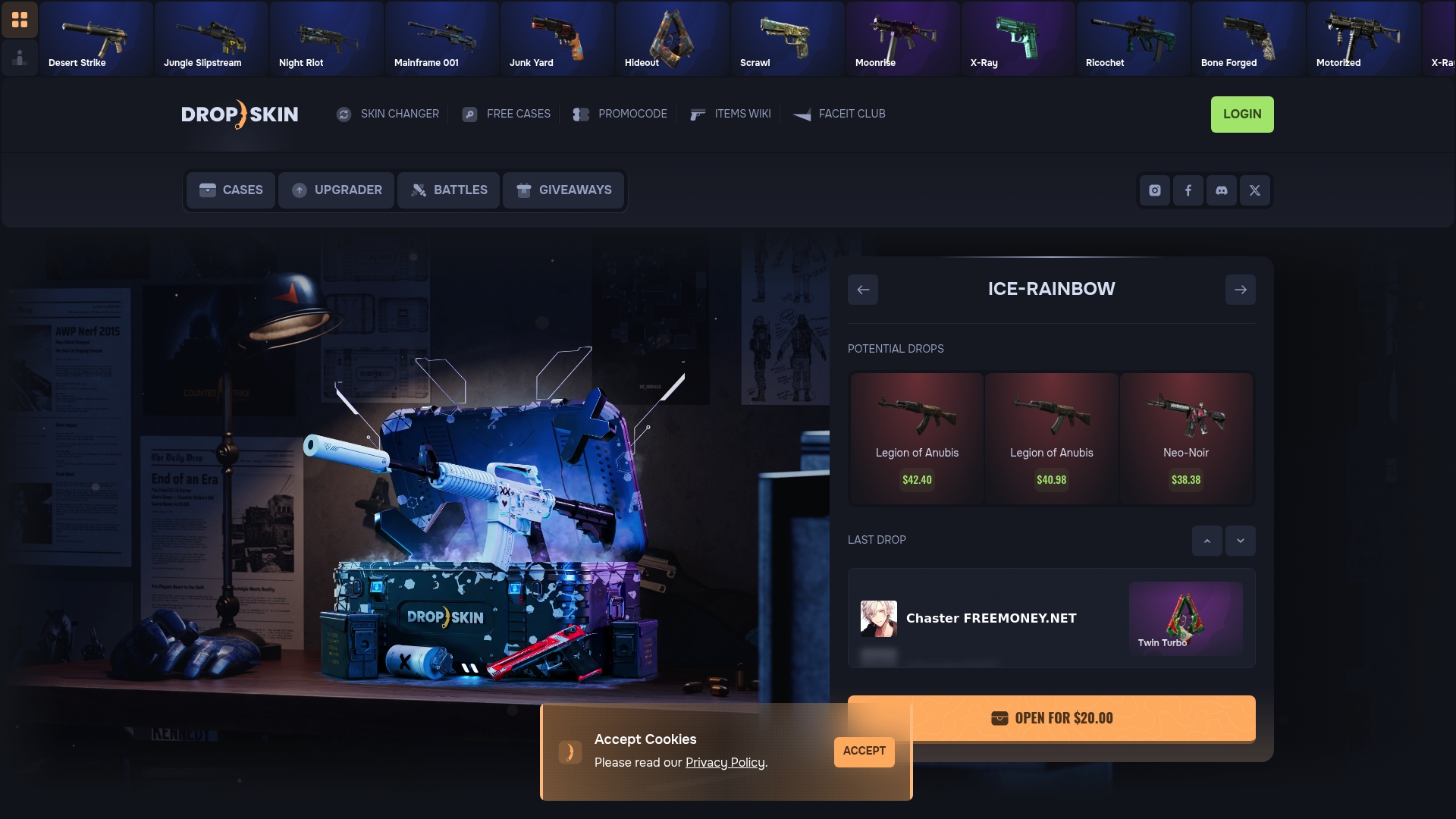
At DROP.SKIN fair skin gambling, you can open cases, battle for skins, and explore a full catalog of CS2 cosmetics with systems built for player trust. Want to put your strategy to work? Try the upgrade skins feature to turn lower-value skins into something worth having, all within a transparent, community-driven environment. Apply the checklist from this guide, ask the right questions, and gamble smarter.
Frequently asked questions
How can I verify a skin gambling site is fair?
Look for a provably fair badge and confirm you can check game results through server seed verification after each round. If the platform hides this process, don't trust it with your skins.
What are the risks of unregulated skin gambling?
Unregulated platforms may use harmful mechanics like near-misses and rapid replay, with over 50 sites operating without oversight in Great Britain alone, posing real risks of financial loss and problem gambling.
What actions has Valve taken to promote fairness?
Valve has imposed trade holds, banned gambling-related sponsorships, and pursued legal action against suspicious sites, with ongoing lawsuits in 2026 potentially redefining skins as gambling assets.
Are provably fair systems foolproof?
Provably fair systems greatly increase trust, but you must still verify results independently. A hash verification check after every round is the only way to confirm the system is working as advertised.
How can I avoid scams in skin gambling?
Stick to well-known platforms, confirm provably fair systems are testable, and avoid sites that hide odds or use rapid-play mechanics that research links to higher problem gambling risk.