
TL;DR:
- Collections in CS:GO are themed groups of skins that influence how skins are obtained, traded, and valued within the game economy. They also shape gameplay decisions, trading systems, and cultural significance, with different types affecting scarcity and market behavior.
Collections in CS:GO are defined as themed groupings of weapon skins that determine how those skins are obtained, traded, and valued within the game's economy. The role of collections in CS:GO goes far beyond cosmetics. Collections set the rules for Trade-Up Contracts, control skin scarcity, and shape the cultural identity of the entire player community. Whether you are chasing a rare AK-47 finish or building a trading portfolio, understanding how collections work is the single most useful thing you can do as a collector or trader.
What types of CS:GO collections exist?
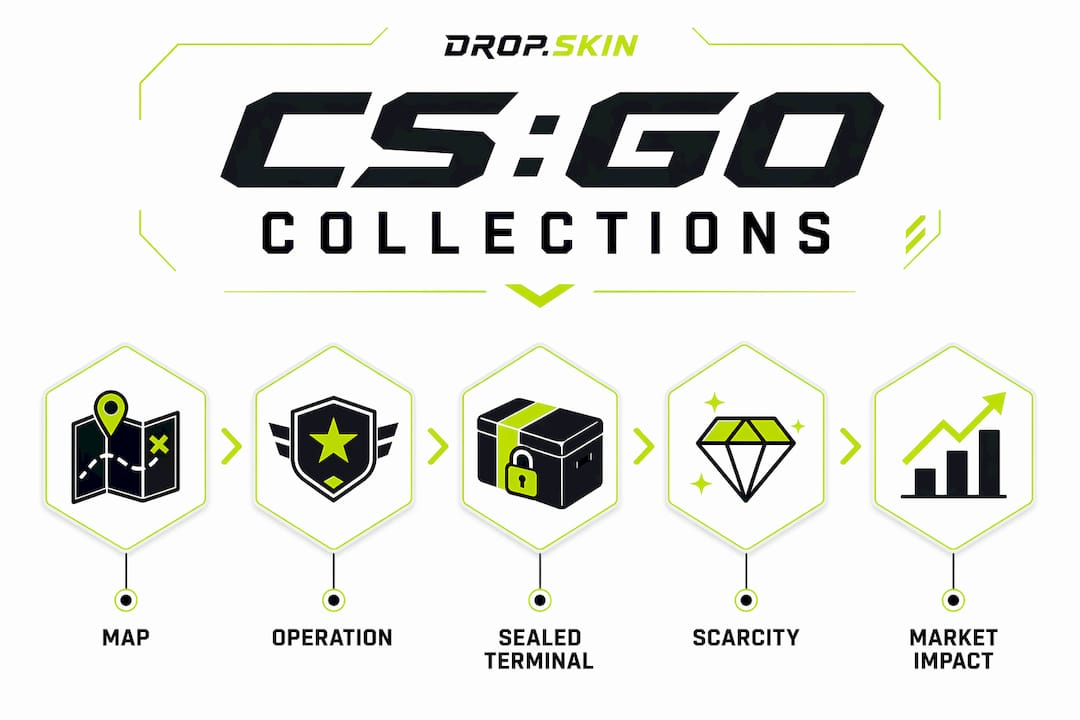
CS:GO and CS2 organize skins into three distinct collection types, and each one behaves differently in the market. Three main categories exist: Map Collections, Operation Collections, and Sealed Terminal Collections. Knowing which type a skin belongs to tells you almost everything about its long-term value.
Map Collections are the most accessible. They drop as weekly rewards through the game's drop system and contain primarily low-tier skins. Critically, they include no knives and no gloves. The Dust 2, Mirage, and Italy Collections are classic examples. Because they keep dropping indefinitely, their supply stays high and prices stay low for most skins.
Operation Collections work on a completely different logic. They are released during limited-time Operation events and removed from the drop pool once the event ends. The Norse and St. Marc Collections are well-known examples. Once an Operation closes, no new skins enter the supply. That hard cap on supply is what makes Operation skins appreciate over time.
Sealed Terminal Collections represent the current primary system in CS2. These are the most feature-rich releases, often including new weapon skins and gloves together. The Dead Hand Collection, released in march 2026, is a strong example. It features 17 weapon skins and 22 glove finishes, making it the first collection to include gloves since 2020. That combination of weapons and gloves in one set makes Sealed Terminal releases the most anticipated drops in the current meta.
Pro Tip: When a new Sealed Terminal Collection drops, the glove skins often spike in price within the first 48 hours before the market corrects. Watch the timing before buying.
The type of collection a skin belongs to directly determines its scarcity. Operation and Sealed Terminal skins face supply caps that Map Collection skins never encounter. That structural difference is why two skins with similar visual quality can have wildly different price tags.
How do collections affect gameplay and trading mechanics?
Collections are the engine behind the Trade-Up Contract system, which is the most direct way collections affect actual gameplay decisions. The Trade-Up Contract works like this: you input 10 skins of the same rarity tier, and the game outputs one skin of the next rarity tier up. The collection those input skins belong to determines which collection the output skin comes from.
If all 10 input skins come from the same collection, the output is guaranteed to come from that same collection. If you mix skins from multiple collections, the output probability splits proportionally across those collections. That mechanic has been empirically validated to within 1% accuracy in the CS2 ecosystem. It means collection identity is not just a label. It is a mathematical variable in every trade-up calculation.
Here is how the Trade-Up Contract process works in practice:
- Select your rarity tier. All 10 input skins must share the same rarity (Consumer Grade, Industrial Grade, Mil-Spec, etc.).
- Choose your source collection. Sticking to one collection locks your output to that collection's next-tier skins.
- Identify the target skin. Research which high-tier skin from that collection you want, then work backward to find the cheapest inputs.
- Calculate float values. The output skin's float is an average of the input floats. Lower float inputs produce better-condition outputs.
- Execute and repeat. Profitable trade-up chains often require multiple rounds to reach the target tier.
The most counterintuitive insight in CS:GO trading is that low-tier "junk" skins from retired collections can be worth serious money. Consumer Grade skins from The Cobblestone Collection, for example, hold significant value because traders need them as trade-up inputs to reach the collection's higher-tier skins. A skin that looks worthless in isolation becomes valuable the moment it is the cheapest path to something rare.
Pro Tip: Before buying trade-up inputs, check whether the target output skin is actually worth more than the combined cost of 10 inputs plus Steam's transaction fees. Many trade-ups look profitable on paper but break even or lose money after fees.
Why do collections matter culturally and economically?
Collections function as mini economic ecosystems within CS:GO. Scarcity, cultural recognition, and associative demand all operate at the collection level, not just the individual skin level. A skin's value is partly determined by the status of the set it belongs to.
The cultural weight of older, retired collections is real and measurable. Legacy sets carry rarity, nostalgia, and esports exposure that newer collections cannot replicate. When a professional player uses a skin from a specific collection on a major tournament stage, demand for that entire collection rises. The individual skin gets attention, but the whole set benefits.
Valve has recognized the power of themed aesthetics. Collections like Harlequin and Achroma group skins by visual palette and style rather than just by map. That approach deepens emotional investment. Players who love a specific color scheme or art direction want every skin in the set, not just one. That "complete the set" psychology drives higher trading volume and longer engagement with the collection.
Here is what makes collections culturally significant beyond their market price:
- Map identity. Collections tied to iconic maps like Dust 2 or Mirage carry the history of those maps. Owning a Dust 2 Collection skin is a statement about your relationship with the game's most played map.
- Era markers. Skins from early CS:GO collections mark specific periods in the game's history. Collectors treat them the way sports fans treat vintage jerseys.
- Esports legacy. Collections associated with major tournaments or professional players carry prestige that purely aesthetic collections do not.
- Community recognition. Rare collection skins signal experience and investment to other players. They function as social currency within the CS:GO community.
The skin economy is built on these cultural layers. Stripping them away would leave a much thinner market.
How to acquire and manage CS:GO collections effectively
Getting skins from specific collections requires a clear strategy because the acquisition method varies by collection type. You have four main paths: weekly drop rewards, opening collection packages, direct trading with other players, and Trade-Up Contracts. Each path has a different cost structure and risk profile.
Weekly drops give you Map Collection skins for free, but you cannot choose which collection you receive. Trading gives you precision but costs market price. Trade-Up Contracts let you target specific collections if you control your inputs. Opening collection packages gives you a random skin from a specific set, which balances targeting with chance.
Key practices for managing your collection portfolio:
- Track retirement dates. When a collection leaves the active drop pool, its supply freezes. Buying before retirement is announced is almost always cheaper than buying after.
- Focus trade-ups within one collection. Mixing collections in your inputs dilutes your chances of hitting the target skin. Single-collection trade-ups give you predictable outcomes.
- Prioritize StatTrak weapon skins. StatTrak variants command a 30–80% premium over non-StatTrak skins. Gloves do not have StatTrak, so weapon skins are the primary vehicle for StatTrak value in any collection.
- Watch float values on inputs. If you are targeting a Factory New output, you need Factory New or Minimal Wear inputs. Mixing floats wastes money.
- Monitor esports exposure. When a pro player uses a specific collection's skin in a major tournament, that collection's prices move fast. Being ahead of that curve is a real edge.
| Acquisition method | Cost control | Collection targeting | Speed |
|---|---|---|---|
| Weekly drops | Free | None | Slow |
| Direct trading | Market price | High | Fast |
| Collection packages | Variable | High | Fast |
| Trade-Up Contracts | Calculated | High | Medium |
The cultural and profit angle of collecting becomes clearest when you combine collection knowledge with consistent acquisition habits. Collectors who understand collection types, retirement cycles, and trade-up math consistently outperform those who buy skins based on looks alone.
Key Takeaways
Collections are the structural backbone of CS:GO's skin economy, and understanding their types, mechanics, and cultural weight is the difference between collecting randomly and building real value.
| Point | Details |
|---|---|
| Three collection types | Map, Operation, and Sealed Terminal collections each have different supply limits and market behavior. |
| Trade-Up Contract math | Single-collection inputs guarantee output from that collection; mixed inputs split probability proportionally. |
| Junk skin value | Low-tier skins from retired collections hold real market value as trade-up inputs for higher-tier targets. |
| StatTrak premium | StatTrak weapon skins command a 30–80% premium; gloves have no StatTrak, making weapons the priority. |
| Cultural demand | Retired and esports-exposed collections carry legacy value that newer collections cannot replicate quickly. |
Dropskin's take on where collections are heading
Collections have shifted from being a cosmetic feature to functioning as the primary economic and cultural infrastructure of CS:GO. That shift is not slowing down. The move toward visually themed sets like Harlequin and Achroma tells me Valve is deliberately engineering emotional attachment at the collection level, not just the skin level. Players are no longer buying individual skins. They are buying into a set's identity.
The most undervalued opportunity right now is in recently retired collections that have not yet received esports exposure. These sets have capped supply but have not hit peak demand. Once a professional player picks up a skin from one of these collections in a major event, prices move fast and the window for affordable entry closes.
For new collectors, my advice is straightforward. Pick one collection type to understand deeply before spreading your attention. Sealed Terminal Collections are the best starting point in 2026 because they combine weapon skins, gloves, and active market liquidity. Learn the trade-up math for that collection, track its float values, and you will build a stronger portfolio than most players who have been collecting for years.
The collectors who treat collections as economic ecosystems rather than cosmetic catalogs are the ones who consistently come out ahead. That mindset is the real edge.
— Dropskin
Dropskin's tools for building your CS:GO collection
Knowing how collections work is only half the equation. Having the right tools to act on that knowledge is the other half.
Dropskin gives you direct access to CS2 case openings and skin upgrades built specifically for collectors who want to move up the rarity ladder without paying full market price. The skin upgrader lets you trade lower-tier skins for a chance at higher-tier skins from the same collection, which mirrors the logic of Trade-Up Contracts but with a faster, more direct interface. Whether you are targeting a specific Sealed Terminal skin or trying to complete a set, Dropskin's platform gives you the tools to do it efficiently and at a price point that makes sense for active traders.
FAQ
What is a CS:GO collection?
A CS:GO collection is a themed group of weapon skins that share a common source, such as a map or event. Collections determine how skins are obtained, their rarity structure, and their role in Trade-Up Contracts.
How do collections affect Trade-Up Contracts?
When all 10 input skins in a Trade-Up Contract come from the same collection, the output skin is guaranteed to come from that collection. Mixing collections splits the output probability proportionally across the input collections.
Why are old CS:GO collections worth more?
Retired collections have a fixed supply that cannot grow. Combined with nostalgia, esports exposure, and historical significance, that supply cap drives prices higher over time compared to actively dropping collections.
What is the StatTrak premium in collections?
StatTrak variants of weapon skins typically command a 30–80% price premium over standard versions. Gloves do not have StatTrak, so weapon skins are the primary target for collectors focused on StatTrak value.
How do I get skins from a specific collection?
You can acquire skins from a specific collection through weekly drop rewards (Map Collections only), direct trading, opening collection packages, or using Trade-Up Contracts with inputs from that collection.