TL;DR:
- Rarity in CS2 skins sets a baseline but does not determine their true market value, which depends on multiple factors. Float values, wear tiers, pattern indexes, StatTrak, and stickers all influence price, making skin grading a layered process. Understanding these elements enables traders and collectors to make smarter, data-driven decisions in a complex marketplace.
Most collectors assume the rarest skin is automatically the most valuable. That's the first mistake. Explaining skin grades in CS2 means understanding a layered system where rarity is just the starting point. Float values, wear tiers, pattern indexes, StatTrak status, and sticker condition all combine to set the actual market price. Miss any of these factors and you will either overpay consistently or sell quality skins short. This guide breaks down every grading dimension so you can make smarter calls in the marketplace.
Table of Contents
- Key takeaways
- Skin rarity tiers explained
- Float values and wear levels
- Pattern index, StatTrak, Souvenir, and stickers
- How to assess skin grades when trading
- My honest take on skin grading
- Put your skin knowledge to work on Dropskin
- FAQ
Key takeaways
| Point | Details |
|---|---|
| Rarity sets the floor, not the ceiling | Rarity determines drop odds, but float, pattern, and demand drive the final price. |
| Float values are fixed forever | A skin's float is locked at creation and never changes, so buy carefully. |
| Wear tiers have named ranges | Factory New runs 0.00 to 0.07 while Battle-Scarred covers 0.45 to 1.00. |
| StatTrak and Souvenir add real premiums | StatTrak can raise a skin's price by 15 to 100 percent depending on demand. |
| Pattern index matters only on select skins | Finishes like Fade or Crimson Web have rare pattern variants worth significant premiums. |
Skin rarity tiers explained
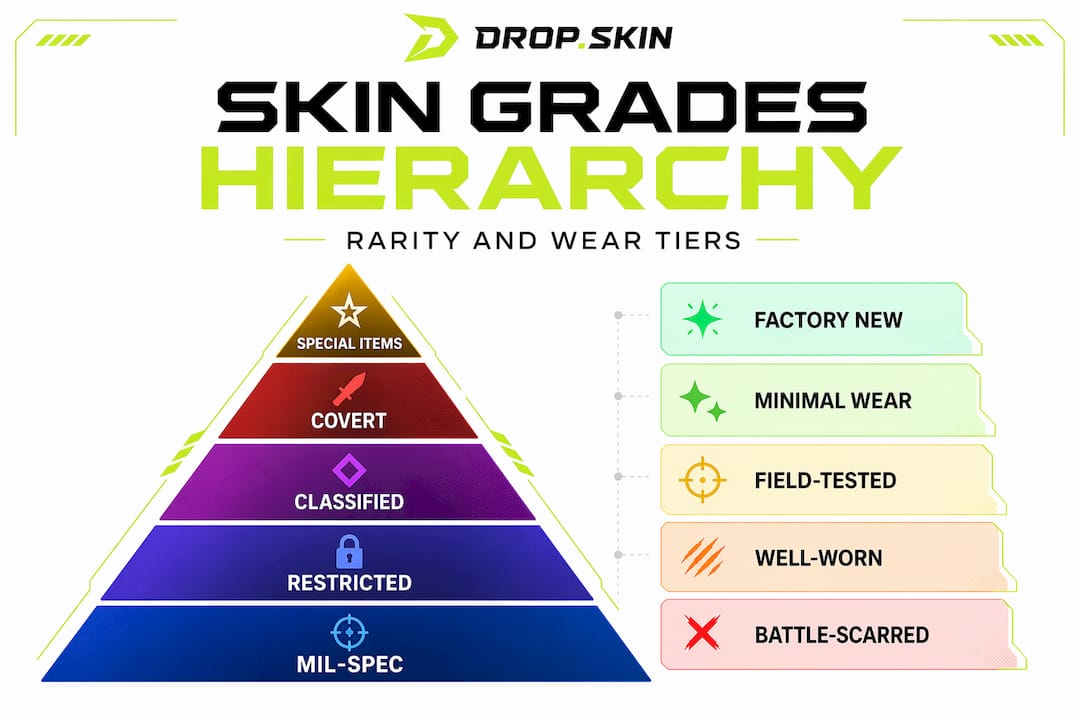
CS2 organizes every skin into a color-coded rarity system. Drop odds are tiered by rarity with Mil-Spec appearing most frequently and Covert items appearing rarely. This is the scaffolding that supports understanding skin grades at every other level.
Here is a breakdown of all seven tiers and their approximate drop rates from cases:
| Rarity tier | Color | Drop chance | Notes |
|---|---|---|---|
| Consumer Grade | White | Not in cases | Base-level skins, map drops only |
| Industrial Grade | Light blue | Not in cases | Slightly above base, map drops |
| Mil-Spec | Blue | ~79.92% | Most common case drop |
| Restricted | Purple | ~15.98% | About 1 in 6 odds |
| Classified | Pink | ~3.20% | About 1 in 31 odds |
| Covert | Red | ~0.64% | About 1 in 156 odds |
| Contraband | Orange | Extremely rare | Only the M4A4 Howl |
Knives and gloves fall under a separate "Special Items" category sitting at roughly 1 in 385 odds, which explains their astronomical prices on the Steam Community Market.
One misconception worth squashing: higher rarity does not automatically mean higher price. A Mil-Spec skin with a pristine float and heavy demand can trade above a mediocre Classified skin that nobody wants. Market prices reflect a complex interplay of rarity, wear, float, pattern, and supply-demand rather than rarity alone. Knowing this changes how you shop entirely.
Pro Tip: Check the CS2 skin rarity guide on the Dropskin blog to see how rarity tiers interact with case odds and collection value before you start spending real money on upgrades.
Float values and wear levels
This is where skin condition grading gets genuinely interesting. Every CS2 skin receives a float value between 0.00 and 1.00 at the moment it drops. That number is fixed forever. It never degrades from use. It never improves. You live with it.
That float gets sorted into one of five wear buckets:
- Factory New (FN): Float 0.00 to 0.07. Cleanest possible condition, minimal scratches, highest price ceiling.
- Minimal Wear (MW): Float 0.07 to 0.15. Light wear, barely visible. A popular sweet spot for value buyers.
- Field-Tested (FT): Float 0.15 to 0.38. Visible wear but still sharp-looking on most skins. The most common trade tier.
- Well-Worn (WW): Float 0.38 to 0.45. Noticeable scuffs and scratches. Prices drop significantly here.
- Battle-Scarred (BS): Float 0.45 to 1.00. Heavy wear across the entire skin. Usually the cheapest tier.
CS2 running on the Source 2 engine changed how wear actually looks. The engine introduced volumetric wear and dynamic lighting for scratched surfaces, which made high-float skins far more visually distinct than they were in CS:GO. On some skins, that wear creates unique aesthetics that collectors actively seek out.
The "Blackiimov" is the perfect example. The AWP Asiimov in Battle-Scarred condition has its scope paint worn completely off, creating a blacked-out scope that many collectors prefer over the Factory New version. Collectors regularly pay premiums for extreme float visual appearances like this.

For mid and high-value skins, the exact float number within a tier matters too. A Factory New AK with a float of 0.003 trades at a real premium over the same skin at 0.069, even though both carry the FN label. For skins valued over $50, exact float becomes a primary pricing factor. Third-party float checkers like CSFloat let you see that precise number before committing to a purchase.
Pro Tip: Never buy an expensive skin without verifying the exact float using a third-party tool. The Steam Market label only shows the wear tier, not the number inside it. A "Field-Tested" skin at 0.151 and one at 0.379 are in the same bucket but worth very different amounts.
Pattern index, StatTrak, Souvenir, and stickers
Beyond rarity and float, four additional factors shape how traders and collectors price specific skins. Understanding these layers is the difference between rating skin types accurately and leaving serious money on the table.
-
Pattern index. Every skin with a non-solid finish is generated from a template, and a pattern index between 0 and 999 determines which portion of that template appears on the weapon. Most indexes are unremarkable. A few are worth multiples of the base price. Pattern index drives value in select finishes like Karambit Fade phases, where a "full fade" index trades far above a partial one, or Crimson Web knives, where a full centered web on the blade commands a massive premium. For generic finishes like solid paints, pattern index is completely irrelevant.
-
StatTrak skins. These track confirmed kills and display the count on the weapon. That single feature boosts skin prices by 15 to 100 percent depending on the specific skin and current demand. The premium is widest on popular Covert weapons and knives.
-
Souvenir skins. Dropped only during official Valve tournaments, Souvenir skins carry gold stickers from the event, teams, and the player involved in the round they dropped from. They cannot roll StatTrak and exist outside the normal case system entirely. A Souvenir Dragon Lore or Souvenir Medusa from a major tournament can sell for thousands of dollars above the base Covert price.
-
Stickers. Applied to any skin's four slots, stickers can add or subtract value depending on what they are and where they sit. High-tier tournament stickers add huge premiums when applied cleanly to visible spots. Katowice 2014 holos and IBP/Titan paper stickers are the headline examples. A well-placed Kato 2014 holo on an AK-47 can increase the skin's price by hundreds of dollars. Scratched or cheaply applied stickers? Those often hurt the value instead.
How to assess skin grades when trading
Putting all of this into practice requires a structured approach. Randomly browsing the Steam Market without a checklist will cost you money over time. Here is how experienced traders evaluate skins:
- Verify the rarity first. Check the skin's collection and confirm the tier color. Know whether you are working with Classified or Covert before looking at price.
- Pull the exact float. Use a third-party float checker before buying anything above $20. The label on Steam is not specific enough.
- Check the pattern index if it applies. Look up whether the finish has known premium pattern variants. For AK-47 Case Hardened, Blue Gem pattern indexes are publicly cataloged and change the price dramatically.
- Factor in StatTrak or Souvenir status. Decide whether the premium is worth it to you or whether a non-ST version gives better value per visual quality.
- Evaluate stickers on the specific skin. Research what stickers are applied and their current market value. A worn-down sticker of no significance could be covering a desirable patch of the skin's design.
- Check recent sale history. Steam's price history graph shows actual trade volume. A skin with no recent sales is illiquid. Getting out of that position later may take weeks.
Skin value in CS2 is always driven by the combination of all these factors, not one alone. When you understand how they interact, you can spot underpriced skins with strong fundamentals and avoid paying inflated prices for skins with one impressive attribute but weak supporting factors.
Pro Tip: Trade Up Contracts follow a specific rule where 10 skins of one tier produce one skin of the next higher tier, with a special rule requiring five Covert skins to produce a knife or glove. Running the math on these contracts before using them can reveal whether the trade is genuinely profitable or a losing bet.
My honest take on skin grading
I've spent enough time watching traders get burned to say this clearly: rarity is the most overrated factor in skin valuation. I've seen players drop serious money on a Covert skin with a terrible float, a forgettable pattern, and no sticker interest, all because it had a red name and looked expensive on the market listing. Meanwhile, a Restricted knife with a near-zero float and a premium pattern went for triple its tier's expected price and nobody blinked.
What I've learned is that the CS2 market rewards precision. Not enthusiasm, not intuition. Precision. The collectors who consistently profit are the ones who know that a Field-Tested skin with an exact float near the Minimal Wear boundary can carry a significant premium over a mid-range FT. They know which Fade percentages matter. They track sticker prices separately from skin prices.
The hardest lesson? Pattern and sticker valuation is genuinely subjective and volatile. A tournament sticker worth $800 today might soften over the next two years as supply from older inventories surfaces. I've seen collectors overpay for sticker skins assuming the premium holds forever. It does not always.
My recommendation is to study the master skin collecting guide for CS2 and start with one or two grading factors you understand deeply before adding more. Trade volume beats trade complexity for beginners. Build the knowledge first. The profit follows.
— DROPSKIN
Put your skin knowledge to work on Dropskin
Now that you understand how rarity, float, pattern, and condition all shape skin value, you can actually use that knowledge to your advantage. Dropskin gives you direct tools to act on it.
Open CS2 cases across an extensive collection on Dropskin's case opening platform and see exactly which tier and condition you land. If you already have a decent inventory, the CS2 skin upgrader lets you put your grading knowledge to work directly, turning lower-tier skins into higher-value ones through a process that actually rewards knowing your float ranges and rarity tiers. Dropskin also runs regular giveaways and offers promo codes for new users, making it a genuinely low-barrier entry point for collectors at any level.
FAQ
What does skin grade mean in CS2?
Skin grade refers to a combination of rarity tier, wear level, and float value that determines a skin's visual condition and market value. It goes beyond the color-coded rarity system to include float precision and additional factors like pattern and StatTrak status.
What is a float value and why does it matter?
A float value is a number between 0.00 and 1.00 assigned to a skin at creation that determines its wear appearance and never changes. For expensive skins, the exact float within a wear tier significantly affects the price.
How many wear tiers exist in CS2?
CS2 uses five wear tiers: Factory New, Minimal Wear, Field-Tested, Well-Worn, and Battle-Scarred. Each corresponds to a specific float range, with Factory New covering 0.00 to 0.07 and Battle-Scarred covering 0.45 to 1.00.
Does StatTrak always increase a skin's price?
Yes, StatTrak versions consistently sell at a premium, with price increases ranging from 15 to 100 percent depending on the skin's tier and demand. The premium is largest on high-demand Covert skins and knives.
Are Battle-Scarred skins ever worth more than Factory New?
Yes. Some skins like the AWP Asiimov develop unique visual effects at extreme float values that collectors pay premiums for, making specific Battle-Scarred versions more desirable than their cleaner counterparts.