
TL;DR:
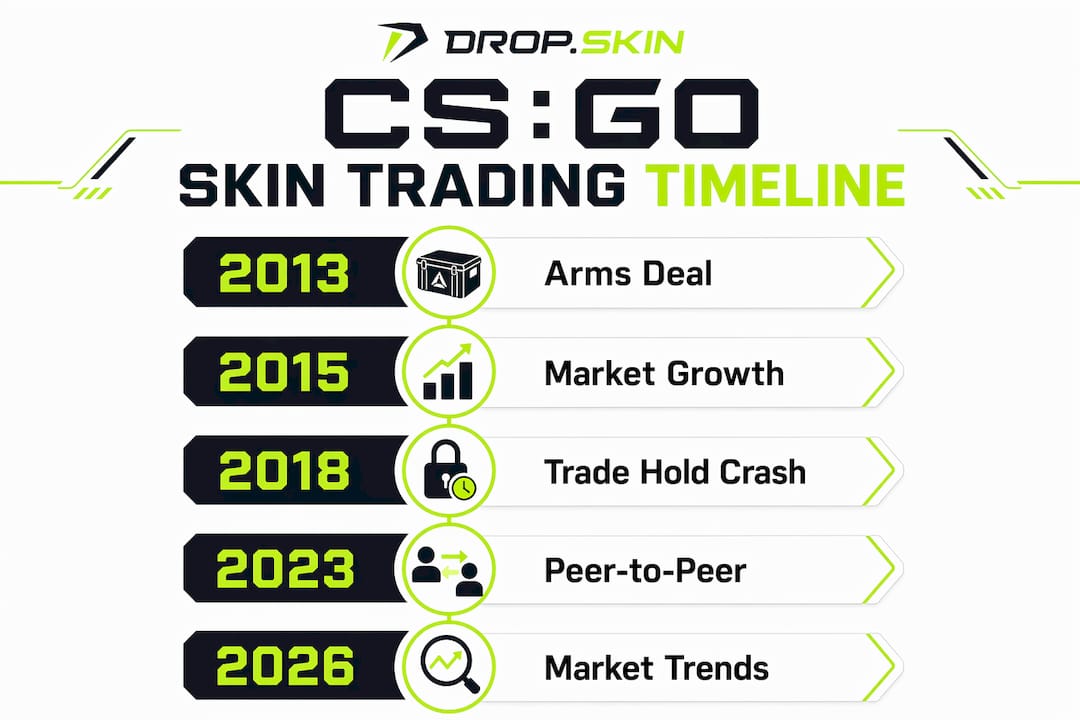
- CS:GO skin trading began with Valve's Arms Deal Update in 2013, creating a player-driven economy with value linked to rarity and history. Major policy changes in 2018 shifted the market from bot-based to peer-to-peer trading, increasing resilience and transparency. The market continues to mature, with high-rarity skins and provenance driving sustained demand and valuation.
CS:GO skin trading is the buying, selling, and exchanging of cosmetic weapon skins within a virtual marketplace that Valve created on august 14, 2013, with the Arms Deal Update. That single update launched one of the most complex player-driven economies in gaming history. What started as a cosmetic feature grew into a market where individual items sell for thousands of dollars and entire communities form around rarity, float values, and pattern indexes. Understanding the history of CS:GO skin trading explains not just where the market came from, but why it still drives so much of the CS2 ecosystem today.
How did CS:GO skin trading start?
Valve's Arms Deal Update introduced 18 weapon skins, nine weapon cases, rarity tiers, and the StatTrak kill counter on august 14, 2013. The original cases included the Bravo Case, the eSports 2013 Case, and the Winter Offensive Case. Each case required a separately purchased key, which created a revenue stream for Valve from day one.

The Steam Community Market launched alongside the update, giving players a direct way to buy and sell skins using Steam Wallet funds. Valve charged a 5% transaction fee on every sale. That fee model meant Valve earned money every time a skin changed hands, aligning the company's financial interests with a healthy, active trading community.
Early third-party platforms like CSGOLounge appeared quickly. CSGOLounge let players bet skins on professional match outcomes, which introduced a gambling layer that massively accelerated trading volume. The community reception was electric. Players who had never cared about cosmetics started opening cases, chasing rare drops, and learning the difference between Factory New and Battle-Scarred condition grades.
- The Arms Deal Update introduced rarity tiers: Consumer, Industrial, Mil-Spec, Restricted, Classified, Covert, and the ultra-rare Special items.
- StatTrak technology tracked confirmed kills, adding a personal history layer that made individual skins feel unique.
- The Steam Community Market gave players a legitimate, Valve-backed venue for transactions.
- Third-party sites extended trading into gambling, betting, and case-opening formats almost immediately.
Pro Tip: If you want to understand skin rarity mechanics before trading, start with the rarity tier system. Knowing the difference between Mil-Spec and Covert items is the foundation of every smart trade.
What major events shaped the CS:GO skin market?
The 2015 to 2016 period was the market's wildest growth phase. Third-party gambling sites multiplied rapidly, with platforms processing millions of dollars in skin bets every week. Valve sent cease-and-desist letters to dozens of operators in july 2016, citing violations of the Steam Subscriber Agreement. Several high-profile YouTubers faced public backlash for promoting gambling sites they secretly owned. The scandal drew mainstream media attention and regulatory scrutiny across multiple countries.
"The 2018 trade hold was the single most disruptive policy change in the history of CS:GO skin trading. It didn't just slow the market. It restructured it entirely."
Valve's response came in march 2018 with a 7-day trade hold on all items traded to non-friends. The effect was immediate and severe. Skin liquidity dropped by roughly 90%. Automated bot marketplaces, which depended on instant item transfers, could no longer function at scale.
- OPSkins, one of the largest third-party skin marketplaces, shut down in june 2018 after the trade hold made its bot-based model unworkable.
- Skin prices crashed 30–50% across most categories in the months following the policy change.
- Smaller platforms that relied on rapid bot trades either closed or pivoted their business models.
- The Steam Community Market gained market share by default, as it was exempt from the trade hold restrictions.
The market did not collapse permanently. It reorganized. Peer-to-peer trading platforms emerged to replace bot marketplaces, keeping items in user inventories until the moment of exchange. That shift made platforms harder to shut down and more resilient to future policy changes.
How have skin valuations shifted through recent market cycles?
The CS skin market lost about a third of its value between september 2025 and may 2026. That correction hit broad market indices hard. The recovery, however, was not uniform. Knives recovered 245% from their cycle lows by june 2026, though they remained 12% below their pre-crash highs. That gap matters because it shows knives are recovering faster than the general market but have not fully reset.
The divergence between asset tiers is the most important pattern in recent CSGO skin market trends. Median skin prices drift sideways during down cycles while high-rarity collectibles appreciate 25–60% in the same period. Souvenir Major skins and blue gem Case Hardened patterns are the clearest examples. Their supply is permanently fixed, which insulates them from dilution by new case releases.
| Asset tier | Market behavior | Example |
|---|---|---|
| Common weapon skins | High volume, sideways price drift | AK-47 Redline |
| Knives and gloves | High volatility, strong recovery cycles | Karambit Doppler |
| Souvenir skins | Appreciation even in down markets | Souvenir AWP Dragon Lore |
| Blue gem patterns | 30–60% appreciation 2024–2026 | Case Hardened AK-47 #661 |
Float value premiums have also matured significantly. In 2026, mid-tier skins like the M4A4 Desolate Space in Factory New command 40–60% price premiums for sub-0.01 float values compared to standard 0.06 floats. That same premium was only 15–25% in 2023. Collectors are paying more for hyper-rare float variants than ever before.
Pro Tip: Check the 2026 skin trading trends before making any high-value purchase. The float premium gap between sub-0.01 and standard floats has widened dramatically and shows no sign of reversing.
How did third-party skin marketplaces evolve?
CSGOLounge and OPSkins defined the first generation of third-party skin trading. Both platforms used automated bots to hold and transfer items, which made transactions fast and frictionless. CSGOLounge focused on match betting. OPSkins focused on direct sales with real-money pricing. At their peak, these platforms processed more daily volume than the Steam Community Market.
Valve's 2018 crackdown ended that era. The shift to P2P trading developed as a direct survival mechanism. P2P platforms keep items in the seller's Steam inventory until the trade executes, which means no bots hold items and no bot accounts can be banned. The tradeoff is slower transactions and more complex logistics, but the model is far more durable.
- CSGOLounge pioneered skin-based match betting, creating the first major third-party trading community.
- OPSkins built a real-money marketplace that gave skins a clear dollar value outside of Steam.
- Valve's 2018 trade hold destroyed the bot-based model and forced platform operators to rebuild.
- P2P platforms like Skinport and Buff163 emerged as the dominant model post-2018.
- Float databases and pattern indexes became standard tools, giving traders transparent pricing data for rare variants.
The float database tools deserve specific credit. Before these tools existed, pricing a rare blue gem pattern required personal expertise or community knowledge. Now, any trader can look up the exact pattern index of a Case Hardened skin and compare it against historical sales. That transparency raised the floor for informed trading across the entire market.
Why is CS:GO skin trading culturally significant?
CS:GO skin trading created a collector culture that has no real parallel in gaming history. Skins became status symbols inside matches, on streaming platforms, and across social media. A player carrying a Karambit Fade or an AWP Dragon Lore signals something to every other player in the server. That social signaling function is why skins hold value far beyond their cosmetic purpose.
The collector sub-economies are genuinely complex. Souvenir skins from Major tournaments carry the autographs of the players who competed in those matches. That ties a skin's value to esports history. An AWP Dragon Lore from a Major final where a legendary player competed is not just a skin. It is a piece of competitive gaming history with a permanent, verifiable record on Steam.
- Autograph capsules from CS:GO Majors created a secondary market tied directly to esports results and player legacies.
- Rare pattern indexes like the AK-47 Case Hardened "blue gem" turned a common skin into a five-figure collectible.
- Streaming culture amplified skin visibility, with top streamers' inventories becoming aspirational benchmarks for their audiences.
- The skin economy guide for CS2 shows how these cultural layers now inform pricing models across the entire market.
Some 2020–2022 cases gained over 366% in value, outperforming Bitcoin's 256% gain and the S&P 500's 81% return over the same period. That comparison is not an argument for treating skins as investments. It is evidence that the cultural demand driving skin prices is real, measurable, and capable of producing returns that rival traditional asset classes in specific segments.
Key Takeaways
The history of CS:GO skin trading is a story of Valve's 2013 Arms Deal Update creating a virtual economy that survived regulatory crackdowns, market crashes, and platform shutdowns to become one of gaming's most mature digital asset ecosystems.
| Point | Details |
|---|---|
| Origins in 2013 | Valve's Arms Deal Update introduced skins, cases, rarity tiers, and the Steam Community Market on august 14, 2013. |
| 2018 trade hold crisis | Valve's 7-day trade hold caused a 90% liquidity drop and ended the bot-based marketplace era. |
| Rarity drives value | High-rarity items like blue gem patterns and Souvenir Majors appreciate even during broad market corrections. |
| P2P replaced bots | Peer-to-peer platforms emerged post-2018 as the durable model for third-party skin trading. |
| Cultural depth matters | Skins carry social, historical, and collector value that sustains demand independent of game updates. |
Dropskin's take on where this market is heading
The market has proven one thing repeatedly: it does not die, it adapts. Every time Valve changed the rules, the community found a new structure. The 2018 trade hold looked like a death blow. Instead, it produced a more resilient P2P ecosystem and a sharper focus on genuine rarity rather than volume-driven speculation.
What I find most interesting is how the market has matured its pricing signals. Float values, pattern indexes, and souvenir provenance are now priced with real precision. That level of sophistication in a gaming economy is remarkable. It means the community has built genuine expertise over a decade of trading.
The next phase will likely deepen that expertise further. As CS2 continues to release new cases and the player base grows, the fixed supply of legacy items from 2013 to 2018 will only become more scarce. The traders who understand skin trading terminology and rarity mechanics today are positioning themselves well for what comes next.
— Dropskin
Dropskin: put your skin knowledge to work
The history of CS:GO skin trading is fascinating to study. Acting on that knowledge is where things get interesting.
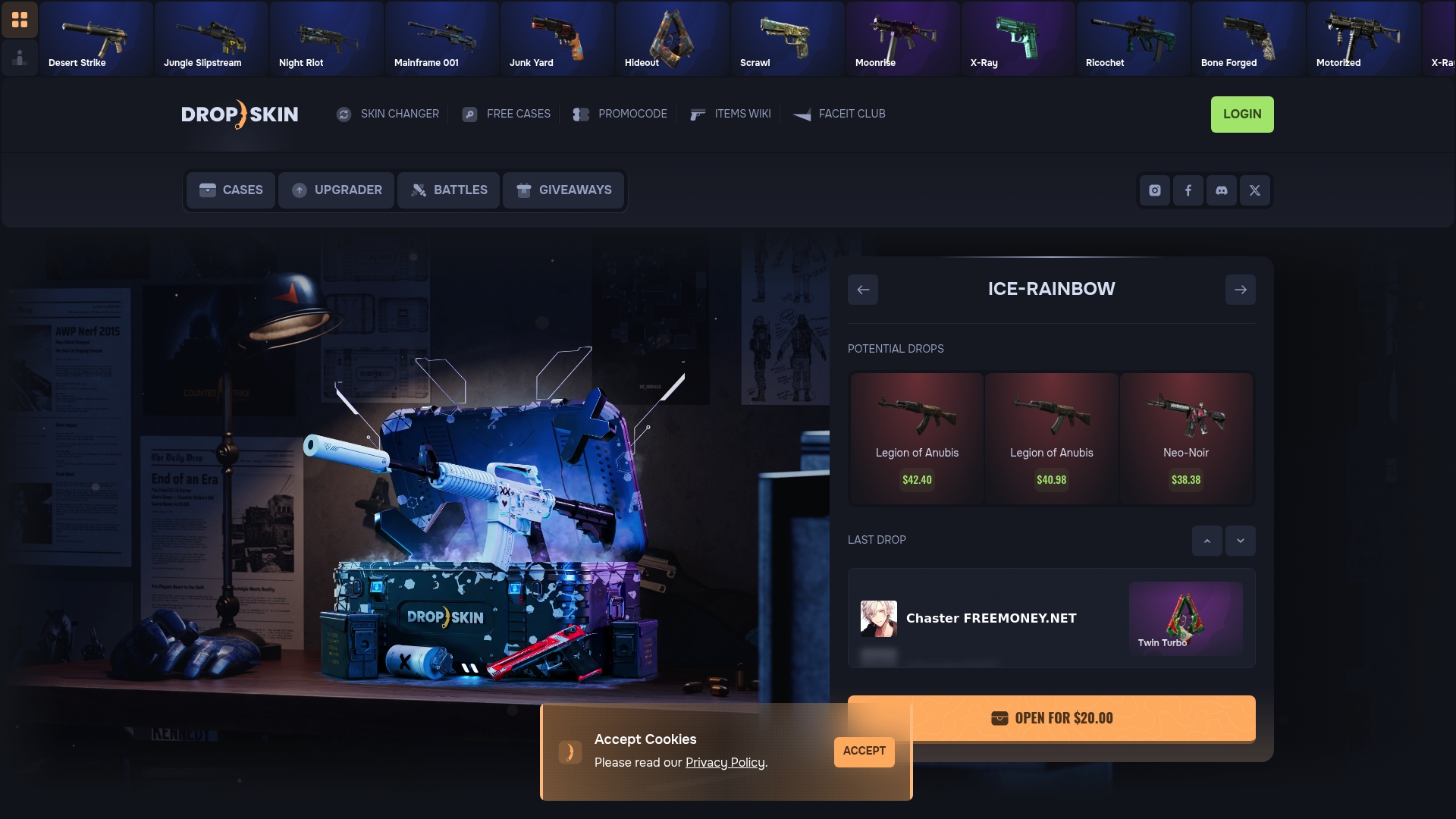
Dropskin gives you a direct way to upgrade your inventory through CS2 skin upgrading, case openings, and PvP case battles. If you have a collection of lower-value skins and want to trade up, the upgrader tool is built exactly for that. You can also jump into active case battles to compete against other players for better skins in a format that rewards both knowledge and nerve. Dropskin combines the trading and collecting sides of the skin economy into one platform, making it a practical next step for anyone who just spent time learning how this market works.
FAQ
When did CS:GO skin trading start?
CS:GO skin trading started on august 14, 2013, when Valve released the Arms Deal Update. That update introduced weapon skins, rarity tiers, StatTrak technology, and the Steam Community Market.
What caused the biggest crash in CS:GO skin trading history?
Valve's 7-day trade hold in march 2018 caused a 90% drop in skin liquidity and a 30–50% price crash. The policy ended the bot-based marketplace era and forced the market to restructure around peer-to-peer trading.
Are CS:GO skins a good investment?
Skin performance varies sharply by segment. Some 2020–2022 cases gained over 366%, outperforming Bitcoin and the S&P 500, but the broad skin market has underperformed the S&P 500 by 55 percentage points over the same period. Segment selection is everything.
What makes a CS:GO skin rare and valuable?
Rarity comes from a combination of drop tier, float value, pattern index, and provenance. Blue gem Case Hardened patterns and Souvenir Major skins with player autographs carry the highest premiums because their supply is permanently fixed.
How did third-party skin marketplaces change after 2018?
After Valve's 2018 trade hold ended bot-based trading, platforms shifted to peer-to-peer models that keep items in user inventories until the moment of exchange. This made platforms more secure and harder for Valve to shut down.