
TL;DR:
- Rarity is the primary factor driving skin value due to limited supply and market demand.
- Higher rarity skins, especially Covert and Special tiers, have significantly higher market prices.
- Understanding rarity and condition helps traders and collectors optimize their investments and trades.
How rarity impacts skin value in CS:GO and CS2
Most players assume a skin's price comes down to how cool it looks. That's a reasonable starting point, but it misses the biggest driver of value in the CS:GO and CS2 economy: rarity. A skin's rarity tier controls how often it can appear from cases, which directly limits supply, and limited supply pushes prices up. Whether you're buying your first Covert rifle skin or trying to flip knives for profit, understanding how rarity works gives you a real edge in every trade you make.
Table of Contents
- What rarity means in CS:GO and CS2 skins
- How rarity determines skin value on the market
- Rarity vs. other skin value factors: What really matters?
- How to leverage rarity: Market strategies for collectors and traders
- The truth about rarity obsession: Beyond the numbers
- Upgrade your skin collection with DROP.SKIN
- Frequently asked questions
Key Takeaways
| Point | Details |
|---|---|
| Rarity sets the price | The rarer the CS:GO or CS2 skin, the higher its potential market value due to limited supply. |
| Not all value is rarity | Other factors like condition and community demand can boost or undercut a skin’s price. |
| Market trends shift fast | Event-driven hype, eSports trends, or changes in drop rates can quickly affect rare skin prices. |
| Smart collectors use data | Tracking rarity tiers, market averages, and timing helps traders maximize gains with rare skins. |
What rarity means in CS:GO and CS2 skins
Rarity, in the CS:GO and CS2 skin world, refers to how frequently a skin can be obtained from in-game cases or drops. It's not a subjective label based on how a skin looks. It's a hard-coded classification system built by Valve that determines both how often a skin appears and how many exist in circulation. As skin rarity tiers influence in-game drops and market supply, every tier has a direct effect on how many copies of a skin can realistically exist.
The rarity system uses color-coded tiers that players and traders treat almost like a universal language. Here's how the tiers stack up from most common to most exclusive:
- Consumer Grade (white): The most common skins with the highest drop rate
- Industrial Grade (light blue): Slightly less common, but still widely available
- Mil-Spec (blue): The first tier where scarcity starts to matter to casual traders
- Restricted (purple): A noticeable step up in rarity and, usually, price
- Classified (pink): Rare enough that demand often outpaces supply
- Covert (red): The top standard tier, associated with the most desirable rifle and pistol skins
- Contraband (orange): A one-of-a-kind tier currently occupied only by the Souvenir M4A4 Howl, which was removed from its original case after a copyright issue
- Special (yellow/gold): Reserved for knives and gloves, representing the most coveted drops in the game
To put those tiers into concrete numbers, here's a simplified look at the approximate odds of receiving each rarity from a standard CS2 case:
| Rarity tier | Approximate drop chance |
|---|---|
| Consumer Grade | ~79.92% |
| Industrial Grade | ~15.98% |
| Mil-Spec | ~3.20% |
| Restricted | ~0.64% |
| Classified | ~0.32% |
| Covert | ~0.064% |
| Special (knife/gloves) | ~0.026% |
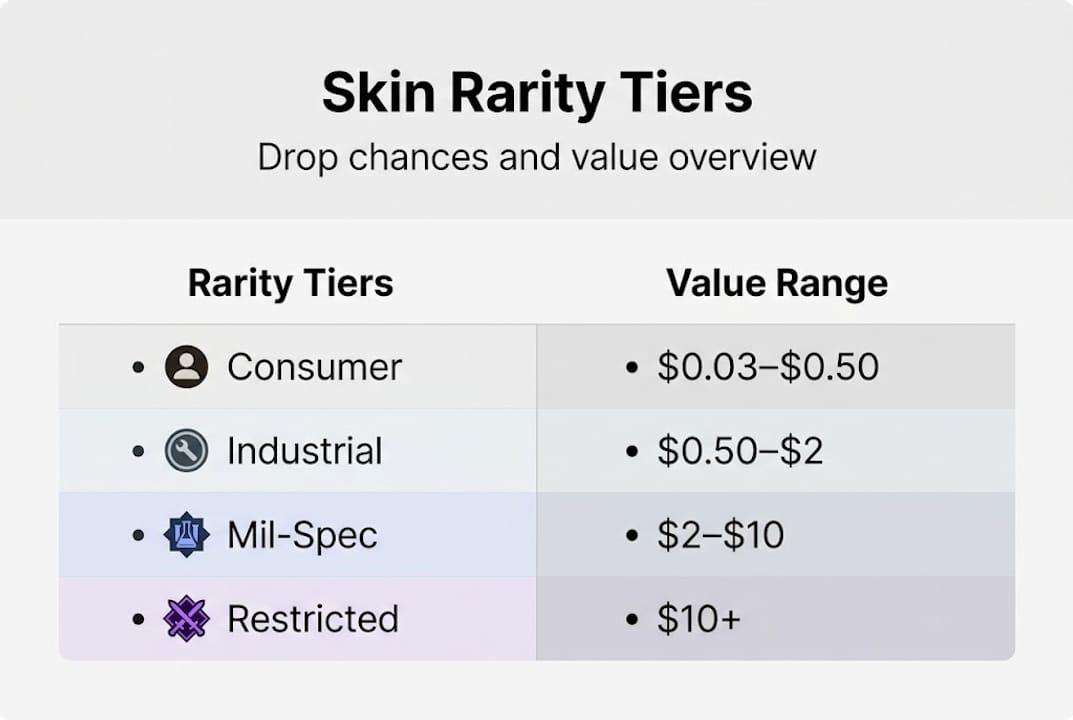
These numbers make it obvious why Covert and Special skins command premium prices. You can open hundreds of cases and never see one.
To check the rarity of a skin you already own or are considering buying, you can:
- Hover over the skin in your Steam inventory and look at the color border
- Check the item description page directly inside CS2
- Use third-party sites like the CS2 skin rarity overview to cross-reference tier, float, and market price at once
- Search the skin on community market databases that list rarity alongside pricing history
Rarity matters to collectors and traders because it is the closest thing to a guarantee of long-term value. A skin might look average, but if only 0.064% of case opens can produce it, the supply stays permanently low while demand grows over time.
How rarity determines skin value on the market
Now that we know how rarity is measured, let's see how it actually drives the prices you see in the market.
The core economic logic is simple. When skin value is most influenced by rarity level and market supply, low drop rates mean fewer skins enter circulation each day. Fewer skins in the market means sellers can charge more because buyers have fewer options. This is not speculation. It's the same supply and demand principle that makes rare trading cards or limited sneaker drops expensive.
Here's a comparison table that shows how dramatically price shifts between rarity tiers, using real-world examples from typical CS2 case pools:
| Skin example | Rarity tier | Estimated market price |
|---|---|---|
| MP5-SD Acid Wash | Consumer Grade | $0.03 to $0.10 |
| P250 Mehndi | Industrial Grade | $0.05 to $0.20 |
| Glock-18 Oxide Blaze | Mil-Spec | $0.30 to $1.50 |
| AK-47 Point Disarray | Restricted | $2.00 to $8.00 |
| M4A1-S Hyper Beast | Classified | $15.00 to $50.00 |
| AK-47 Wild Lotus | Covert | $800.00 to $2,500.00 |
| Karambit Fade (knife) | Special | $1,000.00 to $4,000.00+ |
The price gaps between tiers are staggering. A Consumer Grade skin can cost pennies while a Covert skin from the same case can run into the hundreds or thousands of dollars. That's not just aesthetics at work. That's rarity doing the heavy lifting.
Hype events make this effect even more dramatic. When a new case drops, the initial excitement drives enormous case opening volume. Covert and Special skins that appear in the first wave of openings often get listed at inflated prices before the market stabilizes. Traders who understand rarity and price impact know to watch these launch windows carefully.
Pro Tip: Use market tracking tools like Steam Community Market history or third-party price trackers to monitor price movements for newly released Covert and Special skins during the first 48 to 72 hours after a case drops. Early sellers often underprice panic listings, giving smart buyers a real advantage.
CS2 introduced some nuances compared to CS:GO. Because CS2 operates on an updated engine, older CS:GO skins that carried over became a distinct collector category. Some of these legacy skins carry extra value because they represent a fixed, historical supply that will never increase. Knowing whether you're dealing with a legacy skin or a current-era drop matters when you assess skin value factors on the market.

Rarity vs. other skin value factors: What really matters?
But rarity isn't the only thing that affects value. Let's compare how it stacks up to other popular factors.
According to research on key value factors, multiple factors including rarity, design, and demand all contribute to a skin's value. Here's how those factors actually break down in practice:
What most gamers think matters:
- The design looks premium or flashy
- The weapon is a popular pick in competitive play
- A pro player was seen using that skin in a tournament
- The skin has a cool name
What actually drives prices:
- Rarity tier and the case drop odds associated with it
- Float value (also called wear level), which determines how scratched or clean the skin looks
- Total supply currently listed on the market
- Demand spikes tied to community events or eSports moments
- Whether the skin has been discontinued or is still in active case pools
- Pattern index for skins with randomized visual outcomes, like the Doppler or Case Hardened
Float value (a number ranging from 0.00 to 1.00 that reflects how worn a skin appears) interacts with rarity in a powerful way. A Factory New Covert skin and a Battle-Scarred Covert skin might share the same rarity tier, but the Factory New version can be worth ten times more. Float doesn't override rarity. It multiplies or discounts the rarity premium based on condition.
"A rare skin with a poor condition rating can sit unsold for months, while the same skin in Factory New condition triggers bidding wars."
This is where things get interesting for collectors who are thinking about collecting digital skins as a long-term hobby. Rarity creates the ceiling for how valuable a skin can become. Condition, design, and demand determine where within that ceiling a specific copy lands.
There are real scenarios where rarity alone isn't enough. Consider a skin from a very old case that has an extremely low drop rate but features a design most players find unattractive. The rarity is there, but community demand is missing. Prices stagnate. On the flip side, a Classified skin attached to a weapon that dominates the current competitive meta, like an AK-47 or an M4A1-S variant, can outperform many Covert skins simply because player demand is relentlessly high.
The skin collectibles impact on trading markets shows that community psychology and cultural relevance can occasionally punch above rarity's weight. But over a long enough time horizon, rarity almost always wins.
How to leverage rarity: Market strategies for collectors and traders
Once you know how rarity and other factors interact, you can start putting this information to work.
Understanding rarity tiers and scarcity trends allows smarter market moves and better collection strategies. Here's a practical step-by-step approach:
- Learn every tier in your target case. Before opening or buying, look up the full skin pool for the case you're interested in. Note which skins sit at Covert or Special rarity and research their current market prices and historical trends.
- Identify undervalued Classified and Restricted skins. These tiers sit right below Covert in rarity but often get overlooked. New players flood to the flashiest Covert skins while ignoring Classified pieces that have similar scarcity dynamics at a fraction of the price.
- Track newly released cases in their first week. The first 72 hours after a case drops create pricing chaos. Some rare skins get panic-listed cheaply, while others spike unnaturally. Watch without buying immediately to separate real trends from hype.
- Hold Covert and Special skins during major tournament seasons. eSports events drive viewership, which drives demand for premium skins. A knife or Covert rifle skin held through a Major tournament season often appreciates noticeably.
- Flip Restricted and Mil-Spec skins for faster liquidity. Lower rarity skins move faster on the market because more buyers exist at lower price points. For traders who want quick turnover rather than long holds, mid-tier rarity offers the best volume.
- Build a reputation around rare holdings. In the trading community, your inventory signals your credibility. Holding a few genuinely rare skins, even without actively trading them, signals that you understand value and builds trust for future deals.
Pro Tip: Watch for sticker capsule releases and eSports event sticker drops. Skins that already have rare stickers applied from past tournaments can carry a premium completely separate from the skin's own rarity tier. A Mil-Spec skin with a $200 foil sticker on it can outprice a Covert skin with no stickers at all.
Building a collection through the lens of skin collecting culture also has real social value. Within the CS2 community, your loadout tells other players what kind of collector or trader you are. Rare skins open doors to high-value trades that average inventories simply cannot access.
The truth about rarity obsession: Beyond the numbers
Here's something veteran collectors and traders learn only after years in the market: the relentless chase for the rarest possible skin can quietly drain the joy out of the whole experience.
Conventional wisdom in the community says that only Covert skins and knives are worth your attention. It's treated almost like a rule. But that framing causes a lot of players to spend months grinding toward a single acquisition and then feel empty once they have it. The hunt consumed all the fun.
What long-time traders and collectors will tell you, if they're being honest, is that the skins they enjoy most aren't always the rarest ones. They're the ones tied to a specific memory, a clutch round, a team win, or a trade that took real skill to negotiate. Rarity informs why skins are valuable from a market perspective, but personal value and market value are two very different things.
The smartest approach is to use rarity as a framework for trading decisions, not as a personal scorecard. Know your tiers, understand the supply dynamics, and use that knowledge to build a collection that actually reflects what you enjoy about the game. A clean Factory New Classified skin on your favorite rifle, at a price that didn't require you to liquidate half your inventory, can feel more rewarding than a Covert skin you resent buying.
Upgrade your skin collection with DROP.SKIN
If you want to put your knowledge of rarity into action, here's where to take the next step.
At DROP.SKIN, we built the tools collectors and traders actually need. Browse the full CS2 skins wiki to research rarity tiers, float ranges, and price history before you commit to any trade.
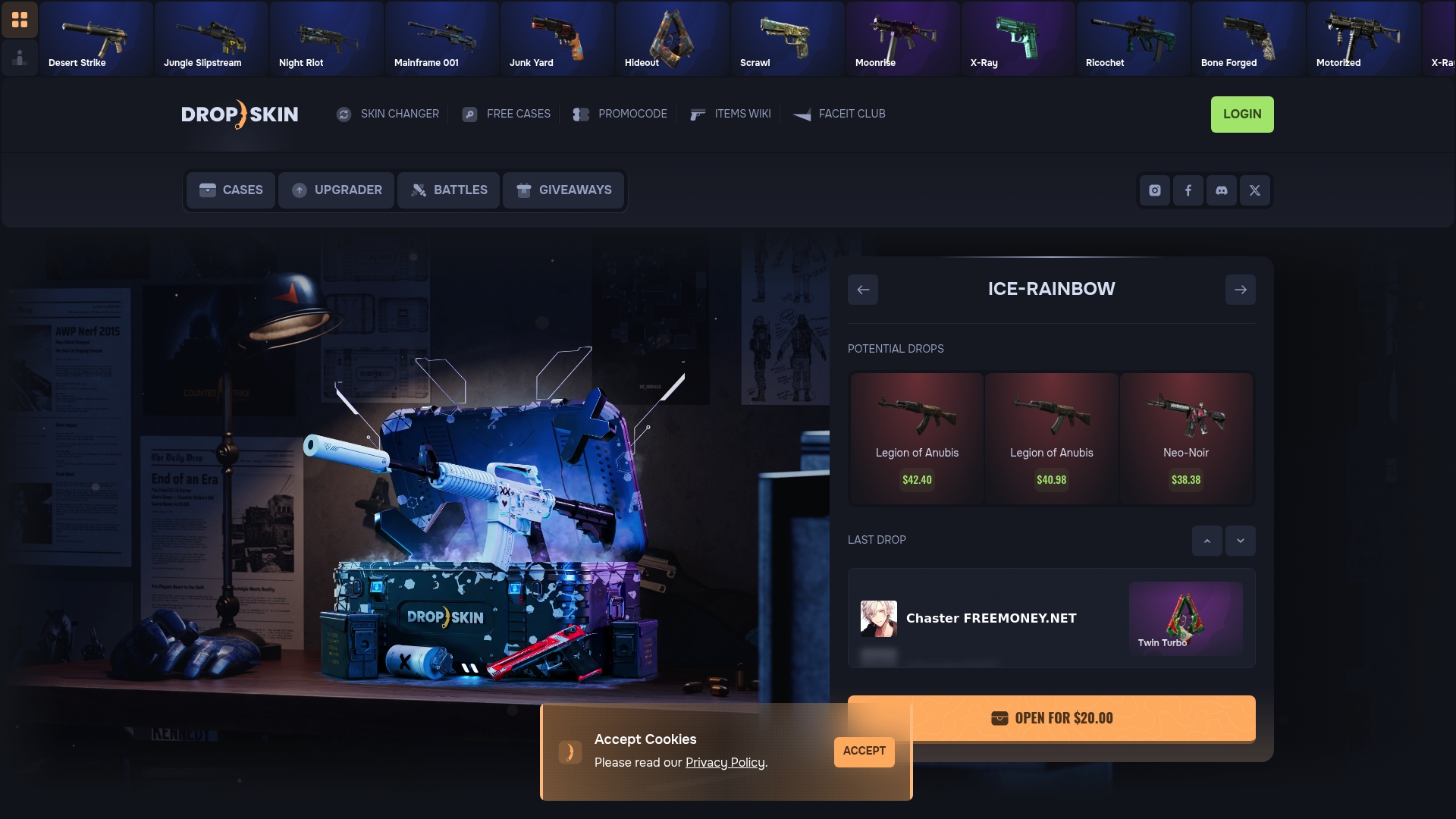
Want to turn lower-rarity skins into higher-value pieces? Our skin upgrader lets you put your existing inventory to work, transforming cheaper skins into something with real market weight. If you'd rather test your luck and chase those Covert or Special drops directly, open CS2 cases from our extensive catalog and experience the thrill of the rarest pulls at competitive odds. Fast, safe, and built for serious skin collectors.
Frequently asked questions
How are skin rarity tiers determined in CS:GO and CS2?
Rarity tiers and drop odds are defined by Valve and built into each case's loot table, assigning fixed percentages to each tier before any case is opened.
Does a skin's condition affect its value as much as its rarity?
Both matter significantly, but rarity is usually dominant, with condition acting as a multiplier that increases or reduces the value within the range rarity sets.
Can a common skin ever become valuable?
Yes. Community demand can create value for common skins when they are discontinued, featured by a popular streamer, or tied to a memorable community moment.
Where can I check real-time values and rarity tiers for my skins?
DROP.SKIN's wiki offers up-to-date rarity breakdowns and price data so you can research any skin before buying or selling.