
TL;DR:
- Probability in CS2 and CS:GO skin drops is a layered system of independent chances covering rarity, item, float, and StatTrak. Understanding this system helps players stop chasing luck and make decisions based on math and probabilities.
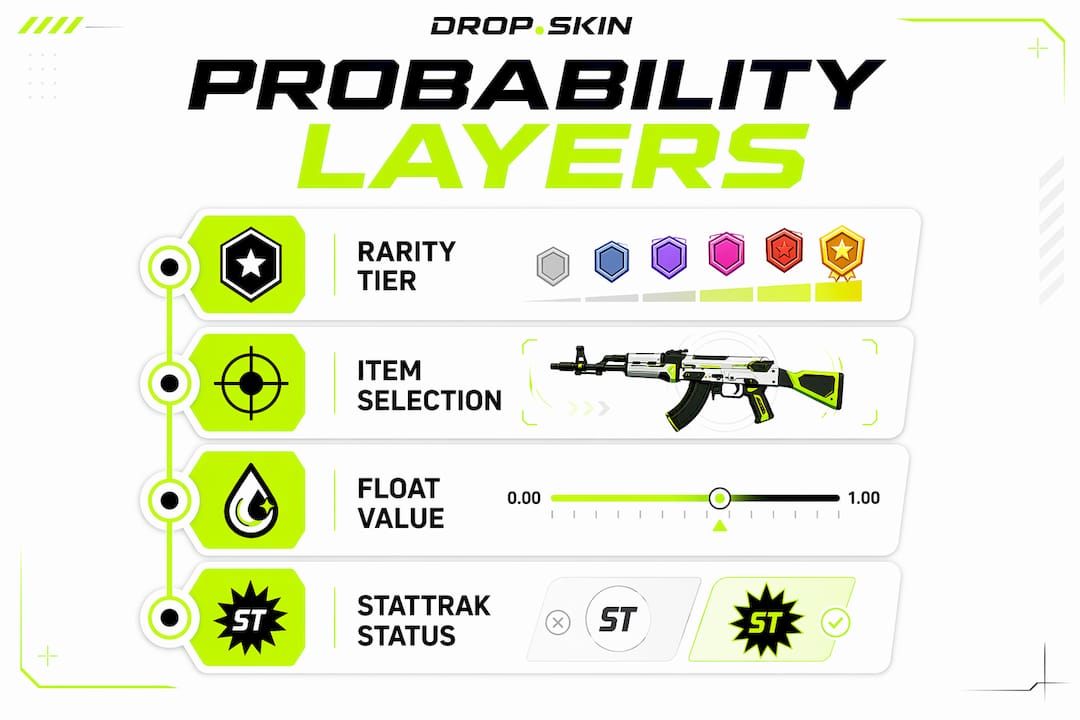
Probability governs every skin drop outcome in CS2 and CS:GO, functioning as the mathematical framework that determines how likely you are to receive skins of different rarities and qualities. The role of probability in skin drops is not a single number. It is a layered system of independent chances stacked on top of each other, covering rarity tiers, specific item selection, float wear ranges, and StatTrak status. Players who understand this system stop chasing luck and start making decisions grounded in math. That shift changes everything about how you approach case openings and skin acquisition.
How probability layers determine skin drop outcomes in CS2 and CS:GO
Skin drops in CS2 operate through a conditional, layered probability model. Each layer is independent, meaning the outcome of one does not affect the others. Treating each layer as a separate event is the only way to calculate accurate rarity estimates.

The rarity tier layer
The first layer is rarity tier selection. CS2 rarity tiers carry fixed probabilities: Mil-Spec at 79.92%, Restricted at 15.98%, Classified at 3.20%, Covert at 0.64%, and Knife or Gloves at 0.26%. These numbers mean that for every 1,000 cases you open, you can statistically expect roughly 800 Mil-Spec drops and fewer than 3 Knife or Gloves drops. The gap between the most common and rarest tier is enormous, and most players underestimate it.
The item selection and float layers
Once a rarity tier is selected, the game picks a specific skin from that tier with uniform probability. If a case contains 8 Covert skins, each has a 1-in-8 chance of being selected. After item selection, the float value is drawn from a continuous distribution, which determines the wear condition from Factory New to Battle-Scarred. Not all float ranges are equally wide, so some wear conditions are rarer than others even within the same skin.
The StatTrak layer
StatTrak status is an independent roll applied after rarity tier selection, carrying roughly a 10% chance. A StatTrak Covert skin therefore has a combined probability of approximately 0.064% per case opening. That is about 1 in 1,563 cases just to land a StatTrak Covert, before accounting for which specific skin or float range you want.
Compound probability and extreme rarity
Multiplying all four layers together produces the true probability of a specific outcome. A particular knife finish with a specific float tier and StatTrak status can reach a probability near 1 in 5.2 million per case. That figure illustrates why certain skins feel mythical. They are not just rare. They are mathematically extreme.
| Rarity tier | Base drop chance | StatTrak combined chance |
|---|---|---|
| Mil-Spec | 79.92% | ~7.99% |
| Restricted | 15.98% | ~1.60% |
| Classified | 3.20% | ~0.32% |
| Covert | 0.64% | ~0.064% |
| Knife / Gloves | 0.26% | ~0.026% |
Pro Tip: Multiply the rarity tier probability by the item count within that tier, then by the float tier probability, then by 0.10 for StatTrak. That four-step calculation gives you the true per-case odds for any specific skin you are targeting.
What are the biggest misconceptions about skin drop randomness?
The most damaging belief in the CS2 community is that losing streaks increase your odds on the next roll. Each drop attempt is fully independent. A failed case opening does not move you closer to a rare skin. The system has no memory. Every roll starts fresh at the same fixed probabilities.
Here are the most common myths that cost players money and frustration:
- The hot streak myth. Winning several good skins in a row does not mean the system is "running hot." Each roll is independent, and past results carry zero weight.
- The due fallacy. Opening 50 cases without a Covert does not make case 51 more likely to produce one. The probability resets to 0.64% every single time.
- The manipulation belief. Many players attribute streaks to platform manipulation when the math of independent events naturally produces long dry spells. A 0.64% chance means you will go 100+ cases without a Covert about 52% of the time.
- The "almost" illusion. Seeing a knife land one slot away on the case animation is a visual effect. It has no relationship to actual probability outcomes.
Cumulative probability is the correct tool for setting expectations. The formula is 1 minus (1 minus p) raised to the power of N, where p is the per-case drop chance and N is the number of cases opened. To have a 50% cumulative chance of landing a Knife or Gloves, you need to open approximately 266 cases. To reach 90% cumulative probability, you need roughly 884 cases. Those numbers reframe the conversation from luck to volume.
Pro Tip: Before opening a batch of cases, calculate your cumulative probability using the 1-(1-p)^N formula. Set a case budget that aligns with the cumulative odds you are comfortable with, not with a feeling that you are "due" for a win.
How does probability affect skin acquisition strategies and expected value?
Expected value (EV) is the mathematical foundation of any smart skin acquisition strategy. EV is calculated as the sum of each possible outcome's probability multiplied by its market value, minus the cost of the case and key. The typical EV for a CS2 case sits at 25–45% of the total case cost. That means opening cases is, on average, a losing financial proposition. Knowing that does not mean you should stop. It means you should know what you are actually buying.
Here is a practical framework for using probability to guide your strategy:
- Calculate EV before opening. Look up current market prices for every skin in a case, weight them by their drop probabilities, and compare the result to the case cost. If EV is 30% of cost, you are paying a 70% premium for entertainment and variance.
- Separate entertainment value from investment value. Case openings are high-variance gambles where one jackpot can offset many losses. Treat them as lottery tickets, not savings accounts.
- Use the market instead of cases for target skins. If you want a specific Covert skin, buying it directly on the Steam Community Market or a trading platform is almost always cheaper than opening cases to find it.
- Track your actual results over time. Variance dominates short-run outcomes, but over hundreds of openings, your results will converge toward the mathematical median. Tracking helps you see this clearly.
- Time your purchases around market cycles. Skin prices fluctuate based on new case releases, major CS2 tournaments, and community events. Buying during price dips and holding through demand spikes is a strategy grounded in skin value fluctuation patterns, not luck.
"Players who understand EV and variance can approach case openings as strategic investments rather than pure luck, resulting in better cumulative outcomes over time." — Silicon Insider
How does probability shape skin rarity rankings and market pricing?
Probability-based rarity and demand-driven price are related but not the same thing. Skin price is influenced by mathematical rarity and also by market demand, discontinued item circulation, and community prestige. A skin can be mathematically rare and still trade cheaply if nobody wants it. Conversely, a moderately rare skin with strong visual appeal can command prices far above its statistical scarcity.
The most extreme cases of rarity come from compounding all four probability layers. Some skins carry per-roll probabilities as low as one in billions when you account for pattern bucket, float tier, and StatTrak status together. Factory New condition alone is not enough to make a skin truly scarce. Adding a rare pattern index and StatTrak status multiplies the rarity by orders of magnitude.
| Rarity driver | Probability-based | Demand-based |
|---|---|---|
| Knife with specific finish | Very low (1 in millions) | High demand sustains price |
| StatTrak Factory New Covert | ~0.064% × float probability | Strong collector demand |
| Common Mil-Spec skin | ~79.92% base rate | Low demand, low price |
| Discontinued case skin | Fixed probability | Scarcity from case removal drives premium |
Savvy collectors use probability data alongside market trends to identify undervalued skins. A skin with extreme mathematical rarity but low current demand may appreciate significantly as supply shrinks over time. Understanding the key factors affecting skin value gives you an edge that pure price-watching never will.
Pro Tip: Cross-reference a skin's mathematical rarity with its Steam Market volume. Low volume plus high rarity often signals a collector opportunity before the broader market notices.
Key takeaways
Probability in CS2 skin drops is a layered, independent system where each roll resets to fixed odds, and informed players consistently outperform those who rely on intuition alone.
| Point | Details |
|---|---|
| Rarity tiers are fixed | Knife or Gloves drop at 0.26%; Mil-Spec at 79.92% every single roll. |
| Layers compound rarity | Combining tier, item, float, and StatTrak can push odds to 1 in 5.2 million. |
| Drops are independent | Prior failures never increase your next drop chance; the gambler's fallacy is costly. |
| EV is usually negative | Typical case EV is 25–45% of cost; treat openings as entertainment, not investment. |
| Rarity and price diverge | Mathematical scarcity and market demand drive price separately; use both to find value. |
Dropskin's take on playing the odds smarter
The biggest mistake I see players make is treating probability as an obstacle rather than a tool. When you open 20 cases and get nothing above Restricted, that is not bad luck. That is exactly what the math predicts most of the time. The moment you accept that, your entire approach to skin acquisition changes.
Embracing variance was the shift that changed how I think about case openings. I stopped measuring success by individual sessions and started measuring it by strategy over time. A single jackpot on a Knife or Gloves is a statistical outlier, not a signal that your method is working. What actually works is combining probability knowledge with market timing. Buy skins when demand is low. Understand which float ranges are genuinely rare versus just marketed as rare. Use the skin economy guide to understand how trading markets price rarity versus demand.
The players who build strong inventories over time are not luckier. They are more patient, more informed, and more honest about what the numbers actually say.
— Dropskin
How Dropskin helps you use probability to get better skins
Dropskin gives CS2 and CS:GO players the tools to act on probability knowledge rather than just read about it. The platform displays case odds transparently so you know exactly what you are rolling before you spend a dollar.
The CS2 Skin Upgrader on Dropskin lets you convert lower-value skins into higher-tier ones, giving you a structured way to climb the rarity ladder without relying entirely on raw case luck. If you want to open CS2 cases with full visibility into the math behind every roll, Dropskin is built for exactly that. Giveaways, promo codes, and a transparent odds display make it the platform for players who take skin acquisition seriously.
FAQ
What is the base drop chance for a knife in CS2?
The Knife and Gloves rarity tier carries a fixed drop probability of 0.26% per case opening. That translates to roughly 1 in 385 cases before accounting for which specific knife or finish you want.
Does opening more cases increase my odds per roll?
No. Each case opening is an independent event, so prior results never affect the next roll's probability. More cases increase your cumulative probability of eventually hitting a rare skin, but each individual roll always resets to the same fixed odds.
How do I calculate cumulative drop probability?
Use the formula 1 minus (1 minus p) raised to the power of N, where p is the per-case probability and N is the number of cases. This tells you the probability of getting at least one target skin across your planned openings.
Why are some rare skins cheap and some common skins expensive?
Skin price reflects both mathematical rarity and market demand. A skin can be statistically rare but unpopular, keeping its price low. A moderately rare skin with strong visual appeal or pro player association can trade far above its statistical scarcity.
What is expected value in CS2 case openings?
Expected value is the average return per case calculated by multiplying each skin's drop probability by its market price and summing the results, then subtracting the case cost. Most CS2 cases return 25–45% of their cost in EV, meaning the house edge is significant.