
TL;DR:
- Rarity tiers classify CS:GO and CS2 skins by scarcity and market value, serving as pricing anchors and signals. Price and demand depend on additional factors like community interest, collection age, float, and pattern, not rarity alone. Traders should analyze multiple variables and market activity to make informed decisions, rather than relying solely on rarity classifications.
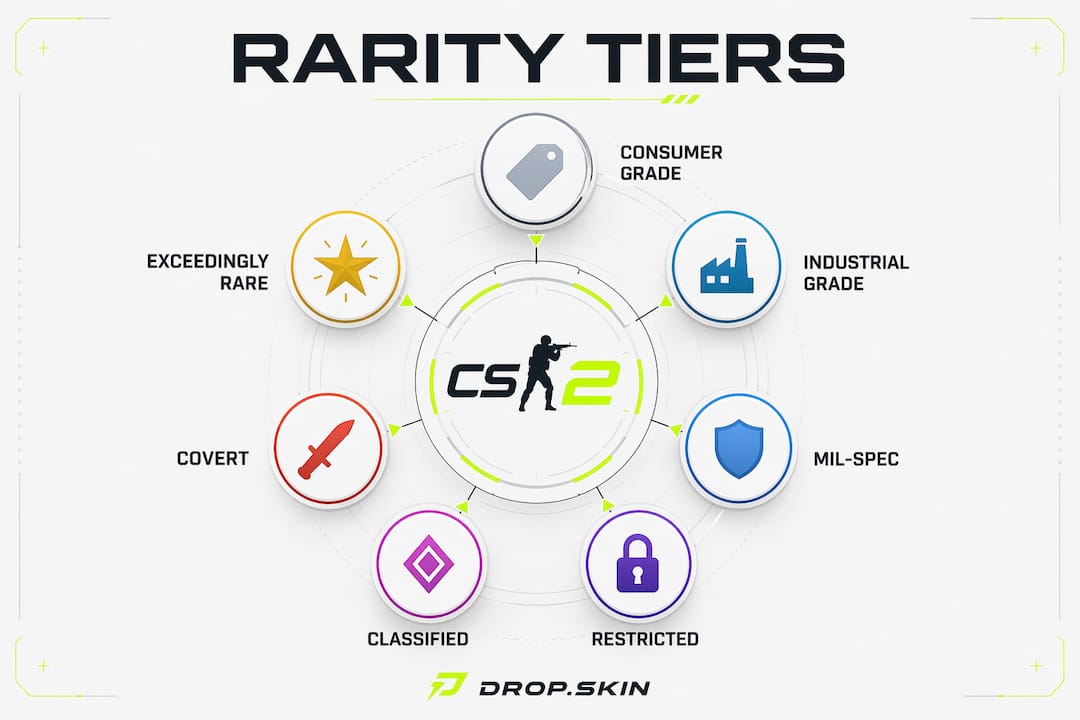
Rarity tiers are the primary classification system that organizes CS:GO and CS2 skins by scarcity and market value. The role of rarity tiers goes beyond simple labeling. These tiers function as pricing anchors and visual signals, giving traders and collectors an instant read on a skin's position in the market. The CS2 system runs from Consumer Grade at the bottom through Mil-Spec, Restricted, Classified, and Covert at the top, with the ultra-rare Special category above all. Understanding this ladder is the foundation of every smart trading and investment decision in the skin economy.
How do rarity tiers affect skin pricing and market value?
Rarity tiers set the floor for skin pricing, not the ceiling. Every tier in the CS2 system carries an implied baseline value that traders use as a reference point before factoring in condition, pattern, or demand. Without that baseline, the market would have no shared language for pricing.

Tier pricing follows bracketed scaling, where costs roughly double between tiers with some flexibility for seasonal items and special collaborations. That doubling effect creates a mental price ladder. A Mil-Spec skin trading at $1–$3 signals a very different conversation than a Covert skin trading at $50–$200. Traders who internalize this ladder can spot mispriced listings faster than those who evaluate every skin from scratch.
Higher tiers also reflect greater production investment. Covert and Classified skins typically feature more complex visual assets, animations, or particle effects than Consumer Grade items. That visual complexity reinforces the price premium and makes the tier signal credible to buyers. When the visual quality matches the rarity label, market trust holds.
Inconsistencies in rarity-to-price relations erode player trust in the market. This is why developers maintain drop rate structures where common items appear at high frequency and legendary or Covert items appear at well below 1% of drops. The scarcity is real, and the pricing reflects it.
Pro Tip: Use rarity tier as your first filter when scanning listings, but always cross-reference with recent sales history. A skin priced below its tier baseline is either a deal or a warning sign worth investigating.
The critical limit to understand is this: rarity sets supply constraints, but it does not guarantee demand. A Covert skin from an unpopular collection can sit below the price of a Mil-Spec skin that every player wants. Rarity tier classifications tell you how rare something is. They do not tell you how much anyone wants it.
Why rarity alone does not determine a skin's real price
Higher rarity sets a supply ceiling but does not assure a higher market price. This is the single most common mistake new collectors make. They buy high-rarity skins expecting automatic returns, then watch lower-tier community favorites outperform them for months.
Demand is driven by community preferences, esports visibility, and cultural momentum. A skin worn by a top-ranked CS2 professional during a major tournament can spike in value regardless of its tier. The esports scene directly shapes skin demand in ways that rarity tier classifications simply cannot predict.
Age and discontinuation add another layer. Older skins from discontinued collections outperform current skins of equal rarity because their total supply is permanently capped. A Classified skin from a retired 2014 collection can command prices that rival newer Covert items. Historical release frequency matters as much as the official rarity label.
Key factors that override rarity tier in price determination:
- Community demand: Skins tied to popular maps, operations, or cultural moments carry premiums that rarity cannot explain.
- Esports association: Professional player usage at major events creates short-term spikes and long-term prestige for specific skins.
- Collection age: Discontinued collections have fixed supply caps. That absolute scarcity compounds over time.
- Market liquidity: High rarity with low velocity can be a liability. A skin nobody is actively trading is hard to sell at any price.
- Skin utility: Skins used on rifles like the AK-47 or M4A4 trade faster and at higher premiums than equivalent-rarity skins on less popular weapons.
Pro Tip: Before buying a high-rarity skin as an investment, check its 30-day trade volume. Low volume at high rarity is a liquidity trap, not a hidden gem.
New collectors often mistake higher rarity for guaranteed return, ignoring that demand and utility are the real price drivers. The rarity tier tells you what Valve decided to make scarce. The market tells you what players actually want.
What technical factors create value differences within the same rarity tier?
Two skins can share the exact same rarity tier and still trade at prices that are worlds apart. The reason is float value, also called wear level, combined with pattern index. These technical factors produce micro-markets inside every official rarity tier.
Float value creates fine-grained valuation differences within the same rarity tier, producing premium sub-markets that experienced traders track closely. A Factory New skin with a float of 0.001 trades at a significant premium over a Factory New skin at 0.069, even though both carry the same official wear label. The closer the float is to zero, the cleaner the skin looks, and the more collectors will pay.
Pattern index matters just as much for certain skins. The Karambit Case Hardened, for example, has specific pattern indices that produce a blue-dominant finish. Those "blue gem" patterns command prices that can be ten times the standard version of the same knife at the same rarity. The official rarity tier says nothing about this. Only collectors who study pattern indices know to look for it.
Key technical sub-tier factors that affect skin value:
- Float value: Lower floats within Factory New or Minimal Wear produce cleaner visuals and higher prices.
- Pattern index: Specific patterns on marbled or case-hardened finishes create rare visual variants that trade as their own category.
- StatTrak technology: StatTrak versions of any skin carry a consistent premium because they track kills, adding a layer of personal history and prestige.
- Souvenir drops: Souvenir skins from major tournaments carry gold stickers from the event and the teams playing. These are permanent and add substantial collector value.
- Sticker placement: High-value stickers applied to a skin, especially in clean positions, can add more value than the skin itself in some cases.
A Factory New skin with a low float can be valued far above a typical Factory New of the same rarity. This is why experienced traders never evaluate a skin by rarity tier alone. They check float, pattern, and any applied stickers before forming a price opinion.
How can collectors and gamers use rarity tiers in trading strategies?
Rarity tiers should be viewed as dynamic starting references for investment, not final price determinants. The collectors who build strong portfolios treat rarity as one input in a multi-factor analysis. Here is how to put that into practice.
-
Start with rarity tier as your filter, not your conclusion. Use tier classifications to narrow your search to a price range. Then evaluate demand, float, pattern, and collection age before committing.
-
Track esports usage actively. When a professional player adopts a specific skin during a major tournament cycle, demand spikes fast. Skin value in CS2 and CS:GO fluctuates with competitive seasons. Getting ahead of that curve requires watching the pro scene, not just the market.
-
Diversify across rarity tiers. Holding only Covert skins concentrates your portfolio in low-liquidity assets. A mix of Mil-Spec skins with strong demand and Classified skins with good float values gives you both trading volume and upside potential.
-
Identify undervalued skins in aging collections. When a collection stops receiving new cases, its supply is fixed. Skins from collections that have been out of rotation for two or more years often appreciate steadily. Key factors affecting skin value include collection age alongside rarity, and this combination is frequently overlooked by newer traders.
-
Avoid the rarity trap on illiquid items. Experienced traders focus on the intersection of supply baselines from rarity with demand, velocity, and pattern uniqueness. A Covert skin with no active buyers is worth less in practice than a Restricted skin with daily trades.
-
Time your trades around game updates and operations. New operations introduce fresh skins and shift community attention. Older skins from previous operations often dip in price during new releases, creating buying opportunities for patient collectors.
Pro Tip: Set price alerts on skins you want to buy. When a Covert skin dips below its tier baseline during a slow trading period, that is often the best entry point before demand recovers.
Collectors treat rarity as a starting point and look for intersections with item velocity to identify genuinely valuable assets. The traders who consistently profit are not the ones chasing the highest rarity. They are the ones who understand the full picture.
Key Takeaways
Rarity tiers define supply constraints in CS2 skin markets, but demand, float value, and collection age are what ultimately drive price.
| Point | Details |
|---|---|
| Rarity sets the price floor | Tier classifications establish baseline pricing ranges, not final values. |
| Demand overrides rarity | A lower-tier skin with strong community demand regularly outprices higher-tier items with low interest. |
| Float and pattern create sub-markets | Within any rarity tier, float value and pattern index produce significant price differences. |
| Collection age compounds scarcity | Discontinued collections have fixed supply caps that increase value over time beyond the official tier label. |
| Liquidity matters as much as rarity | High-rarity skins with low trade velocity are harder to sell and riskier to hold as investments. |
Dropskin's take on rarity tiers and the skin economy
Rarity tiers are one of the most misread signals in the CS2 skin market. After watching thousands of trades play out, the pattern is clear: new collectors consistently overweight rarity and underweight demand. They buy Covert skins expecting the tier label to do the work, then wonder why their portfolio stagnates while someone else profits on a Mil-Spec skin that the whole community loves.
The rarity tier is a psychological anchor. It tells your brain "this is rare, therefore valuable." That instinct is not wrong, but it is incomplete. The market does not pay for rarity in isolation. It pays for rarity combined with desire. A skin nobody wants is just a rare thing nobody wants.
What actually builds portfolio value over time is the combination of a solid rarity baseline, genuine community demand, favorable float, and patience around collection age. The traders who get this right are not smarter than everyone else. They just stopped treating rarity as the whole answer and started treating it as the first question.
The skin economy in 2026 is more sophisticated than it was five years ago. Collectors who rely on rarity tier alone are playing a simpler game than the market actually is. The edge goes to those who layer technical knowledge on top of tier awareness and stay close to what the community actually values.
— Dropskin
Dropskin makes rarity-informed trading accessible
Putting rarity tier knowledge into practice is straightforward on Dropskin. The platform lets you filter skins by rarity, browse case collections, and act on market insights without needing to cross-reference multiple tools.
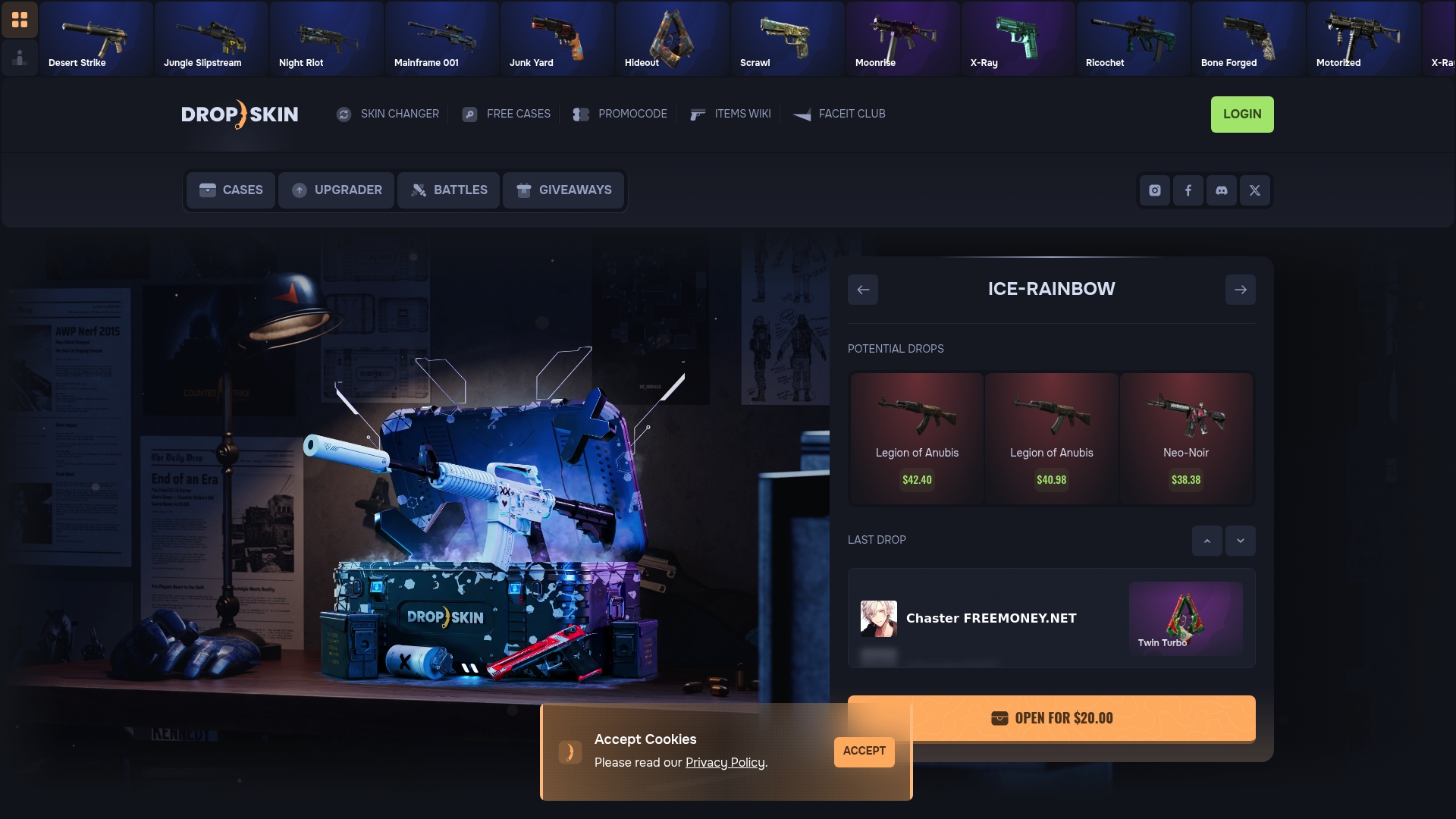
The skin upgrader on Dropskin is built around rarity tier logic. You bring a lower-tier skin and trade up toward a higher-rarity item, using the same tier-based value relationships this article covers. It is a direct application of rarity tier understanding in a format that rewards collectors who know what they are doing. Case openings, upgrade battles, and giveaways all run on the same rarity framework, giving you a consistent environment to apply what you know.
FAQ
What are rarity tiers in CS2 skins?
Rarity tiers are the official classification system that ranks CS2 skins by scarcity, running from Consumer Grade at the lowest through Mil-Spec, Restricted, Classified, Covert, and the ultra-rare Special category. Each tier signals a baseline price range and drop frequency.
Do higher rarity tiers always mean higher skin prices?
No. Higher rarity sets a supply ceiling but does not guarantee a higher market price. Demand, esports usage, and collection age regularly push lower-tier skins above higher-tier items in actual trading.
What is float value and how does it affect rarity tier pricing?
Float value measures a skin's wear level on a scale from 0 to 1. Within the same rarity tier, a lower float produces a cleaner visual and commands a higher price, creating distinct sub-markets inside each official tier classification.
How does collection age interact with rarity tiers?
Older skins from discontinued collections outperform current skins of equal rarity because their total supply is permanently capped. A fixed supply combined with growing demand over time increases value beyond what the rarity label alone predicts.
What is the rarity trap collectors should avoid?
The rarity trap is buying high-tier skins purely based on their classification while ignoring trade volume and community demand. High rarity with low velocity can be a liability. A skin that nobody is actively trading is difficult to sell at any price, regardless of its official rarity tier.